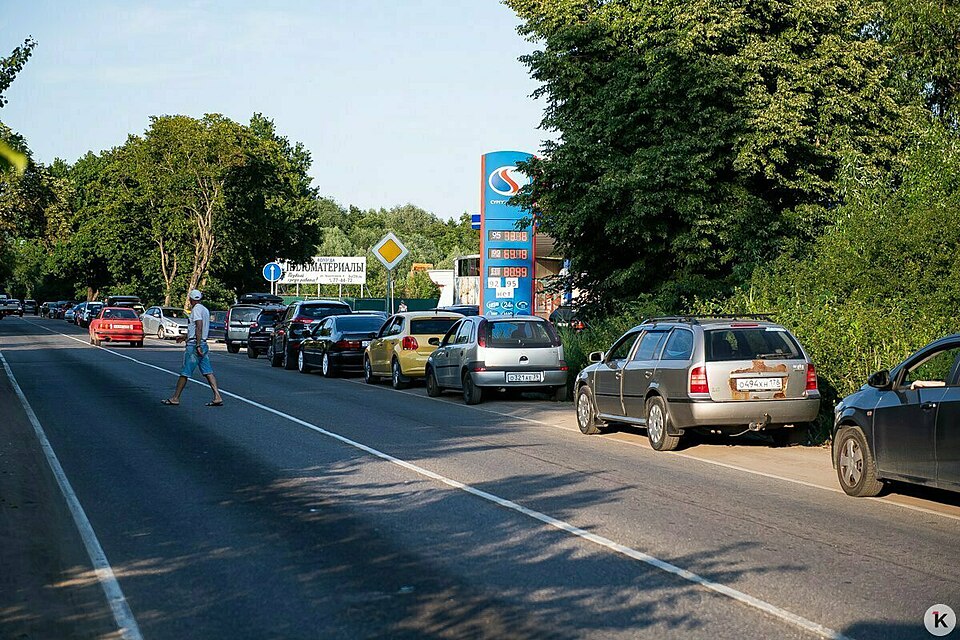
A day of driving around Moscow was enough for a BBC team to see the problem. Nearly every petrol station had a line of cars and lorries. Where there was no queue, the pumps had run dry and the station was shut.
That was in the capital, the richest and most populous city in Russia. Drivers elsewhere have it worse.
Lines, fights and rationing
“You are wasting hours to fill up,” a Muscovite named Elmar told the BBC. Prices were climbing as stocks thinned, he said, and he could not decide whether to drive to Dagestan. Asked who was to blame, he smiled. “In our country, you can’t say what is to blame and who is to blame.”
Valery found it strange to wait in line in a country that pumps so much oil. “I have no desire to get used to queues,” he said. Andrei, queuing for the first time with his wife Yekaterina, took a longer view. “We survived the 90s. We remember times that were much more difficult. It doesn’t scare us.”
Elsewhere the mood is rougher. Posts on social media show tailbacks running for miles and fights breaking out. In the Black Sea resort of Anapa, Cossacks have been sent to keep order. Rationing is widespread, and many areas have banned jerry cans. A mayor in Siberia set up portable toilets for waiting drivers. Some regions have cut bus services and rubbish collection, and farmers worry about this summer’s harvest.
The Kyiv Independent reported that most Russian regions now ration fuel in some form, either by order of local authorities or through private fuel companies. Queues are often counted in days. Some state services have been disrupted or suspended for lack of fuel. Scalpers fill jerry cans and makeshift tankers to resell at a markup, and others sell spots near the front of a long line or the codes meant for employees of critical services. One man who waited 39 hours outside Chita told Meduza the authorities had been “far too soft” on Ukraine.
Refineries under fire
The cause is a run of Ukrainian drone strikes. The Lukoil-Nizhegorodnefteorgsintez refinery, the country’s fourth largest and second-largest gasoline producer, was hit on June 24 and shut down. It had just restarted when drones struck again on July 2. Four days later, on July 6, drones hit Gazprom’s Omsk refinery, the largest in Russia, about 2,445 kilometers (1,519 miles) from Ukrainian-held ground. Its primary oil refining unit took direct hits and production stopped.
The Kyiv Independent counted Omsk as the sixth major refinery to shut partly or fully since the start of June. Hundreds of drones went after the Moscow Oil Refinery on June 16 and June 18, causing severe damage and knocking it out of action until 2027. Only Rosneft’s Angarsk refinery in Irkutsk Oblast, roughly 4,450 kilometers (around 2,700 miles) from Ukrainian-controlled territory, has escaped damage this year.
Ukraine’s General Staff says 42.74% of Russian refining capacity was disabled as of July 4. The International Energy Agency puts it at “more than 20%”. Russia has also suspended exports of gasoline and jet fuel.
Putin has admitted the strain. “Unfortunately, there are still lines at gas stations, and the right grade of gasoline isn’t always available,” he told oil executives on June 28. On state TV he said the attacks were “obviously creating problems” but that “it’s not critical.”
The government is buying gasoline from India by ship, from Belarus and Kazakhstan by pipeline, and in limited amounts from China by rail. It is also subsidising prices. Kommersant reported on June 29 that the Kremlin might allow Euro-2 grade fuel, which is cheaper to refine but can damage modern engines.
Pressure on the Kremlin
Alan Riley of the Atlantic Council Global Energy Center said export facilities can be fixed fairly fast, but the hardest refinery components “can take a long time, perhaps a couple of years to replace.”
The Levada Center puts Putin’s approval at around 74%, and says only 52% of Russians think the country is heading the right way, down from 61% in May. Gallup found 60% of Russians saw their local economy getting worse, the highest share in 20 years. State pollster VCIOM recorded trust in Putin falling 3.4 percentage points to 73% in a week.
Nina Khrushcheva of The New School doubts any of this will move him. “The more pressure he feels, the more likely he would act aggressively and repressively,” she said. Jade McGlynn of King’s College London sees the effect as “corrosive” rather than “explosive”. “It wears people down, it hands the Kremlin one more fire to fight.”
Days earlier, Putin was filmed in fatigues with commanders, promising more territory. He also ordered his generals to study the role of Ukraine’s European allies in “real combat actions”. “We need this analysis for taking responsible decisions in the future,” he said, without elaborating.
Sources
- Russian fuel shortages bite – but will Putin change tack in Ukraine war?
- As Ukrainian drone strikes cripple Russia’s fuel supply, Moscow faces 'one crisis after another'