
On 10 May 2024 the Earth experienced a G5‑level geomagnetic storm, the most severe category on the space‑weather scale. The disturbance, driven by solar activity, was the strongest recorded since the early 2000s and produced effects that were observed worldwide. Hours before the storm arrived, the National Oceanic and Atmospheric Administration’s Space Weather Prediction Center (NOAA SWPC) issued a G4‑level storm watch—the first such alert since 2005.
When the solar ejecta reached Earth, the storm exceeded the forecast, reaching G5 intensity, a rating reserved for “extreme” events. G5 storms are rare and can cause prolonged high‑frequency radio outages, voltage control problems in power grids, and even transformer damage.
In this instance, none of those impacts escalated to catastrophic levels, though the potential for such damage was present. The driver of the event was a large interplanetary coronal mass ejection (ICME) and associated corotating interaction region (CIR) expelled from the Sun. When these plasma and magnetic‑field structures collided with Earth’s magnetosphere, they compressed and disturbed the planet’s magnetic field, generating the storm.
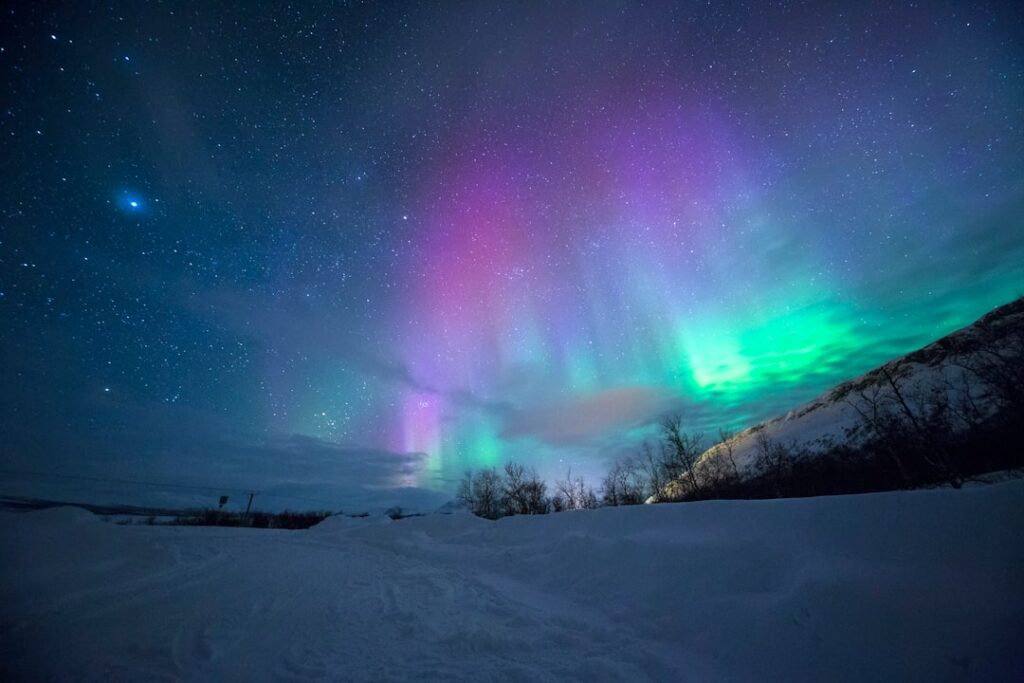
The most visible manifestation was a spectacular auroral display. Both the aurora borealis in the Northern Hemisphere and the aurora australis in the Southern Hemisphere were reported at latitudes far beyond their usual ranges, offering rare sky‑watching opportunities for many observers.
Beyond the visual show, the storm perturbed the upper atmosphere, a condition that can affect satellite operations, alter spacecraft orbits, and degrade GPS accuracy. Polar‑route airline flights also faced an elevated risk of communication blackouts, a known hazard during G5‑level events. This storm arrived during the solar maximum phase of the current sunspot cycle, a period characterized by heightened flare activity, more frequent coronal mass ejections, and an overall increase in space‑weather disturbances.
Scientists had anticipated a rise in activity over the preceding months, and the May 10 event serves as concrete evidence of that trend. Key parameters that determine a storm’s severity include solar‑wind speed, plasma density, and the orientation of the interplanetary magnetic field.
A fast, dense solar wind with a southward‑pointing magnetic field can trigger strong coupling with Earth’s magnetosphere. The conditions on 10 May matched this profile, allowing the storm to reach G5 intensity. Researchers are now analyzing data collected by ground‑based observatories and space‑borne instruments to dissect the event in detail. The comprehensive dataset will support studies of extreme geomagnetic storms for months to come.
For the general public, the storm underscores the Sun’s dynamic nature. Though often perceived as a distant, steady source of light, the Sun can produce rapid, powerful changes that reverberate through modern technological systems.
The May 10 2024 G5 storm was not merely a light show; it was a clear reminder that the solar cycle is entering an active phase, and that preparedness for future space‑weather events will be increasingly important.




