
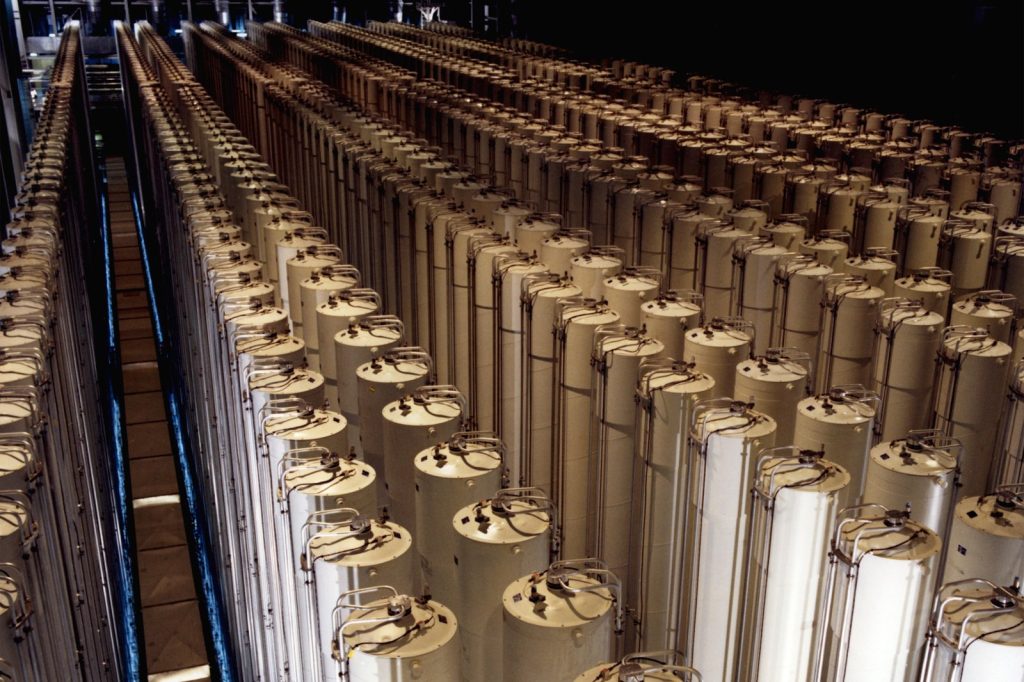
WASHINGTON, July 22 — The gas centrifuge, a device whose development spans nearly a century and whose proliferation has reshaped the global nuclear order, remains a quiet fulcrum of strategic competition. What began as a laboratory experiment in 1934 now underpins the enrichment calculus of several states, and the technology’s history carries lessons that Washington’s policymakers cannot afford to ignore. The physics are deceptively simple.
A gas centrifuge uses centrifugal force to accelerate gaseous molecules, separating particles of different masses along the radius of a rotating container. Its primary application today is the enrichment of uranium-235 from the more abundant uranium-238 — a process that, by increasing the concentration of the fissile isotope, can produce fuel for reactors or, at higher enrichment levels, the core of a nuclear weapon.
The method replaced the far more energy-intensive gaseous diffusion approach, and by arranging many centrifuges in series, operators can achieve the elevated concentrations needed for either purpose. Strategically, the shift to centrifuge enrichment altered the energy and financial calculus for would-be proliferators: a cascade of centrifuges requires significantly less electricity than the older method, lowering the barrier to entry.
Roots in the Manhattan Project
The concept was first suggested in 1919, but it was successfully demonstrated in 1934 by American scientist Jesse Beams and his team at the University of Virginia. They separated two chlorine isotopes using a vacuum ultracentrifuge — a proof-of-principle that went largely unnoticed outside academic circles until the Manhattan Project brought together some of the era’s sharpest minds. During World War II, Harold Urey and Karl P.
Cohen pursued the method, but research was discontinued in 1944 because it was not expected to yield results by the war’s end. The United States instead bet on gaseous diffusion and electromagnetic separation, the two methods that produced the uranium and plutonium for the first atomic bombs.
That wartime decision delayed American investment in centrifuge technology for decades. Key contributions came from a group of European scientists working on the project — Franz Simon, Rudolf Peierls, Klaus Fuchs, and Nicholas Kurti — but the fundamental separation theory that underlies modern enrichment plant design was developed by Paul Dirac. It was a remarkable concentration of theoretical and practical talent, yet the immediate strategic payoff went to the Soviet Union.
Moscow successfully used gas centrifuges in the postwar period and eventually became a leading enriched uranium supplier, a position that gave it leverage over nuclear markets and nonproliferation norms for decades.
The Zippe Breakthrough and a Pakistani Path
The long-term economic viability of the centrifuge method improved with the development of the Zippe-type centrifuge, a more robust and efficient design that reduced the energy penalty and engineering complexity of earlier models. That innovation proved critical in the 1970s and 1980s, when Pakistani scientist Abdul Qadeer Khan conducted research using vacuum methods to advance centrifuge roles in producing nuclear fuel for Pakistan’s atomic bomb. Khan overcame initial skepticism among colleagues, building a program that eventually produced the fissile material for Islamabad’s arsenal.
What this signals is the persistent challenge of controlling a technology that, in its essentials, can be reproduced by a determined state with access to precision materials and a small core of skilled engineers. The broader stakes of the gas centrifuge’s history extend beyond South Asia.
Enrichment via centrifuge has also been used in experimental physics, but the most consequential legacy is the technology’s role in proliferation networks. By the end of the 20th century, centrifuge know-how had been smuggled to at least three countries, posing non-proliferation challenges that the international community is still grappling with. The spread of centrifuge knowledge — through clandestine supply chains, stolen blueprints, and the movement of scientists — effectively decentralized the capacity to produce weapons-grade material, making the attempt to control enrichment a central feature of modern arms control diplomacy.
A Technology That Will Not Be Uninvented
The gas centrifuge is not a new weapon system or a breakthrough technology; it is an old physics instrument that eight decades of geopolitics have weaponized by proxy. The United States, which saw its own Manhattan-era centrifuge research shelved in 1944, has spent the subsequent years trying to manage the consequences of a process it helped conceive but did not deploy first.
Washington’s current administration inherits a world in which the centrifuge remains a stubborn variable in the proliferation equation — one that cannot be disinvented but only constrained by inspection regimes, export controls, and the willingness of states to forgo enrichment for non-proliferation commitments. Looking ahead, the strategic calculus for centrifuge technology turns on two variables: the continued pace of centrifuge innovation, and the reliability of international verification mechanisms.
If the history stretching from Jesse Beams’s laboratory in 1934 to Abdul Qadeer Khan’s network in the 1980s teaches anything, it is that the device itself is a blank tool. What determines its impact is the state — or the smuggler — that chooses to spin it.




