Florida’s Indian River Lagoon carries a lot of money on its back. The Florida Oceanographic Society says nearly a million people live and work around it. It accounts for $300 million in fisheries revenue and sits beside a $2.1 billion citrus industry, and boat and marine sales top $300 million a year. A 2008 assessment put the combined recreational spending and use value of the water at $2.1 billion. All of that rests on a shallow estuary that is in trouble.
A shallow, crowded estuary
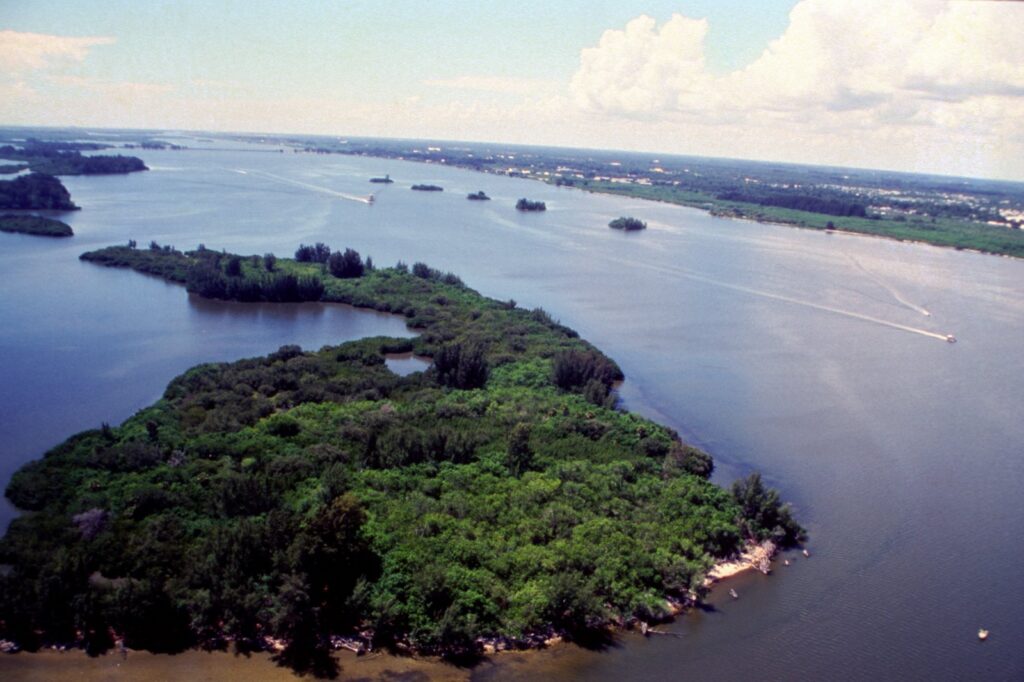
The lagoon is really three bodies of water: the Mosquito Lagoon, the Banana River and the Indian River, strung along Florida’s Atlantic coast for 156 miles from Ponce de Leon Inlet to Jupiter Inlet. It holds more than 4,300 species of plants and animals, and it has five state parks, four federal wildlife refuges and a national seashore along its edges. It is also thin. Width runs from half a mile to five miles, and the average depth is about four feet, so there is little water to dilute whatever flows in.
What flows in has changed a great deal. Early European settlers drained swamps to grow pineapples and citrus, and the canals they dug now send fresh water into the lagoon at five times the historical volume. Causeways built after the 1930s, once cars arrived, diverted the sluggish current. Then came the people. Between 1989 and 2013 the population along the shore climbed 50 percent to 1.6 million, and the sewage and road runoff climbed with it. By 2018, millions of gallons of sewage were going into the water.
Fertilizer, septic tanks and the muck
In 2013, four main problems with water quality were identified. Runoff carried excess nitrogen and phosphorus from fertilizer. Somewhere between 8 and 11 percent of the county’s tens of thousands of septic tanks were failing. Muck from construction, farming, erosion and dead plants settled on the bottom, smothering growth and using up oxygen. And invasive species, including the Asian green mussel, were eating clams and fish larvae.
Nitrogen and phosphorus feed algae. In 2010 the lagoon took in 3.3 million pounds of nitrogen and 475,000 pounds of phosphorus. A 2011 superbloom of phytoplankton wiped out 32,000 acres of seagrass, and a brown tide fouled the northern lagoon the following year. In 2016 a brown tide set off the worst fish kill on record, hitting 30 species. By 2017 about 95 percent of the seagrass that manatees depend on had disappeared after an algae bloom fed by fertilizer.
The weight of blame has moved toward septic systems. A 2023 study by Florida Atlantic University’s Harbor Branch Oceanographic Institute found that human sewage from septic systems was primarily to blame for the lagoon’s poor condition. In 2016 an estimated 300,000 septic tanks served the five counties around the lagoon. Sewage plants used to be worse: 46 of them discharged about 55 million gallons a day in 1986, and the state ended most of that pollution by 1995.
Farming still matters. Between 1913 and 2013 the lagoon’s watershed grew from 572,000 acres to 1.4 million, which means more freshwater and more nutrients from farms washing in.
Courts and the state house
Pressure to act is building. In 2024, federal District Judge Carlos Mendoza noted that the Environmental Protection Agency and the plaintiffs in a case before him agreed Florida had not met the agency’s 2013 water quality standards in the lagoon.
In the Florida House of Representatives, Randy Fine pushed for $50 million a year in matching funds to upgrade lagoon sewage treatment plants, along with higher fines for illegal discharges.
The cost of waiting is visible in the seagrass count. After hurricanes Ian and Nicole, there was virtually no detectable seagrass across the lagoon by 2023. By January 2024 it had recovered to cover 4.3 percent of the lagoon.
Sources
- Indian River Lagoon
- 86-year-old man found dead after submerged vehicle pulled from Indian River Lagoon
- SpaceX successfully launches NASA's Crew-13 mission to the ISS
Photo: U. S. Fish and Wildlife Service (Public domain)