
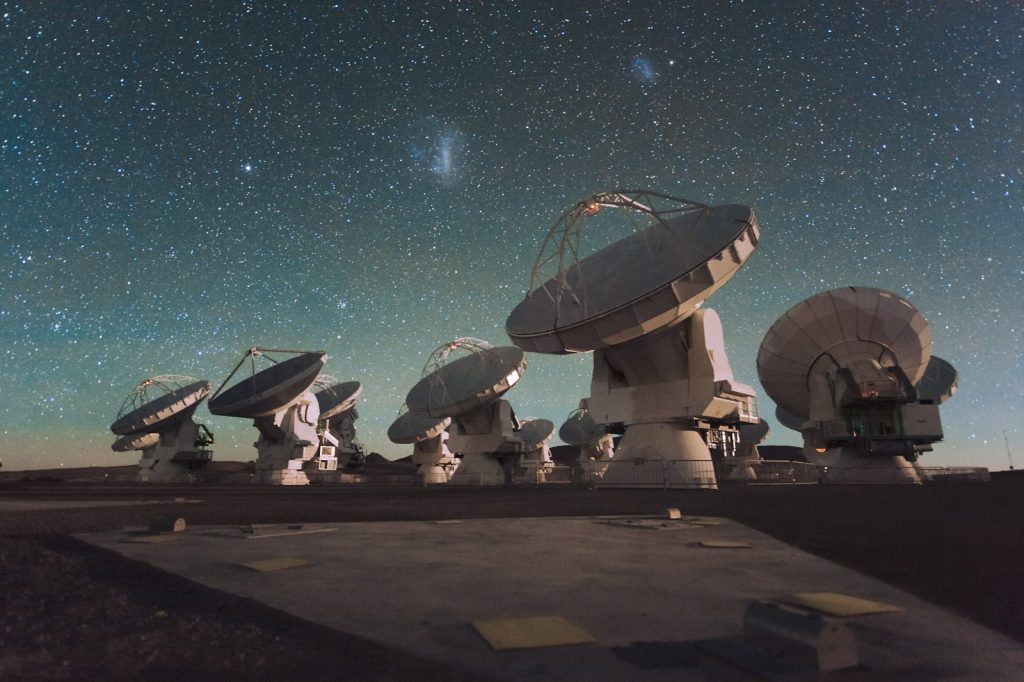
SANTIAGO, July 13 — 66 antennas. That is the figure that matters for the Atacama Large Millimeter/submillimeter Array, the radio telescope array sitting at 5,000 meters — 16,400 feet — in northern Chile’s Atacama Desert. ALMA, as it is known, is not new.
It was inaugurated in March 2013, with early science operations beginning in 2011. But the array continues to deliver the kind of data that keeps astronomers busy.
The bottom line: ALMA’s sensitivity and resolution allowed researchers to detect the spectral signature of glycolaldehyde in the gas surrounding a young star-like object in Sagittarius B2. That is a sugar molecule, and finding it in a star-forming region is the kind of breakthrough investors in scientific infrastructure like to see pay off.
By the numbers
The array is an international partnership. Europe, North America, and East Asia are in, with the Republic of Chile cooperating. ALMA operates at millimeter and submillimeter wavelengths.
That wavelength range is why it can see what optical telescopes miss. The molecule was identified by its unique rotational spectrum — think of it as a fingerprint.
ALMA had to distinguish that faint signal from the complex background of other molecules in the star-forming region. That required the array’s full capability. Investors will note that this kind of detection is exactly what the partnership funded when it built the 66 high-precision antennas.
What was found
Glycolaldehyde. That is the molecule. It is a simple sugar, and its detection in the gas around a young star-like object in Sagittarius B2 is significant.
The spectral signature was there, buried in the noise. ALMA pulled it out.
The figure that matters is not just the 66 antennas or the 5,000-meter altitude. It is the resolution. The array’s ability to separate the faint signal from the background clutter is what made the detection possible.
Without that, the molecule would have remained hidden. The Atacama Desert is one of the driest places on Earth.
That is why the array is there. Water vapor in the atmosphere absorbs millimeter and submillimeter waves. At 5,000 meters, above much of that vapor, the sky is clear for ALMA’s work.
The location is not cheap or easy. It is a logistical challenge. But the data justifies the cost.
Looking ahead
ALMA has been operating for over a decade. The 2011 early science operations and the 2013 inauguration are in the past. What matters now is what the array can still do.
The glycolaldehyde detection is one data point. There will be more.
The partnership structure — Europe, North America, East Asia, Chile — remains in place. The antennas are still collecting data. The bottom line: ALMA is not a completed project.
It is a running instrument. And it is still finding things.
Sources
{“@context”: “https://schema.org”, “@type”: “NewsArticle”, “headline”: “How ALMA Telescope Made the Historic Sugar Detection in Space”, “description”: “SANTIAGO, July 13 — 66 antennas. That is the figure that matters for the Atacama Large Millimeter/submillimeter Array, the radio telescope array sitting at 5,000…”, “datePublished”: “2026-07-13T09:30:00+00:00”, “author”: {“@type”: “Person”, “name”: “Ava Anderson”}, “publisher”: {“@type”: “Organization”, “name”: “InfoPulse Today”, “url”: “https://newsfeed.infopulsetoday.com/”}, “citation”: [{“@type”: “CreativeWork”, “url”: “https://en.wikipedia.org/wiki/Atacama_Large_Millimeter_Array”}]}




