
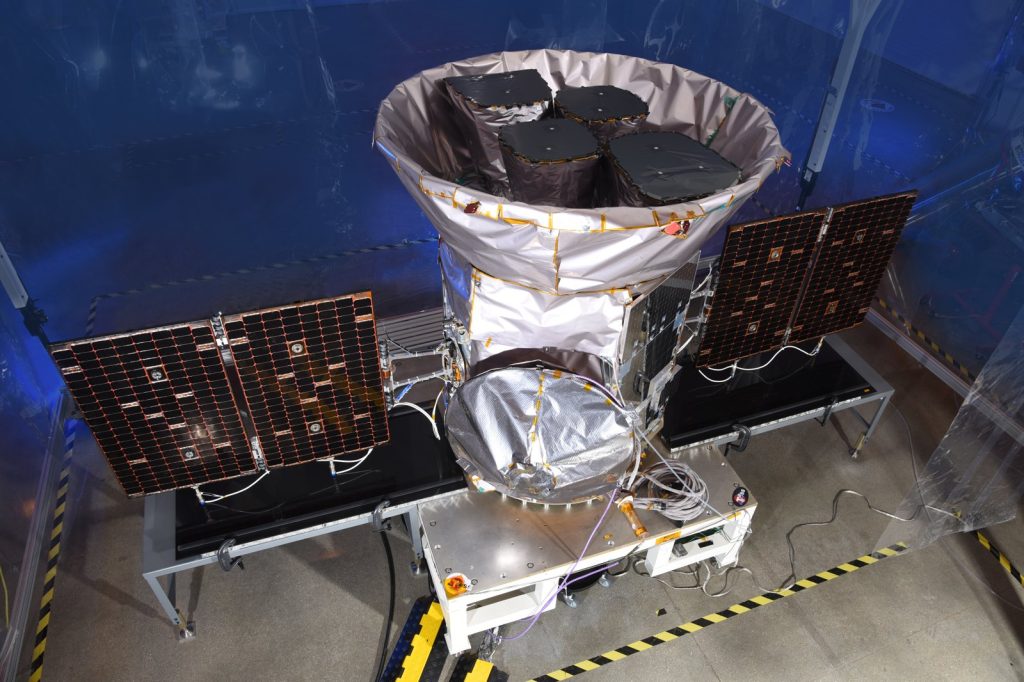
WASHINGTON, July 21 — A planet that dims its host star by only 0.02 percent — a signal easily lost in the electronic noise of a space telescope — has been confirmed using a cross-referencing method that pairs optical data from NASA’s Transiting Exoplanet Survey Satellite (TESS) with infrared observations from the now-retired Spitzer Space Telescope. The technique, detailed in a new study, offers a path to verify similarly faint candidate worlds that remain unconfirmed.
The transit method for detecting exoplanets relies on measuring the slight drop in a star’s brightness when a planet passes in front of it. NASA’s Kepler space telescope, which operated from 2009 to 2018, used this technique to discover more than 2,600 confirmed planets.
But faint stars or small planets produce dimming as low as 0.01 percent — a change that is easily swallowed by the random variations, or noise, inherent in any telescope’s detectors. In the case of the planet described in the new study, the dimming measured by TESS was only 0.02 percent. That signal would ordinarily be borderline.
The study’s authors had to remove systematic noise from TESS’s cameras before the transit could be isolated.
Cross-Referencing Two Datasets
The procedure that confirmed the planet is straightforward in concept but demanding in execution. Researchers analyzed two independent datasets: optical photometry from TESS, which records images in 30-minute intervals across most of the sky, and infrared observations from the Spitzer Space Telescope. By verifying the signal in both wavelengths, scientists ruled out false positives caused by instrumental artifacts or astrophysical mimics such as binary stars.
The record shows that this two-step verification method can be applied to other candidate signals that TESS has flagged in its full-frame images, which survey the sky every 30 minutes. According to the filing, more than 1,000 TESS candidates remain unconfirmed, their weak signals still awaiting definitive validation.
Unconfirmed Candidates Await
On the timeline of exoplanet science, the Kepler mission proved the power of the transit method for bright, large planets. TESS was designed to survey the entire sky, but many of its detections involve fainter stars and smaller planets, producing dimmings near the noise floor. The cross-referencing technique demonstrated in this study offers a disciplined way to sift those signals from the noise — using the combined power of optical and infrared eyes.
Sources familiar with the research note that the method does not require new hardware; it relies on archival data from Spitzer, which ceased operations in 2020, and on TESS’s ongoing survey. That means the pipeline for confirming the remaining candidates is already in place, provided the targets were also observed by Spitzer.
The study, published this week, is the latest example of astronomers extracting faint evidence from swelling datasets. It also underscores a broader challenge: as telescopes become more sensitive, the cosmic noise they record grows alongside the signals. Separating one from the other continues to demand rigorous method and cross-checked data.




