Vandenberg Space Force Base has tied its own record for launches in a year, according to the base, and it is part of a plan to go as high as 100 a year. How does a stretch of California coast keep up that pace? Geography does a good deal of the work.
Why this coastline
The base sits in Santa Barbara County on the Central Coast, between Lompoc and Santa Maria. It was established in 1941 and is run by Space Launch Delta 30, the host unit, which is equivalent to an Air Force air base wing. Intriguingly, what makes it useful today is what made it attractive to military planners in the 1950s. A committee that looked at more than 200 candidate sites in 1956 picked it for its size, remoteness, mild climate and coastline. Missiles could fly west over the Pacific without crossing populated land, and satellites could be sent into polar orbit toward the South Pole without passing over any landmass until Antarctica.
Beyond the military missions and missile testing, the base now hosts launches for NASA and SpaceX, flying from what is called the Western Range.
Boosters that come back
The mission that matched the record was a Falcon 9 carrying 27 Starlink satellites. The first-stage booster was on its 36th flight. Its earlier work includes Sentinel-6 Michael Freilich, DART, Transporter-7, Iridium OneWeb, SDA-0B, NROL-113, NROL-167, NROL-149 and NAOS, plus 26 Starlink missions. After stage separation, a booster like this returns to Earth and lands on the drone ship Of Course I Still Love You, waiting in the Pacific.
Weather and noise
The record launch did not go smoothly. SpaceX first targeted Tuesday, 20 October, then moved to Wednesday and Thursday. On Thursday the countdown was stopped just 23 seconds before liftoff, and the launch finally went on Friday, 23 October. Officials did not explain every scrub, but a storm had moved through the region that week.
Residents can also hear these flights. Depending on weather and conditions at liftoff, one or more sonic booms may reach the area.
From Army camp to spaceport
The land has a longer story. In March 1941 the Army picked out about 86,000 acres of open ranch land to train infantry and armored forces, drawn by a flat plateau, hills, canyons and distance from towns. Camp Cooke was activated on 5 October that year and named for the cavalry officer Phillip St. George Cooke. Over 400 groups trained there during the war. After 1946 it became a maximum-security military prison, and it served again as a training ground for Korean War units from 1950 to 1953.
In 1957 the Air Force took over part of the site as Cooke Air Force Base. It was renamed Vandenberg Air Force Base on 4 October 1958, after General Hoyt Vandenberg, the service’s second Chief of Staff. A final purchase of 15,000 acres in 1966 for the Manned Orbiting Laboratory program brought the base to its present size of 99,099 acres.
Sources
- Vandenberg Space Force Base
- Record-Tying Rocket Launch Takes Off From Vandenberg SFB After Multiple Delays Friday
- UPDATE: SpaceX reschedules rocket launch for Friday
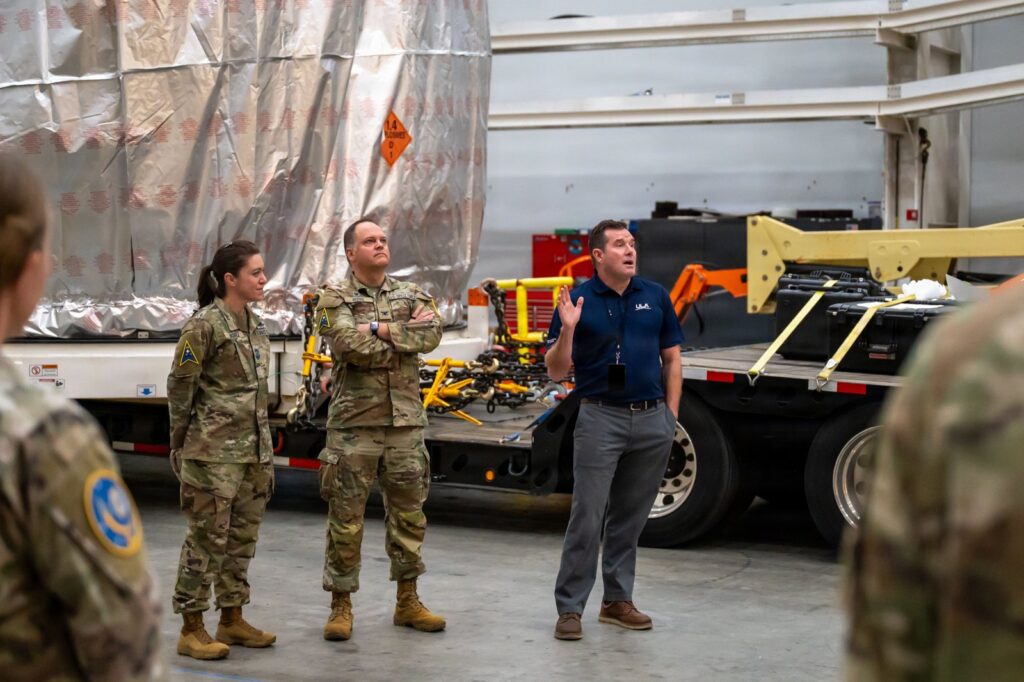
Photo: U.S. Space Force photo by Staff Sgt. Joshua LeRoi (Public domain)