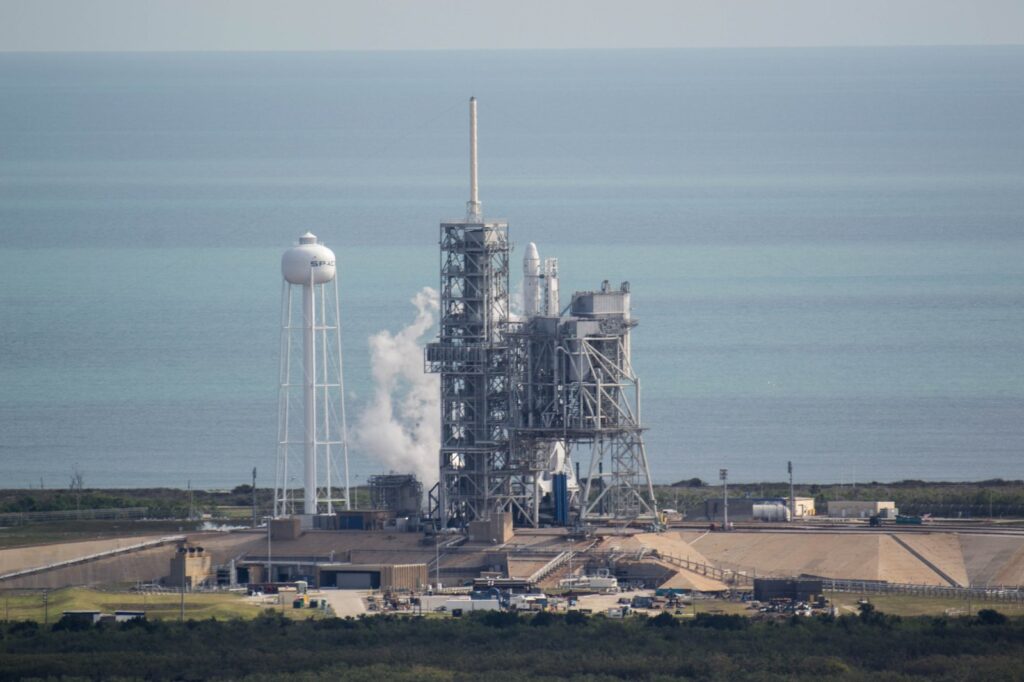
How does a rocket company end up with a $4.4 billion quarterly profit? Partly by renting out computing power. SpaceX posted that net profit for the third quarter of 2026 on Tuesday, October 20, reversing more than a year of operating losses.
Where the money came from
Consolidated revenue rose 161 percent year over year to $14.6 billion. Two engines drove it. One is Starlink, the broadband network that now has about 11,150 satellites in low Earth orbit. They talk to user terminals and to gateway ground stations that tie the constellation to the terrestrial internet. Starlink had 13.6 million consumer subscribers as of September 30 and serves roughly 160 countries and territories. Its Connectivity segment brought in $5.25 billion in revenue and $2.37 billion in operating income for the quarter. For the whole of 2025, Starlink had already become SpaceX’s largest segment, with $11.4 billion in revenue and $4.4 billion in operating income.
The other engine is new. As AI workloads surged, SpaceX leased dedicated compute capacity and space-bound processing resources to outside developers, a high-margin line alongside launch and communications.
Net income came to $0.35 per share, ahead of Wall Street projections. SpaceX shares, which debuted in June, closed Tuesday at $147.79 and rose 2.2 percent in after-hours trading.
Spending to match
The company is spending heavily. Capital expenditure reached $19.6 billion for the quarter, nearly triple the year before. Management forecast $35 billion to $40 billion for the fourth quarter, going to Starship manufacturing lines and orbital hardware such as Starlink Gen3 satellites with onboard AI processing.
Reuse or nothing
On the post-earnings call, leadership tied long-term financial health to reusable launch vehicles. “The only way that we can extend consciousness beyond Earth on a sustained basis is with a fully reusable orbital launch vehicle,” Elon Musk said. In November, SpaceX plans another integrated Starship test flight. The goal is to catch both the Super Heavy booster and the Starship upper stage with the tower’s mechanical arms at Starbase, Texas. Proving full recovery matters for commercial launch schedules and for NASA’s Artemis lunar landing timeline.
The Ukraine problem
Starlink’s reach has a harder side. Starshield, the military variant, is used by Ukraine’s forces to fly drones and keep units in contact. Ukraine said limits were imposed on its use of Starshield without warning. A drone unit commander who goes by Flint told NBC News that one drone lost its connection mid-flight and fell, aborting the mission. “Its primary role is maintaining the connection with the drone, so this is a very significant loss for us,” he said.
President Donald Trump said Musk had restored service. Kyiv said it saw no lifting of restrictions. President Volodymyr Zelenskyy said the limits remained, but that Secretary of State Marco Rubio had told him full service would return in about 48 to 72 hours. Not every unit was affected: a drone technician in Donetsk told NBC News he had seen no major drops in performance.
The constellation draws criticism elsewhere too. Astronomers say it adds light pollution and orbital congestion, and Starlink accounts for about 75 percent of all active maneuverable satellites in Earth orbit.
Sources
- SpaceX Returns to Profitability With $4.4 Billion Third Quarter on Starlink and Compute Growth
- Starlink
- How Starlink slowdown hit Ukraine’s front line soldiers pushing Russia back
Photo: Daniel Oberhaus (CC BY-SA 4.0)