
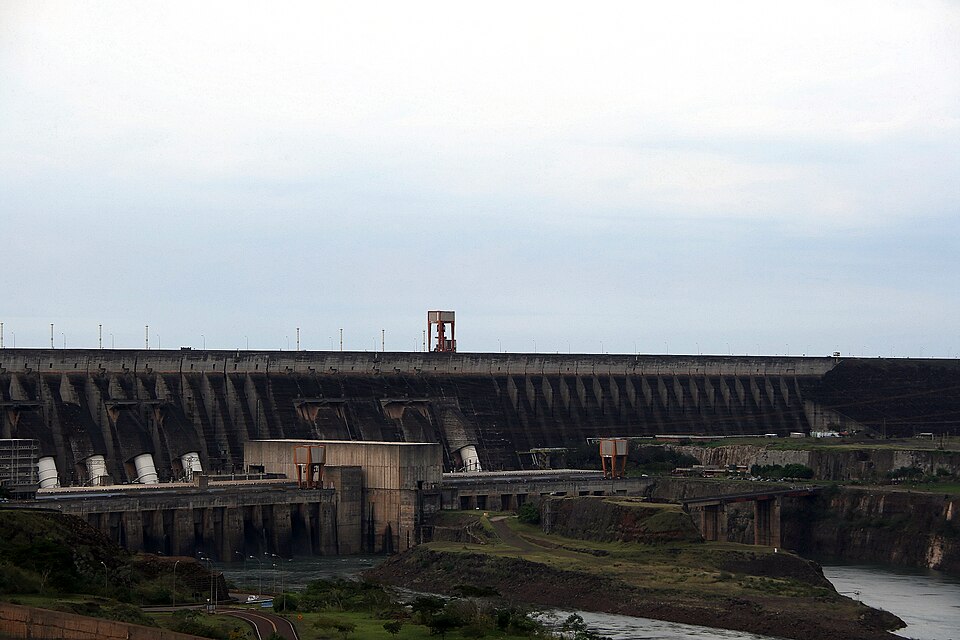
Under the hood, the Itaipú dam is an engineering joke told with a straight face: a 14 gigawatt hydroelectric plant on the Paraná, joint property of Brazil and Paraguay in exact 50-50 shares under a 1973 treaty, whose annual output frequently beats China’s Three Gorges despite the smaller headline capacity, and one of whose two owners has never wanted more than a sliver of the product. Paraguay’s $40 billion economy consumes under 10 percent of the plant’s production. The technical reality is that the machine works perfectly; the arrangement around it does not, and 2024 turned that arrangement into open argument.
The plumbing of the deal first. Itaipú runs on a “cost of service” model: no profits, only obligations covered, and for decades the big obligation was construction debt, serviced at about $2 billion a year until the financing was fully paid off in 2023. Paraguay, entitled to half the electricity, historically used only a quarter of its own supply and ceded the rest to Brazil at compensation prices the treaty prescribes rather than the market sets. The volumes are not small: in 2022 Paraguay drew 17 percent of the plant’s power and Brazil bought the unused 33% of the Paraguayan half for around $1 billion. For Asunción, binational income has meant almost 12 percent of total state revenue across the past 17 years. Cheap power out, hard currency in, sovereignty occasionally bruised.
The tariff fight, anchored to the first week of February 2024, is where the wry part starts. Brazil’s mines and energy and foreign ministers, Alexandre Silveira and Mauro Vieira, traveled to Asunción to deliver the message that their government would not “compromise” on the price of energy, arguing a hike would land on the electricity bills of Brazil’s poorest and hurt its industry. Paraguay, whose president, Santiago Peña, was elected on a promise to renegotiate, wanted the tariff around $20.75 per kilowatt against the $16.71 the board had settled on in April 2023, a figure that already looked generous next to the post-debt payoff price collapse. Enio Verri, the Brazilian-side managing director, conceded the talks had become “a diplomatic problem” whose solution would come “in the timing of foreign affairs”. The detail that matters: the impasse froze Itaipú’s 2024 budget, delaying employee vacation pay and year-end bonuses until a Brazilian labor court ordered payouts, for the Brazilian side only. The two nations’ grand bargain, in other words, briefly failed to pay its own staff.
For Paraguay, the paradox is the payload. A country saturated in clean electricity, using a fraction of it, selling the rest cheap: studies cited at the Wilson Center reckon that absorbing the surplus internally, through power-hungry industry and electric mobility, could quadruple GDP and add more than two million jobs on a 2040 horizon. The politics carry their own voltage, after a 2019 secret agreement nearly impeached a Paraguayan president, and the matrix is monogamously hydraulic, Itaipú, Yacyretá and Acaray, with solar and wind stalled on missing incentives and a state utility short of budget. As ever with megaprojects, the dam solved the problem it was built for and created the ones it now argues about.
The record, then, in one line: 14 gigawatts of carbon-free power, split evenly by treaty, priced by diplomacy, and hostage to an agreement written in 1973 for a different century’s economics. Brazil holds the cheaper-bills argument, Paraguay the forgone-revenue grievance, and both hold staff bonuses hostage in the meantime. The engineering, as ever, is the easy part.
Sources
- Brazil, Paraguay, and the Future of Itaipú | Wilson Center
- In Paraguay, Brazilian ministers reject Itaipu tariff hike




