
GREENBELT, Md., July 17 — The James Webb Space Telescope, the largest telescope in space, continues to transmit data from its orbital station near the Sun–Earth L2 Lagrange point about 1.5 million kilometers from Earth, officials confirmed. Launched on 25 December 2021 from Kourou, French Guiana aboard an Ariane 5 rocket, the telescope reached its destination in January 2022. Its first image was released on 11 July 2022.
The strategic context is clear. Webb was designed for infrared astronomy, observing a frequency range from long-wavelength visible light through mid-infrared, spanning 0.6 to 28.5 micrometres.
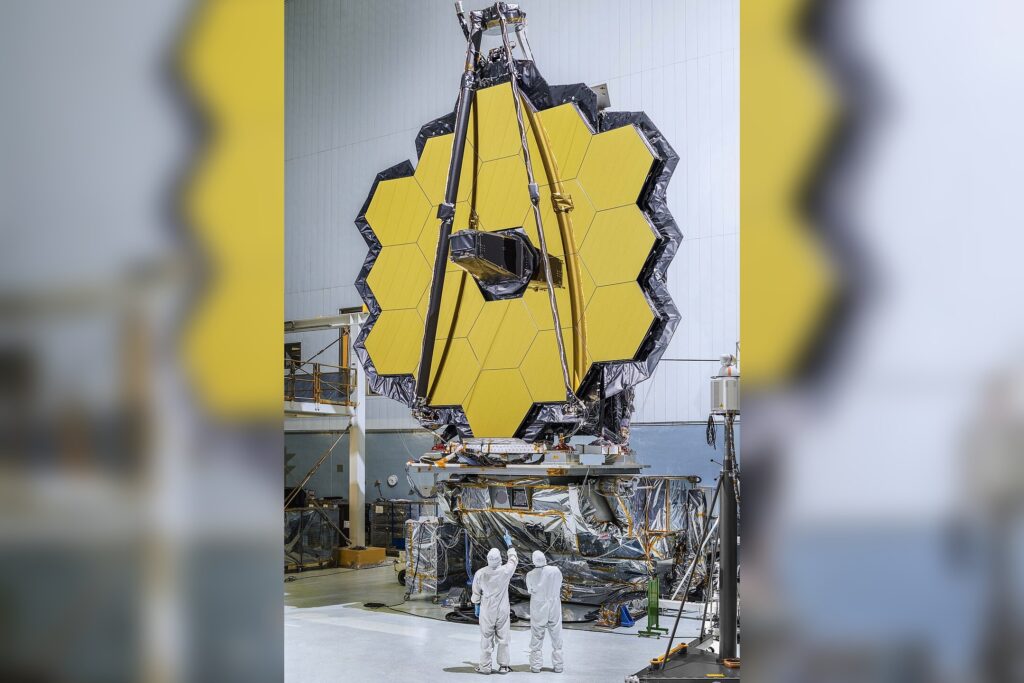
This capability allows it to view objects too old, distant or faint for the Hubble Space Telescope. According to the record, Webb’s primary mirror measures 6.5 metres in diameter, composed of 18 gold-plated beryllium hexagonal segments. The total collecting area is about 25.4 square metres—over six times that of Hubble’s 2.4-metre mirror.
Despite its larger mirror, Webb produces images of comparable resolution to Hubble. Officials explained this is because Webb observes in the infrared spectrum, which has longer wavelengths than the visible spectrum Hubble uses.
The telescope must be kept below 50 K (−223 °C) to avoid interference from its own infrared radiation. A five-layer sunshield maintains this temperature.
Development and Cost Overruns
The program began in 1996 under the name Next Generation Space Telescope. Concept studies in 1999 envisioned a 2007 launch with a $1 billion budget. The record shows the project saw cost overruns and delays.
A redesign occurred in 2005. Construction was completed in 2016, followed by exhaustive testing.
The total cost reached $10 billion. The telescope is named after James E. Webb, who served as NASA administrator from 1961 to 1968.
NASA led development, partnering with the European Space Agency and the Canadian Space Agency. The Goddard Space Flight Center managed development.
The Space Telescope Science Institute operates Webb. Northrop Grumman was the primary contractor.
Scientific Capabilities
Webb’s infrared observation enables detailed atmospheric characterization of potentially habitable exoplanets. This is a capability Hubble cannot match, according to the record. The telescope arrived at its orbital position about 1.5 million kilometres from Earth in January 2022.
The telescope’s 6.5-metre-diameter primary mirror gives it a collecting area of about 25.4 square metres. Each of the 18 hexagonal segments is gold-plated beryllium.
The telescope observes a lower frequency range than Hubble, from long-wavelength visible light (red) through mid-infrared. Officials confirmed Webb must stay below 50 K (−223 °C) to function properly. The five-layer sunshield blocks heat from the Sun, Earth and Moon.
Without this thermal protection, the telescope’s own infrared emissions would contaminate observations. The record shows Webb is the largest telescope in space.
Its launch on 25 December 2021 from Kourou, French Guiana, used an Ariane 5 rocket. The telescope reached its destination in January 2022. Its first image was released on 11 July 2022.
Looking Forward
What to watch next. Webb’s ability to characterize exoplanet atmospheres in detail could yield findings about potentially habitable worlds. The telescope’s infrared capabilities allow it to see objects from the early universe that are too old, distant or faint for Hubble.
According to the record, Webb observes from long-wavelength visible light (red) through mid-infrared, from 0.6 to 28.5 μm. The telescope’s development history shows the challenges of large-scale space projects.
From initial designs in 1996 to a $10 billion total cost, the program required multiple redesigns and extended testing. The partnership between NASA, ESA and CSA, with Northrop Grumman as primary contractor, produced the largest space telescope ever built. Officials confirmed Webb continues operations from its position near the Sun–Earth L2 Lagrange point.
The telescope’s five-layer sunshield keeps it below 50 K (−223 °C). Its 18 gold-plated beryllium hexagonal segments form a 6.5-metre-diameter primary mirror with a collecting area of about 25.4 m².
The record shows this is over six times that of Hubble’s 2.4 m mirror.
Sources
{“@context”: “https://schema.org”, “@type”: “NewsArticle”, “headline”: “James Webb Telescope Detects Exoplanet Atmospheres With Infrared”, “description”: “GREENBELT, Md., July 17 — The James Webb Space Telescope, the largest telescope in space, continues to transmit data from its orbital station near the…”, “datePublished”: “2026-07-17T09:30:00+00:00”, “author”: {“@type”: “Person”, “name”: “Dmitry Volkov”}, “publisher”: {“@type”: “Organization”, “name”: “InfoPulse Today”, “url”: “https://newsfeed.2bme.xyz/”}, “citation”: [{“@type”: “CreativeWork”, “url”: “https://en.wikipedia.org/wiki/James_Webb_Space_Telescope”}]}




