
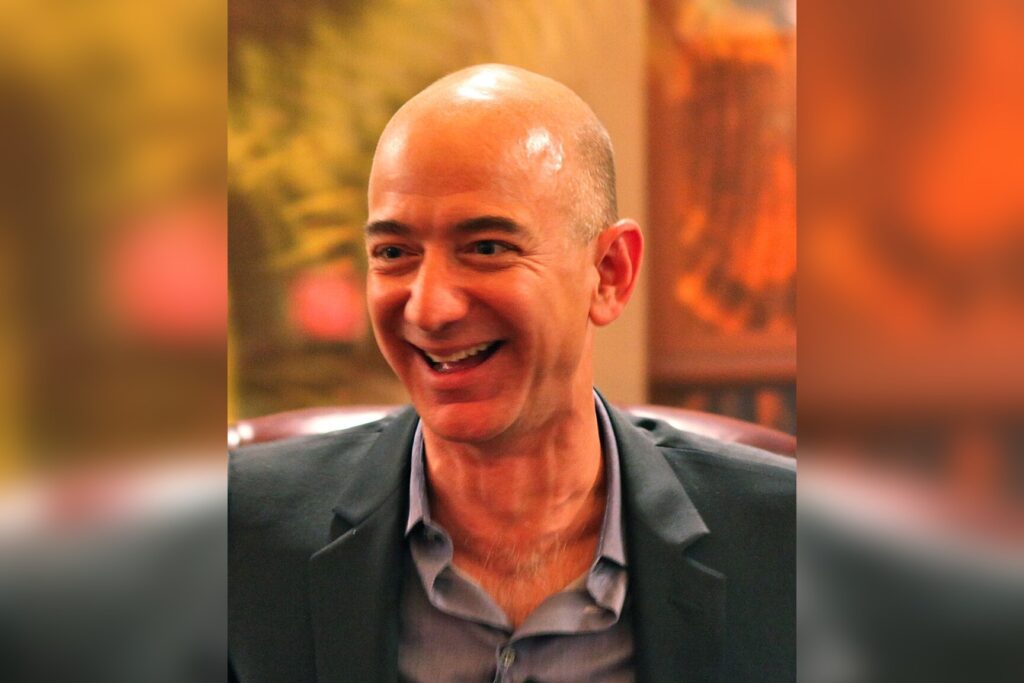
SEATTLE, July 14 — The man who reshaped global commerce now has his eyes fixed on the stars. Jeff Bezos, the founder of Amazon and Blue Origin, has spent more than two decades and over $10 billion of his personal fortune pursuing a singular vision: millions of people living and working in space. Bezos was born on January 12, 1964, in Albuquerque, New Mexico.
He founded Amazon in 1994, building it into a retail and cloud-computing empire that made him one of the wealthiest people on the planet. According to the Bloomberg Billionaires Index, his net worth stood at $150 billion as of October 2023.
He stepped down as Amazon CEO in July 2021, moving into the role of executive chairman. That same month, he flew to the edge of space aboard Blue Origin’s New Shepard rocket on its first crewed flight — a personal milestone for a man who founded the company in 2000 with the long-term goal of opening the cosmos to humanity.
Two rockets, one ambition
Blue Origin operates two major rocket programs. The New Shepard is a suborbital vehicle designed for space tourism and research. Its first crewed flight took place in July 2021.
The company’s larger ambition, however, rides on the New Glenn orbital rocket, named after astronaut John Glenn. First announced in 2016, New Glenn achieved its successful fully reusable orbital launch on October 25, 2023.
That launch positioned Blue Origin as a direct competitor to SpaceX in the commercial launch market. The company also produces the BE-4 engine, a powerful methane-fueled rocket engine that powers United Launch Alliance’s Vulcan Centaur rocket. That rocket first launched in January 2024.
Blue Origin has secured contracts worth $3.4 billion from NASA and the U.S. Space Force, cementing its role as a major player in American space infrastructure. The company’s work on the BE-4 engine and its growing launch manifest have made it a cornerstone of the Pentagon’s and NASA’s plans for assured access to space.
Space as a frontier, not a destination
Bezos has publicly stated that the goal of Blue Origin is to see millions of people living and working in space. That vision — industrializing the solar system to relieve pressure on Earth’s resources — has driven his personal investment of more than $10 billion into the company since its founding in 2000. Unlike some of his peers in the private space industry, Bezos has emphasized a methodical, incremental approach to development, prioritizing reusable hardware and long-term infrastructure over flashy milestones.
By nightfall, the launchpads at Cape Canaveral remain quiet. But the machinery of Blue Origin’s ambition — the engines, the rockets, the contracts — continues to move forward.
With the New Glenn now operational and billions in government contracts in hand, the company is no longer just a billionaire’s hobby. It is a permanent fixture in the American space landscape.




