
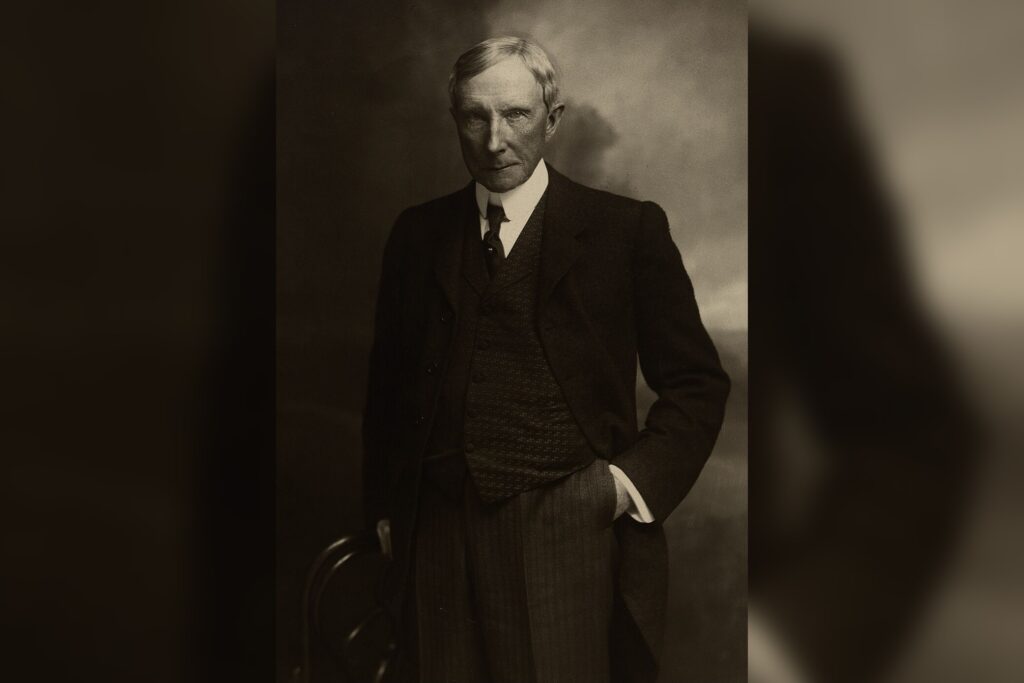
NEW YORK, July 14 — The calculus of American capitalism has never been reducible to a single balance sheet, but John D. Rockefeller’s ledger remains the standard by which all others are measured. The founder of Standard Oil, who died in 1937, still casts a long shadow over the global energy landscape — a strategic architect whose business model shaped the geopolitical chessboard of the 20th century and continues to influence it today.
Rockefeller launched Standard Oil in 1870. Within a decade, his company controlled 90 percent of U.S. oil refining.
That dominance was no accident. He pioneered vertical integration — owning the pipelines, the refineries, and the distribution networks — locking up the entire supply chain from wellhead to consumer. It was a strategic play that left competitors with no room to maneuver.
The Trust and the Breakup
The broader stakes of Rockefeller’s empire became a central question for American antitrust law. In 1911, the U.S. Supreme Court ordered the breakup of Standard Oil under the Sherman Antitrust Act. The company was split into 34 separate entities.
Among the descendants of that breakup are the corporate predecessors of ExxonMobil, Chevron, and ConocoPhillips — names that still dominate the global energy sector and the strategic calculations of nations. What this signals is the enduring architecture of Rockefeller’s original design.
The 34 companies that emerged from the breakup did not vanish; they grew into some of the most powerful corporations on earth. The monopoly was dismantled, but the industrial DNA persisted. At his peak, Rockefeller’s net worth is estimated at $400 billion in today’s dollars.
That figure places him as the richest American in history, a wealth accumulation that had no parallel. Yet the numbers alone do not capture the strategic breadth of his influence.
Philanthropy as Strategy
Rockefeller later donated over $500 million to charitable causes. He founded the University of Chicago in 1890 and established the Rockefeller Foundation in 1913. These institutions were not afterthoughts.
They represented a systematic approach to philanthropy that mirrored his business methods — large-scale, institutional, and designed for permanence. The Rockefeller Foundation became a vehicle for global health and education initiatives, extending American influence in ways that complemented the industrial power Standard Oil had already projected.
The foundation’s work, alongside the University of Chicago’s rise as a research powerhouse, reflects a legacy that combines monopoly power with systematic philanthropy. For analysts watching the current landscape of energy markets and antitrust enforcement, the Rockefeller story remains a reference point. The breakup of Standard Oil established a legal precedent that still informs regulatory strategy.
The companies that emerged from it now operate across the globe, navigating the same geopolitical pressures that Rockefeller himself once managed through sheer market control. What to watch next is how the lessons of Rockefeller’s rise and fall apply to today’s technology and energy giants.
The strategic playbook of vertical integration, market dominance, and institutional philanthropy has not gone out of style. Neither has the government’s willingness to break up concentrations of power when the calculus shifts. The Rockefeller era ended nearly a century ago, but its strategic architecture still shapes the boardroom — and the courtroom.
Sources
{“@context”: “https://schema.org”, “@type”: “NewsArticle”, “headline”: “John D. Rockefeller Built an Oil Monopoly That Changed an Industry”, “description”: “NEW YORK, July 14 — The calculus of American capitalism has never been reducible to a single balance sheet, but John D. Rockefeller’s ledger remains…”, “datePublished”: “2026-07-14T09:30:00+00:00”, “author”: {“@type”: “Person”, “name”: “Noah King”}, “publisher”: {“@type”: “Organization”, “name”: “InfoPulse Today”, “url”: “https://newsfeed.2bme.xyz/”}, “citation”: [{“@type”: “CreativeWork”, “url”: “https://en.wikipedia.org/wiki/John_D._Rockefeller”}]}




