
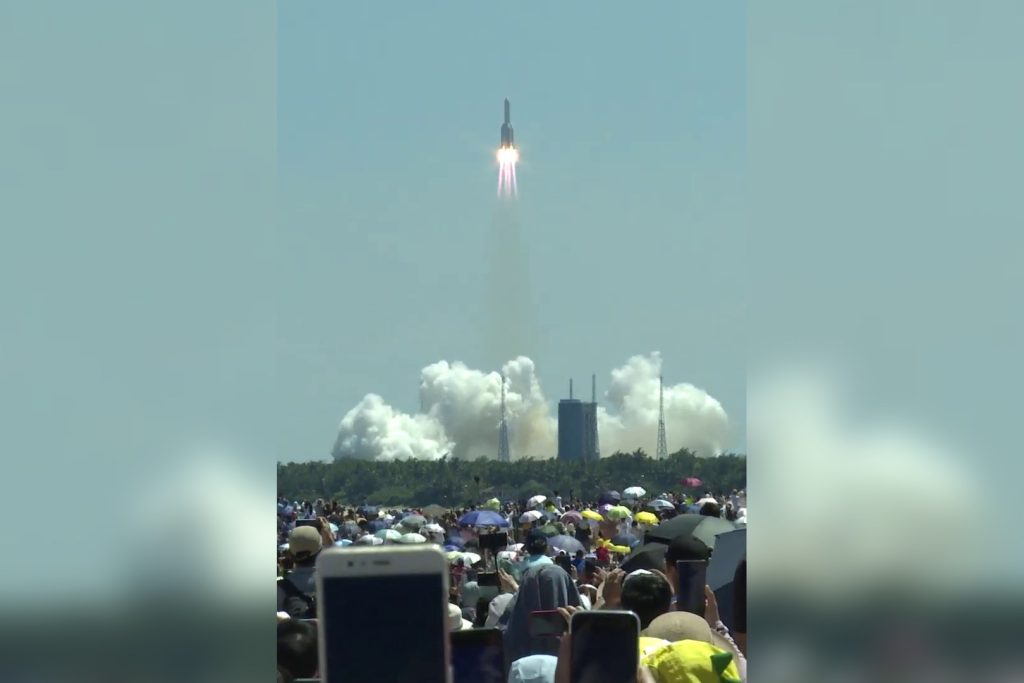
WENCHANG, Hainan Island, July 10 — The launch of the Long March 10B from China’s coastal spaceport here marks another step in Beijing’s methodical expansion of its space capabilities, a program that has long drawn scrutiny from Western capitals for its dual-use technologies and opaque military ties. The rocket, developed by the state-owned China Aerospace Science and Technology Corporation (CASC), lifted off from the Wenchang Space Launch Site, a facility that has been operational since 2014 and sits at 19.6 degrees north latitude on Hainan Island.
It is China’s only coastal launch site, a geographic advantage that permits the transport of larger rocket stages by sea. The Long March 10B is part of a broader family of launch vehicles that includes the Long March 10A, a crewed variant, and the Long March 10C, a heavy-lift variant.
The design of the 10B was led by the China Academy of Launch Vehicle Technology (CALT), a subsidiary of CASC that was established in 1957. The launch was commanded by Zhang Jianheng, a senior CASC engineer, according to officials. The China National Space Administration (CNSA), founded in 1993, oversees China’s space activities and policy, though CASC remains the primary contractor and industrial backbone of the program, employing over 170,000 people.
State Enterprise, Military Ambitions
CASC was founded in 1999 and is headquartered in Beijing. It is not merely a space agency but a sprawling state-owned enterprise that builds missiles, satellites, and launch vehicles, often blurring the line between civilian space exploration and military applications. This structure has long been a point of concern for U.S. defense planners, who view China’s space program as an integral component of the People’s Liberation Army’s modernization efforts.
The Long March 10B, while presented as a civilian launch vehicle, shares technological lineage with systems that could support military reconnaissance, communications, and potentially anti-satellite capabilities. China’s space budget for 2024 is estimated at $12 billion, according to state and international reports.
That figure places it second only to NASA’s $25 billion budget, underscoring the scale of Beijing’s investment in space. The gap, however, remains significant, and the U.S. retains a commanding lead in both funding and technological sophistication. The Trump administration, with President Donald Trump in the White House and Vice President JD Vance, has maintained a posture of strategic competition with China, particularly in space.
Secretary of State Marco Rubio has previously voiced concerns about Chinese space activities that could threaten U.S. assets in orbit.
A Coastal Launchpad and Regional Reach
The choice of the Wenchang launch site is not incidental. Located on Hainan Island, China’s southernmost province, the facility sits closer to the equator than China’s inland launch sites, providing a fuel-saving boost from the Earth’s rotation. This is particularly advantageous for launching heavy payloads, including large satellite constellations and future space station modules.
The site became operational in 2014, and since then, it has hosted some of China’s most ambitious launches, including those for the Long March 5, the country’s most powerful rocket before the 10 family. For regional observers, including in Tehran, the launch carries implications that extend beyond the Pacific.
Iran has long sought to develop its own space launch capabilities, often with technical assistance from China and Russia. The Islamic Republic’s space program, like China’s, is closely tied to its ballistic missile development, a fact that has drawn sanctions from Washington. The Long March 10B launch, while a Chinese achievement, also signals to Iranian officials the kind of technological trajectory Beijing is willing to pursue—and potentially share.
Engineering and Oversight
The Long March 10B was designed by CALT, a subsidiary with deep roots in China’s missile and space history. Established in 1957, CALT predates CASC itself and has been responsible for the Long March series since its inception. The rocket family is named after the Long March, the epic 1934-35 retreat of the Chinese Communist Party that is central to its founding mythology.
The naming convention is deliberate, linking technological achievement to revolutionary legitimacy. The launch was commanded by Zhang Jianheng, a senior CASC engineer.
Officials said the mission proceeded as planned, though specific details about the payload or orbital parameters were not immediately disclosed. This opacity is typical of Chinese space launches, which often lack the real-time public data and press briefings common to NASA or European Space Agency missions. The CNSA, which sets policy, has historically been less transparent than its Western counterparts, a fact that fuels suspicion about the military dimensions of its activities.
Global Context and Competition
The Long March 10B launch comes at a time of heightened competition in space. The United States, under the Trump administration, has prioritized space as a warfighting domain, establishing the U.S. Space Force as a separate military service. NASA’s budget, at $25 billion, dwarfs China’s $12 billion, but Beijing’s spending is growing rapidly and is concentrated on a narrower set of objectives.
China has already deployed its own space station, Tiangong, and has landed rovers on the Moon and Mars. The Long March 10 family is expected to support crewed lunar missions in the coming decade, potentially challenging the U.S. lead in human spaceflight.
For the U.S. and its allies, the question is not whether China can launch large rockets—it clearly can—but what those rockets will carry and for what purpose. The Long March 10B, as a variant of a family that includes a crewed version and a heavy-lift version, suggests a program designed for sustained human presence beyond low Earth orbit. That is an ambition the United States shares, but one that also raises the stakes for orbital infrastructure and space debris management.
What to Watch Next
The next milestones for the Long March 10 family will be closely watched. The crewed variant, the Long March 10A, is expected to undergo testing in the near future, potentially carrying Chinese astronauts to the Tiangong station or beyond. The heavy-lift Long March 10C, if developed, could rival the capabilities of NASA’s Space Launch System.
For now, the Long March 10B launch demonstrates that CASC and its subsidiaries continue to execute on a long-term plan, one that Beijing has pursued with patience and consistency. In Tehran, where the regime’s own space program has suffered repeated launch failures and international sanctions, the Chinese example offers both inspiration and a reminder of the technological gap.
Iran’s space ambitions remain modest by comparison, but the relationship between the two countries—including in missile and space technology—is one that Western intelligence agencies monitor closely. The Long March 10B, for all its engineering achievement, is also a geopolitical signal, one that resonates from Hainan Island to the Persian Gulf.
{“@context”: “https://schema.org”, “@type”: “NewsArticle”, “headline”: “Key Players: CASC and CNSA Behind the Long March 10B Development”, “description”: “WENCHANG, Hainan Island, July 10 — The launch of the Long March 10B from China’s coastal spaceport here marks another step in Beijing’s methodical expansion…”, “datePublished”: “2026-07-10T09:30:00+00:00”, “author”: {“@type”: “Person”, “name”: “Reza Karimi”}, “publisher”: {“@type”: “Organization”, “name”: “InfoPulse Today”, “url”: “https://newsfeed.infopulsetoday.com/”}}




