
A network of optical sensors positioned more than two kilometers beneath the Mediterranean Sea detected an extraordinarily energetic neutrino on February 12, 2025. The European KM3NeT collaboration, which operates the underwater observatory, announced the particle carried 30 times more energy than any previously recorded neutrino.
Neutrinos are subatomic particles that pass through ordinary matter with almost no interaction. Trillions travel through the human body each second, most originating from the sun or Earth’s atmosphere. Their elusive nature makes detection exceptionally difficult.
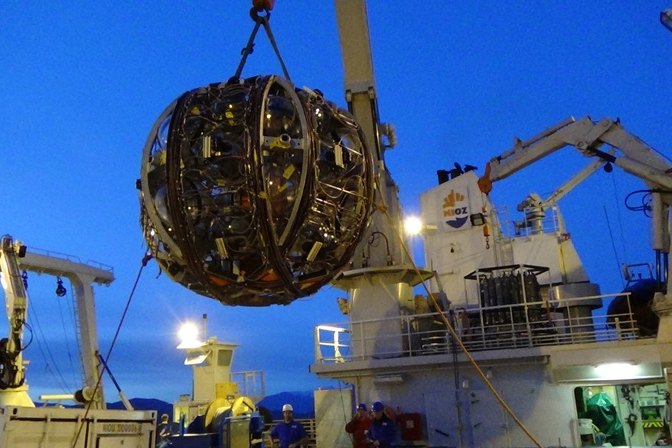
The KM3NeT telescope, formally named the Cubic Kilometre Neutrino Telescope, consists of thousands of optical sensor modules arranged along vertical lines anchored to the seafloor. These sensors wait in darkness for a flash of blue light called Cherenkov radiation, which occurs when a neutrino collides with another particle and produces a charged secondary particle. Scientists analyze the timing and direction of this faint light to determine the neutrino’s path and energy.
The February 12 event produced energy 30 times greater than the previous record holder. The collaboration did not identify a specific source for the particle, noting that work remains to trace its origin. However, the detection confirms the telescope operates at the scale and sensitivity its designers intended.
KM3NeT comprises two sites: one off Sicily’s coast and another near Toulon, France. Both sit at depths exceeding two kilometers. The water above shields sensors from cosmic rays that affect surface-based detectors. The water itself serves as the detection medium, being cheap, abundant, and transparent enough for Cherenkov light to travel through.
The IceCube experiment at the South Pole, which has operated for over a decade, previously held the record for highest-energy neutrino detection. KM3NeT differs by being located in the Northern Hemisphere, offering a complementary view of the sky. It uses water rather than ice, providing better angular resolution due to water’s greater clarity. This resolution is crucial for tracing neutrinos back to cosmic sources such as supernovae, gamma-ray bursts, or active galactic nuclei.
A neutrino of this energy likely originated outside the Milky Way galaxy, possibly from a cosmic accelerator far more powerful than any human-built machine. The energy level indicates extreme astrophysical processes exist in the universe.
The detection came from a partially completed configuration of KM3NeT, as the collaboration continues building the full array. This achievement demonstrates the infrastructure works and the detection method is sound, validating the hundreds of millions of euros invested and years of engineering required to deploy sensitive electronics on the deep seafloor.
Neutrino astronomy remains a young field that relies on directions and energies rather than traditional images or spectra. These two measurements, coming from particles that cross the universe unimpeded, carry significant scientific weight. The Mediterranean Sea has become a frontier for this research, with sensors waiting in darkness for rare events like the one recorded on February 12, 2025.




