
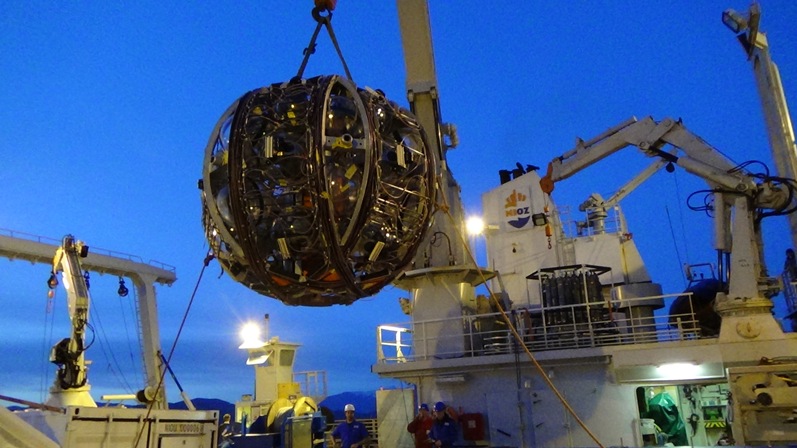
On February 12, 2025, the KM3NeT collaboration announced the observation of the most energetic neutrino ever measured. The particle’s energy exceeds that of the previous record holder by a factor of thirty, marking a significant leap forward for neutrino astronomy. The detection was made possible by the KM3NeT infrastructure, which sits on the seafloor of the Mediterranean Sea.
This facility forms the Cubic Kilometre Neutrino Telescope, a European research array purpose‑built to capture neutrinos arriving from distant cosmic sources as well as those produced in Earth’s atmosphere. KM3NeT employs water‑Cherenkov technology.
Thousands of optical sensor modules are arranged in vertical strings and anchored at depths greater than two kilometres. When a neutrino interacts with the surrounding water or rock, it can produce a charged particle that moves faster than the speed of light in that medium, emitting a faint flash of Cherenkov radiation. The sensor modules record the timing, position, and direction of these photons, allowing researchers to reconstruct the incoming neutrino’s path and energy. The achievement highlights the telescope’s sensitivity and the expertise of the international team behind it.
By pushing the observable energy frontier, KM3NeT opens a new window onto the most violent phenomena in the universe, such as supernova explosions, gamma‑ray bursts, and the environments surrounding black holes. Scientists anticipate that studying ultra‑high‑energy neutrinos will yield fresh insights into particle acceleration mechanisms and the composition of cosmic rays.
Because neutrinos interact only weakly, they travel unimpeded across vast distances, carrying information about their origins that photons or charged particles might lose along the way. The Mediterranean location offers a natural, transparent shield that reduces background noise while providing a massive detection volume. This innovative use of the deep sea as a laboratory exemplifies how creative engineering can expand the reach of experimental physics.
Looking ahead, the KM3NeT array will continue to operate and collect data, with the expectation of further high‑energy events. Each detection adds to a growing catalog that could eventually reveal the sources of the most powerful particles in nature and test fundamental theories of particle physics and cosmology.
The February 12 observation stands as a milestone not only for the KM3NeT collaboration but also for the broader astrophysics community. It confirms that deep‑sea neutrino telescopes can operate at the extreme energies needed to probe the universe’s most energetic accelerators, promising a future rich with discovery.




