
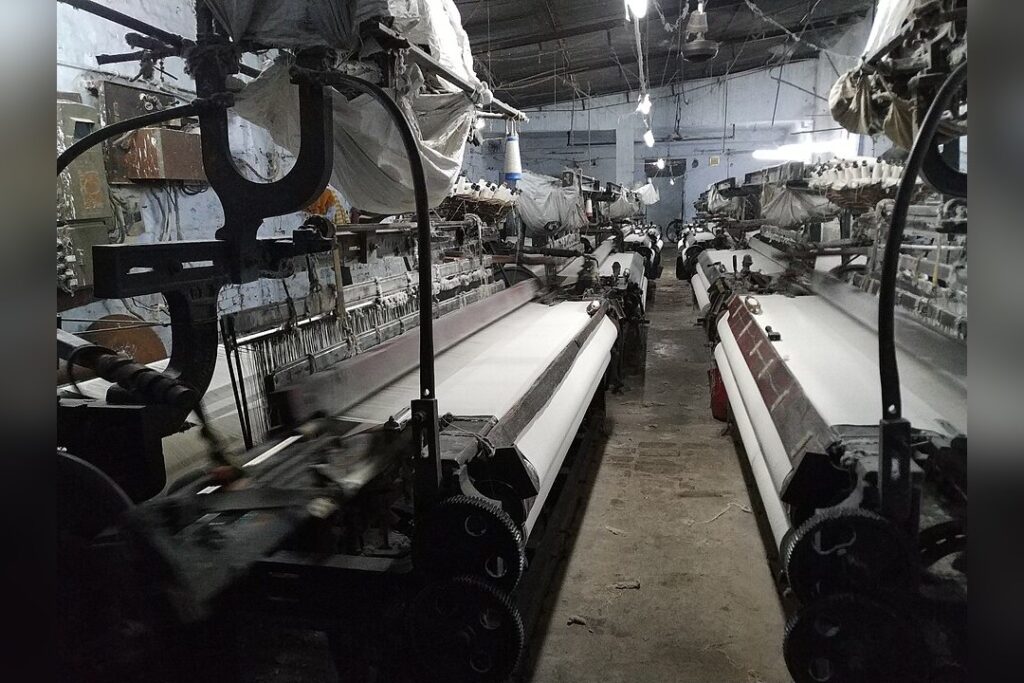
The record opens on March 11, 1811. In Nottingham, British troops broke up a crowd demanding more work and better wages. That night, workers in a nearby village smashed textile machinery. It was the start of what history remembers as Luddism.
EBSCO’s research summary gives a more specific first target: a stocking factory in Arnold, near Nottingham, where an armed band wrecked a new type of knitting frame built to turn out wide fabric for cheap seamed stockings. The men said they acted for “General Ludd.”
Why the north boiled over
Britain had been at war with France since 1793. In 1809 Parliament adopted the Orders in Council in answer to Napoleon’s Continental System, which choked off continental exports and strained trade with the United States. Goods piled up unsold. Factories laid off workers or cut the pay of those who stayed, until wages would not cover basic necessities. Poor harvests in 1810 and 1811 pushed food prices up.
Machines were one grievance among several. They were also the easiest to hit, in a country where working men could not vote and strikes were illegal.
The attacks spread
Raids came nightly at first, then sporadically, then in waves. They spread across a 70-mile swath of northern England, from Loughborough in the south to Wakefield in the north, Smithsonian Magazine reported. They moved from the hosiery shops around Nottingham to the woolen mills of the West Riding of Yorkshire, and finally to the cotton mills near Manchester.
The authorities feared a national conspiracy. Parliament made machine-breaking a capital offense, and the government eventually sent some thirteen thousand troops north under Sir Thomas Maitland. Soldiers were of limited use. The Luddites met in secret, struck at night and were gone before troops arrived.
Some episodes turned deadly. In April 1812, about 2,000 protesters mobbed a mill near Manchester. The owner ordered his men to fire into the crowd, killing at least 3 and wounding 18, and soldiers killed at least 5 more the next day. Earlier that month, a crowd of about 150 had traded gunfire with defenders of a Yorkshire mill, and two Luddites died.
In Yorkshire, the croppers’ leader was George Mellor, who finished woolen cloth with massive shears. He and two others killed a manufacturer, William Horsefall. On April 11, 1812, Mellor led a band of one hundred men against William Cartwright’s fortified mill at Rawlfolds. He was tried at the York Assizes on January 6, 1813, convicted and executed with sixteen other men. EBSCO’s account calls the punishment out of proportion to crimes that mostly damaged property.
A phantom leader
General Ludd, also styled Captain or King Ludd, first appeared in a Nottingham protest in November 1811. By Smithsonian’s account, he never existed. The story told a young apprentice in Leicester who, ordered to “square his needles,” flattened a stocking frame with a hammer. Protesters turned him into a symbolic commander. Their letters mocked officialdom, ending “Ned Lud’s Office, Sherwood Forest,” and in Yorkshire they swung sledgehammers they called “Great Enoch.” “Enoch made them,” they declared, “Enoch shall break them.”
Historian Kevin Binfield, editor of Writings of the Luddites, told the magazine they “were totally fine with machines.” What they wanted, he said, was machines run by workers who had served an apprenticeship and earned decent wages.
The count
By December 1812 the main wave had subsided, helped by hard suppression and a better economy. Scattered sabotage continued until 1816. A total of forty-eight people died, including two managers and eleven attackers killed in raids, and thirty-five people were executed. Half of those hanged had committed property crimes such as looting, probably incidental to the sabotage itself. Laws aimed specifically at frame-breaking followed, though EBSCO notes the movement drew no strong response in Parliament beyond that. The Luddites did not stop mechanization.
Sources
- Luddites Destroy Industrial Machines | History | Research Starters | EBSCOhost
- What the Luddites Really Fought Against | Smithsonian Magazine




