
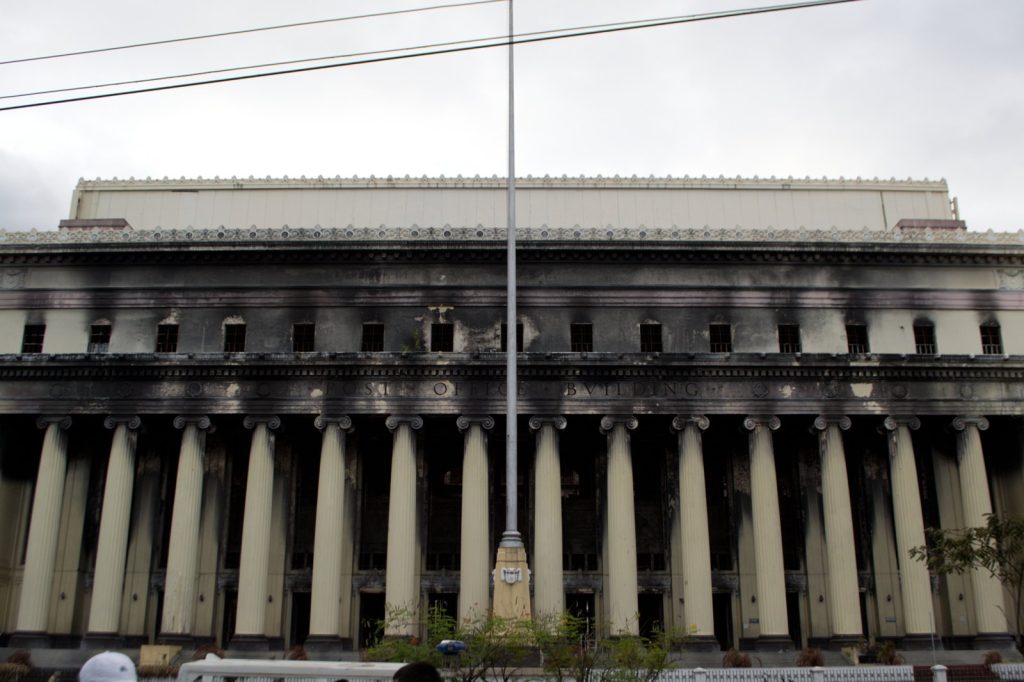
A fire that swept through the Manila Central Post Office on May 21, 2023, has severely damaged the primary sorting and distribution hub for the entire Philippine postal system. The neoclassical structure, situated along the Pasig River in the Lawton district of Ermita, was originally designed by architects Juan M.
Arellano, Tomas B. Mapua, and Ralph Doane as part of the Burnham Plan of Manila. Its riverside location was a deliberate choice, intended to allow mail to be transported and received by water.
The blaze did more than damage a historic landmark; it struck at the physical core of the Philippine Postal Corporation’s operations. The building serves as both the corporation’s headquarters and the main postal office for Manila, functioning as the central nervous system through which every letter and parcel in the national network passes.
When the fire hit, the immediate concern was the continuity of mail services across the country. The Philippine Postal Corporation responded swiftly, activating contingency plans and assuring the public that operations would continue despite the damage. However, the building itself—its sorting floor charred, its distribution center closed, and its headquarters displaced—cannot be easily replaced.
There is no spare sorting facility or backup headquarters available elsewhere. The contingency measures are temporary patches rather than full replacements.
The building’s location, once a logistical advantage for water-based mail transport, made it highly accessible from all sides, which contributed to its role as a central hub. That same visibility meant the smoke rising from the fire served as a public signal that something essential had broken within the country’s infrastructure. Authorities have launched an investigation into the cause of the fire, though that process is expected to take time.
In the meantime, the Philippine Postal Corporation is working to minimize disruption to mail services. The scale of that disruption remains uncertain, as the building’s role in the postal network is unique and irreplaceable in the short term.
The fire raises a fundamental question about infrastructure dependence on physical facilities. When a single building serves as the sole sorting and distribution center for an entire nation’s mail system, its loss creates a break that contingency plans can only partially address. The corporation has stated that mail will continue to move, but it will do so through a system that has lost its center. Efforts are underway to assess the damage and plan for the building’s restoration to its former glory.
That is a long-term project. In the short term, the priority is keeping the mail flowing.
The fire on May 21 did not just burn a historic landmark. It burned the working facility where the country’s mail gets sorted. That is the core fact that matters for the millions of Filipinos who depend on the postal system.




