
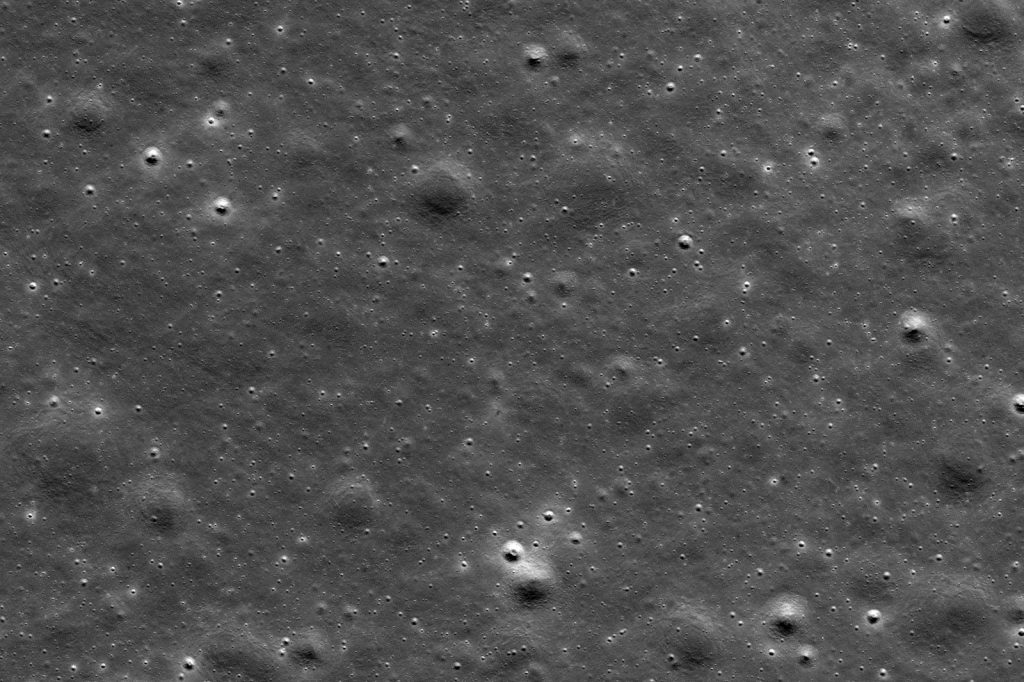
TUCSON, July 20 — The Moon’s far side now carries a scar that no human eye will ever see directly. Near the Hertzsprung crater, at roughly 5 degrees north latitude and 128 degrees west longitude, a crater marks the spot where a piece of human hardware ended a drift through cislunar space. That piece of hardware is the spent upper stage of a SpaceX Falcon 9 rocket.
Left in what engineers call a “chaotic” orbit — one sensitive to gravitational influences — the stage spent years tracing a path around the Earth, its farthest point swinging out to roughly the distance of the Moon’s own orbit, about 384,400 km, while its closest approach skimmed just a few hundred kilometers above the Earth’s surface. Over time, the Moon’s gravity pulled on the stage, gradually lowering its perigee relative to the Moon.
The stage’s orbital period was slightly different from the Moon’s. That mismatch meant that over many years the stage slowly drifted in phase, sliding into a position where its trajectory would eventually intersect the lunar disk. On March 4, 2022, that intersection happened.
A Chaotic Path
The stage’s approach speed relative to the Moon was about 2.58 km/s. At that velocity, the kinetic energy released on impact came to approximately 1.33 × 10¹⁰ joules, the equivalent of about 0.32 tons of TNT. That is enough to blast a hole in the lunar surface some 10–20 meters across, depending on the density of the ground it hit.
The Moon has no atmosphere to slow or break up an incoming object. The stage struck with its full mass and speed intact.
This was not a random collision. The trajectory leading up to the impact was calculated using telescopic observations from Earth. Two survey programs tracked the stage’s position: the Catalina Sky Survey and the Pan-STARRS telescope.
Their data let orbital mechanics refine the stage’s path well in advance, allowing them to pinpoint the precise impact location — even though that location, on the lunar far side, remains out of line of sight from Earth.
Impact and Aftermath
The impact site lies near Hertzsprung crater, a large impact basin on the Moon’s far side. Because the Moon always keeps the same face toward Earth, scientists will have to rely on satellites orbiting the Moon to image the fresh crater in the months and years ahead. The debris plume thrown up at the moment of impact was invisible to ground-based telescopes.
For students of orbital mechanics, the Falcon 9 upper stage’s journey offers a case study in how objects in high Earth orbits behave over long time scales. Its orbit was classified as “chaotic”: tiny changes in initial conditions, amplified by the Moon’s gravitational torque, led to large divergences in its path over the years.
That chaos is what eventually steered it into the Moon. The event also underscores a growing reality in the space age: not all debris finds its way to a stable graveyard orbit. As more hardware is launched into high trajectories, the Moon itself becomes an occasional cosmic dustbin.
This particular piece of debris, a Falcon 9 upper stage left adrift after a previous mission, is one of the first confirmed cases of an Earth-launched object striking the Moon. What will the new crater look like when lunar orbiters eventually photograph it?
The size estimate — 10 to 20 meters in diameter — is a rough bracket. The final answer depends on whether the impact point was soft lunar soil or hard rock. Either way, the crater joins others pocking the far side, this one set apart by its origin story: born not from a random asteroid, but from a rocket stage whose final trajectory was charted from telescopes on Earth by observatories like Catalina Sky Survey and Pan-STARRS.
For now, the scar remains hidden, waiting for the next spacecraft to swing by for a look.




