
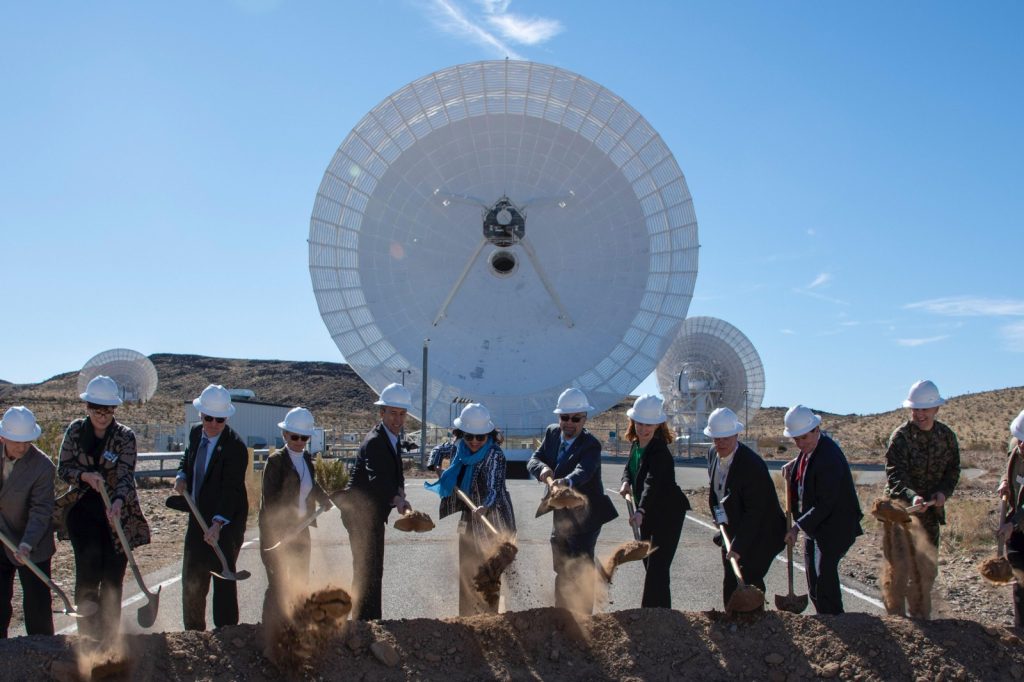
Voyager 1 is about 25.7 billion kilometers (roughly 16 billion miles) from Earth, according to Orbital Day’s late-July 2026 account. A command sent to it takes close to 24 hours to arrive, and the reply needs almost as long to come back. Somebody has to be listening at both ends of that wait. That somebody is NASA’s Deep Space Network.
NASA calls the DSN the largest and most sensitive scientific telecommunications system in the world. It is an international array of giant radio antennas that supports interplanetary missions, plus a few spacecraft that orbit Earth. The Jet Propulsion Laboratory runs it.
Three sites, one planet
The network has three facilities spaced evenly around the globe, roughly 120 degrees apart in longitude. One sits at Goldstone, near Barstow, California. The others are near Madrid, Spain, and near Canberra, Australia.
The spacing is deliberate. As Earth turns, a distant spacecraft sinks below the horizon at one site, and another site picks up the signal and carries on. Contact is never dropped.
Each complex has at least four antenna stations, each fitted with large parabolic dishes and receiving systems sensitive enough to detect very faint radio signals from far away. Every site also has one giant 230-foot (70-meter) dish. These are the biggest and most sensitive antennas in the network, and NASA says they can track a spacecraft tens of billions of miles away.
More than a dish farm
NASA stresses that the DSN is a system, not just a set of big antennas. It commands spacecraft, tracks them and monitors their health and safety at distant planets and moons. The same hardware supports science: investigations into asteroids and the interiors of planets and moons, along with radar and radio astronomy observations of the solar system and the wider universe.
For Voyager 1 the link carries a lot of weight. The probe crossed the heliopause, the outer edge of the Sun’s bubble of solar wind, on August 25, 2012. Orbital Day reported that only two of its science instruments remain switched on, the magnetometer and the plasma wave subsystem. Engineers turned off the cosmic ray instrument on February 25, 2025, and the low-energy charged particles experiment on April 17, 2026, to save electrical power. Its generators lose about four watts every year.
On November 14, 2023, the probe kept transmitting but the data inside the signal became unreadable. Engineers traced the fault to a failed memory chip in the Flight Data Subsystem. They could not fix the chip, so they split the damaged code into smaller sections, stored them in other parts of memory and rewrote the references that tied them together. Readable engineering data returned in April 2024, and by June all four instruments then active were back to normal.
Orbital Day also noted that on November 18, 2026, Voyager 1 is expected to be 25,902,068,356 kilometers away, one light-day out. It would be the first human-made object whose signal takes a full 24 hours to reach us.




