
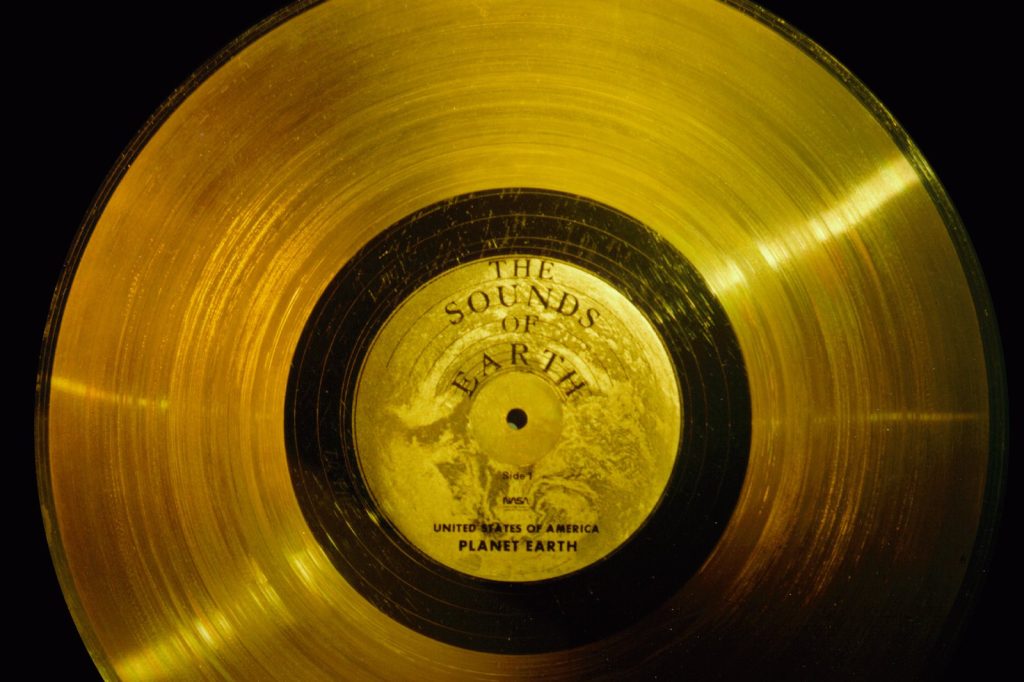
The record is a copper disc, 12 inches across, plated first with nickel and then gold. Two identical copies left Earth in 1977, one on each Voyager spacecraft, carrying sounds and pictures meant for any intelligent life that might find them.
NASA’s project manager, John Casani, handed the job to Carl Sagan. Sagan’s budget was $1,500 for six weeks of work, and Casani insisted the record weigh no more than the plaque on the earlier Pioneer probes. Sagan and his colleagues Linda Salzman and Frank Drake chose a metal phonograph record because it would outlast magnetic tape in space. A committee chaired by Sagan, then at Cornell University, spent almost a year choosing what went on it.
What is on it
There are 116 images, one of them a calibration shot, encoded in analog form as 512 vertical lines each. The first ones are scientific: mathematical and physical quantities, the solar system, DNA, human anatomy. Later pictures show food, architecture, portraits and people going about daily life across many cultures, plus animals, insects, plants and landscapes. NASA would not allow a photograph of a nude man and woman after the criticism over the Pioneer plaque, so the record carries a silhouette of the couple instead.
The sound portion runs from surf, wind and thunder to birdsong and the calls of humpback whales. People are on it too: spoken greetings in 55 ancient and modern languages, among them one in English from UN Secretary-General Kurt Waldheim and one from Sagan’s six-year-old son Nick. A printed message from US President Jimmy Carter is included. So are footsteps, laughter and the Latin phrase Per aspera ad astra in Morse code.
The music spans cultures and centuries, from Bach, Mozart, Beethoven and Stravinsky to Louis Armstrong, Blind Willie Johnson and Chuck Berry. Berry’s “Johnny B. Goode” caused an argument. The ethnomusicologist Alan Lomax called rock music “adolescent,” and Sagan answered, “There are a lot of adolescents on the planet.”
One more track is stranger. Ann Druyan, the creative director, had her brainwaves recorded for an hour while she thought about Earth’s history, civilizations and their problems, and what it was like to fall in love. The hour was compressed into a minute of audio.
Instructions on the cover
The aluminum cover carries the playback instructions in symbols. A drawing shows the stylus in position to play from the outside in, with the rotation time of 3.6 seconds written in binary, measured in units based on a hydrogen atom transition. Another diagram explains how to rebuild the pictures from the signal, and a replica of the first image lets a finder check the decoding. A map shows the Sun’s position relative to 14 pulsars.
Electroplated onto the cover is a sample of ultra-pure uranium-238, which has a half-life of 4.468 billion years. A civilization that finds the record could measure how much remains and work out its age.
Neither spacecraft is aimed at a particular star. In about 40,000 years Voyager 1 will pass within 1.6 light-years of Gliese 445. “The spacecraft will be encountered and the record played only if there are advanced space-faring civilizations in interstellar space,” Sagan said, “but the launching of this ‘bottle’ into the cosmic ‘ocean’ says something very hopeful about life on this planet.”




