
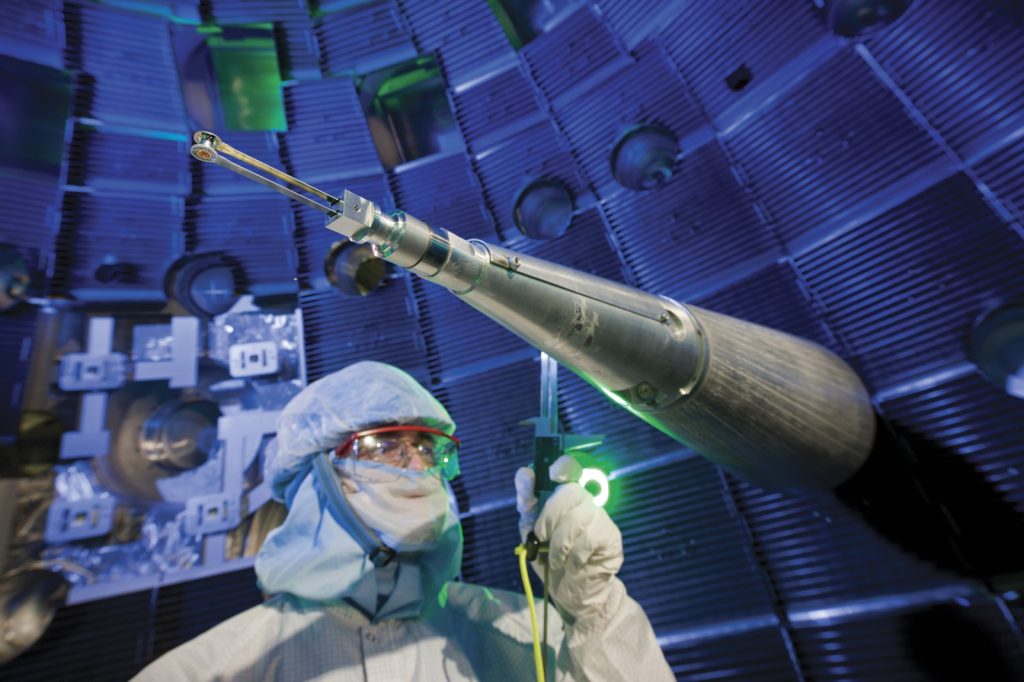
LIVERMORE, Calif., July 9 — Strategically, the United States has held a card in the global energy and security deck that few other nations can match, and the National Ignition Facility remains the center of that calculation. Four years after achieving a world-first net energy gain in a fusion reaction, NIF continues to operate as the world’s largest and most energetic laser system, a sprawling complex the size of three football fields buried in the hills of Lawrence Livermore National Laboratory.
The facility’s core mission is not civilian power generation, but the Stockpile Stewardship Program—the technical backbone of America’s nuclear weapons maintenance strategy. This is the geopolitical chessboard reality: NIF allows scientists to simulate the conditions of a thermonuclear detonation without testing, a capability that has become indispensable as international treaties restrict live nuclear testing.
The broader stakes here involve maintaining a credible deterrent without breaking those commitments.
The Machine and the Milestone
Construction on NIF began in 1997 and was completed in 2009, at a cost of $3.5 billion. The facility uses 192 laser beams that deliver 1.9 megajoules of ultraviolet light into a tiny target chamber. Inside that chamber sits a gold cylinder called a hohlraum, which contains a spherical fuel pellet made of deuterium and tritium ice.
When the lasers fire, they heat the hohlraum, producing X-rays that compress the pellet to densities 100 times that of lead and temperatures over 100 million degrees Celsius. On December 5, 2022, that machine achieved what no laboratory had ever done: ignition.
The experiment produced 3.15 megajoules of fusion energy output from 2.05 megajoules of laser input—a net energy gain of about 1.5 times. The U.S. Department of Energy confirmed the result on December 13, 2022. For the first time, a fusion reaction in a laboratory setting generated more energy than it consumed.
Dr. Kim Budil serves as NIF’s director, overseeing a facility whose primary purpose remains nuclear stockpile stewardship. But the 2022 breakthrough fundamentally shifted the calculus.
What NIF signals to the international community is that controlled fusion—the same process that powers the sun—is no longer a theoretical aspiration in a laboratory context. It is a demonstrated, repeatable physical event.
Beyond the Weapons Mission
The facility also conducts basic science and fusion energy research, a secondary mission that has gained new urgency since the ignition milestone. The physics of compressing a fuel pellet to 100 times the density of lead at temperatures exceeding 100 million degrees Celsius is not merely a weapons simulation tool—it is a platform for understanding matter under extreme conditions that exist nowhere else on Earth. Strategically, the NIF breakthrough reshapes the broader stakes of global fusion research.
Competing efforts in Europe, China, and private industry now operate in a world where the benchmark has been set. The United States demonstrated it can achieve net energy gain from fusion.
The question that follows—whether that gain can be scaled, sustained, and commercialized—remains unanswered. But the first move on that board has been made. What this signals to adversaries and allies alike is that the United States retains the technical capacity to maintain its nuclear deterrent without testing, while also holding the foundational knowledge for what could become a transformative energy technology.
The Stockpile Stewardship Program ensures the reliability of existing warheads; the fusion research ensures the country stays at the frontier of high-energy-density physics.
The Road Ahead
NIF’s 192 laser beams remain the most energetic laser system ever built. Each ignition experiment consumes a gold hohlraum and a cryogenically layered fuel pellet of deuterium and tritium. The process is neither cheap nor quick, but it is now a proven method for achieving fusion ignition.
The broader stakes for the coming years are clear. Can NIF replicate and improve upon the 2022 result?
Can the facility push beyond the 1.5-times energy gain toward higher yields that would make the system more than a scientific demonstration? And can the knowledge gained at Livermore inform the next generation of fusion energy devices, whether government-funded or private? Dr. Budil and her team are working on those questions.
The facility’s primary mission—stockpile stewardship—continues without interruption. But the 2022 ignition event changed the strategic landscape permanently.
The United States now has a working fusion ignition capability. What it chooses to do with that capability will define the next phase of the global energy and security competition. The chessboard has shifted.
The pieces are still moving.
{“@context”: “https://schema.org”, “@type”: “NewsArticle”, “headline”: “National Ignition Facility Achieves Fusion Breakthrough in Landmark Experiment”, “description”: “LIVERMORE, Calif., July 9 — Strategically, the United States has held a card in the global energy and security deck that few other nations can…”, “datePublished”: “2026-07-09T09:30:00+00:00”, “author”: {“@type”: “Person”, “name”: “Noah King”}, “publisher”: {“@type”: “Organization”, “name”: “InfoPulse Today”, “url”: “https://newsfeed.infopulsetoday.com/”}}




