
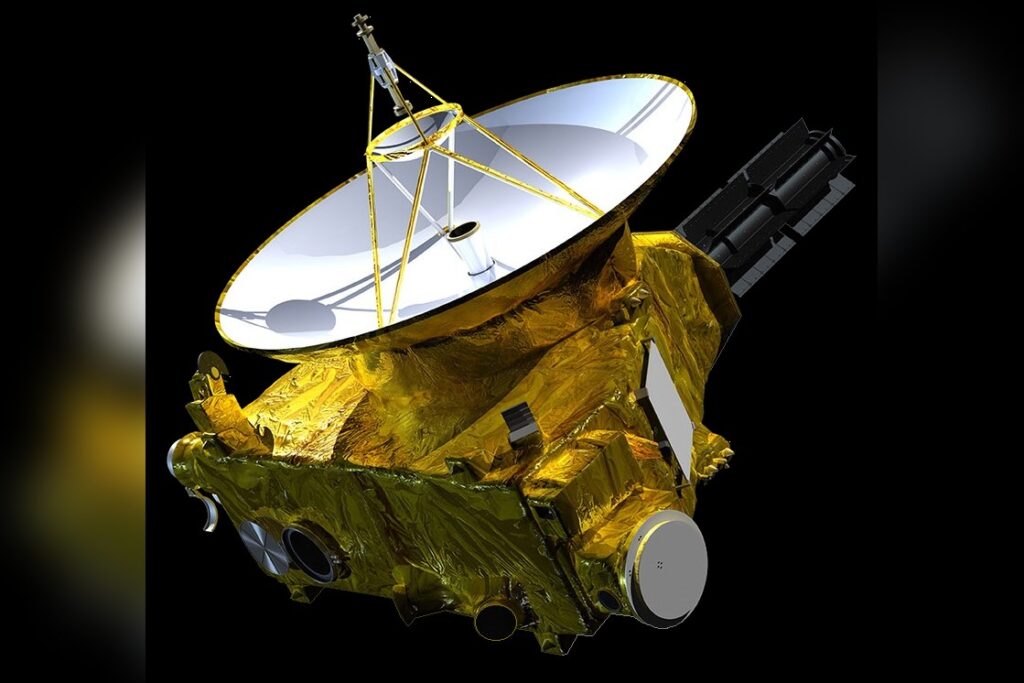
LAUREL, Maryland, July 9 — The New Horizons spacecraft is quietly rewriting the record books as it pushes toward the heliopause, the ragged boundary where the Sun’s influence finally gives way to the interstellar medium. Launched from Cape Canaveral, Florida, aboard an Atlas V rocket on January 19, 2006, the probe is on course to become only the third human-made object to leave the solar system. As of 2025, New Horizons sits approximately 60 astronomical units from the Sun — each AU being about 93 million miles.
That puts it deep in the Kuiper Belt, far beyond the orbits of the known planets, and closing steadily on the frontier that Voyager 1 crossed on August 25, 2012, and Voyager 2 followed on November 5, 2018. The technical reality of crossing the heliopause is more complex than simply passing a line on a map.
This is a dynamic region where the solar wind — the stream of charged particles boiling off the Sun — slows down and begins to interact with the plasma of interstellar space. Its exact location shifts with solar activity, meaning the mission team cannot predict the crossing date with precision. What they do know is that New Horizons is heading through the heliosphere’s nose region, the direction of the Sun’s motion through the galaxy.
From Pluto to the edge of everything
The spacecraft’s journey has already been historic. On July 14, 2015, it provided the first close-up images of Pluto and its moons, transforming a fuzzy dot into a world of ice mountains, nitrogen glaciers, and a heart-shaped plain. Then, on January 1, 2019, it flew past Arrokoth — formerly designated 2014 MU69 — the most distant object ever visited by a spacecraft, a primordial Kuiper Belt relic that has barely changed since the solar system formed.
Under the hood, New Horizons is a study in engineering longevity. It is powered by a radioisotope thermoelectric generator — an RTG — that converts the heat from decaying plutonium into electricity.
That power source, combined with the spacecraft’s seven scientific instruments, has kept the probe operational for two decades and counting. The detail that matters: those instruments were designed to study Pluto and Kuiper Belt objects, but they are equally capable of sampling the interstellar environment once the probe crosses the heliopause.
What crossing the boundary means
Once New Horizons passes the heliopause, it will directly sample interstellar space for the first time. The instruments will measure cosmic rays, magnetic fields, and neutral atoms — the raw material of the galaxy that lies beyond the Sun’s protective bubble. This is not a repeat of the Voyager missions.
Voyager 1 and 2 crossed the heliopause at different points and at different phases of the solar cycle, giving scientists two data points. New Horizons will add a third, from a different trajectory and a different epoch, allowing researchers to compare how the boundary behaves over time and across different regions of the heliosphere.
The mission is managed by the Johns Hopkins University Applied Physics Laboratory in Laurel, Maryland. The principal investigator is Alan Stern of the Southwest Research Institute in Boulder, Colorado. Stern has been with the mission since its inception, and his team has already wrung more science out of the spacecraft than many expected.
As ever with deep-space missions, the pace is slow and the stakes are high. New Horizons is now operating far from Earth, with a signal delay measured in hours.
Every command must be sent, executed, and confirmed across a vast gulf of space. The probe is healthy, the power is holding, and the trajectory is true. The crossing of the heliopause will be a quiet event — no dramatic flash, no sudden change — just a slow shift in the readings as the solar wind fades and the interstellar wind takes over.
What to watch next: the exact timing of the crossing, which will depend on the Sun’s activity in the coming years. A more active Sun pushes the heliopause outward; a quieter one lets it contract. New Horizons is in the right place, at the right time, with the right instruments.
The third human-made object to leave the solar system is almost there.




