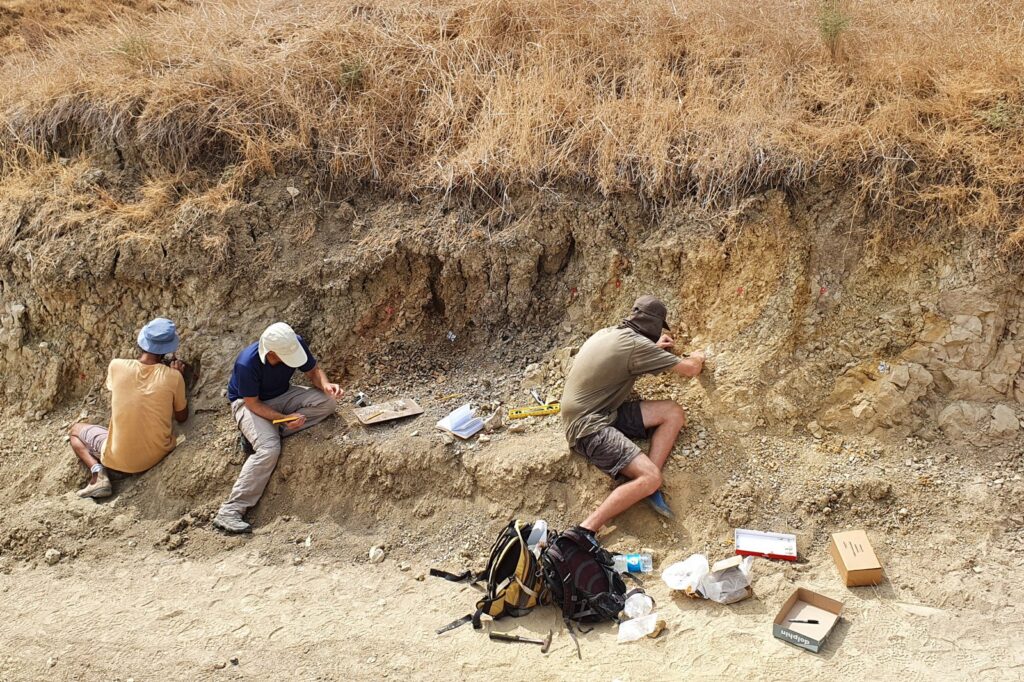
How do you put a date on a layer of mud that has been sitting beside an ancient lake for nearly two million years? That was the puzzle at ‘Ubeidiya, an archaeological site in the Jordan Valley, and a team of Israeli and American researchers now says it has an answer. The site is at least 1.9 million years old. That is hundreds of thousands of years earlier than most scientists had assumed, and it puts ‘Ubeidiya level with Dmanisi in Georgia among the oldest known places where early humans lived outside Africa.
A Site Without a Firm Date
‘Ubeidiya has been studied for decades, mainly for its stone tools. They belong to the Acheulean tradition, which is known for big implements worked on both faces, hand axes among them. The deposits also hold a rich haul of animal bones, from species once tied to Africa and to Asia, and several of them are extinct.
What nobody could do was say precisely when people had been there. Earlier estimates put the site somewhere between 1.2 and 1.6 million years old, but those figures came from comparing ‘Ubeidiya with other sites and other geology, not from measuring the deposits themselves.
The new work was led by Prof. Ari Matmon of the Hebrew University of Jerusalem, Prof. Omry Barzilai of the University of Haifa and Prof. Miriam Belmaker of the University of Tulsa. The team took fresh samples and tried three separate dating methods on them.
Three Clocks, One Answer
The first method is called cosmogenic isotope burial dating. Cosmic rays striking rock at the surface create rare isotopes. Once the rock is buried, shielded from those rays, the isotopes begin to decay at a known rate, so what is left tells you how long the rock has been underground.
The second clock is magnetic. Sediments that settled at the bottom of the ancient lake locked in the direction of Earth’s magnetic field at the time. Set against the known record of magnetic reversals, the pattern showed the deposits formed during the Matuyama Chron, a period that started more than two million years ago.
The third looked at fossil shells of Melanopsis, a freshwater snail found in the sediment. Uranium-lead dating of the shells gave a minimum age for the layers that hold the tools. All three methods pointed to an age well beyond the old estimates.
The Three-Million-Year Wrinkle
It was not entirely tidy. Some early isotope readings suggested rocks around three million years old, far older than the magnetic, fossil and archaeological evidence allowed. Intriguingly, the explanation turned out to be geological rather than a flaw in the method.
The sediments had been moved around more than once. Material was laid down, buried, exposed and carried off again within the Dead Sea rift, and some of it had been buried long before it reached the ‘Ubeidiya lake shore. In the paper’s words, the exposure-burial history implies “recycling of sediments previously deposited and buried in the rift valley… and then redeposited along the ‘Ubeidiya paleo lake shoreline.” Those grains carried an older history than the archaeological layers they ended up in. Once the researchers modelled that recycling, the readings agreed.
What It Means for the Migration Story
Dmanisi and ‘Ubeidiya now look about the same age, which suggests early humans were spreading into more than one region at around the same time. The toolkits differ, though. The evidence points to groups carrying different stone technologies out of Africa in overlapping periods: the simpler Oldowan tradition on one hand, the more carefully shaped Acheulean on the other. Rather than one technology following another in neat sequence, both may have travelled at once with separate groups.
The Homo genus is evidenced by H. habilis more than 2 million years ago, so a 1.9-million-year-old site outside Africa leaves little time between the first Homo and the first movement beyond the continent. The findings appear in Quaternary Science Reviews, in a 2026 paper by Matmon and colleagues on sediment recycling in the Dead Sea rift.
Sources
- Human evolution
- 1.9-million-year-old discovery rewrites the story of human evolution
- BHU-Aus univ pact for evolution research | Varanasi News – The Times of India
Photo: עומרי ברזילי – Omry Barzilai (CC BY-SA 4.0)