
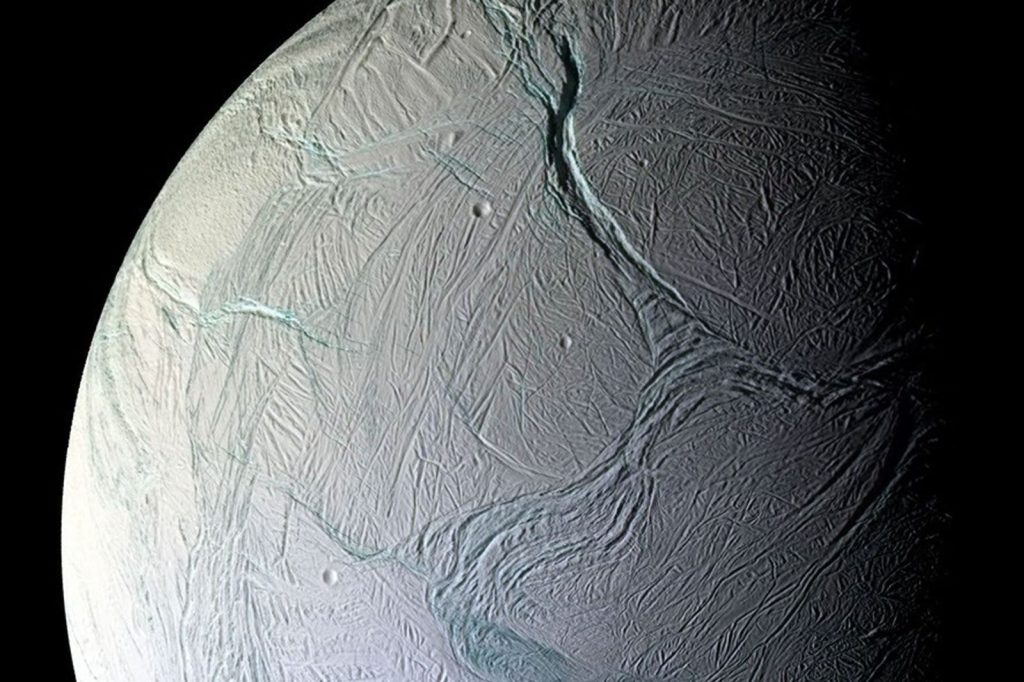
On October 1, 2025, researchers at the Free University of Berlin announced the discovery of additional organic substances in the water‑vapor plumes that erupt from Enceladus, an icy moon of Saturn. The finding was made by analyzing data collected by the Cosmic Dust Analyzer aboard the Cassini spacecraft, which ended its mission in 2017 by plunging into Saturn’s atmosphere. Although the instrument was originally designed to study dust particles in the Saturnian system, it also captured traces of chemicals carried by those particles, revealing a richer inventory of organics in the moon’s plume material.
The plumes, first observed by Cassini in 2005, shoot hundreds of kilometres into space through cracks in Enceladus’s global ice shell. They sample a subsurface ocean that has never seen sunlight—a dark, cold, salty sea kept liquid by tidal heating from Saturn’s gravity.
This ocean, estimated to lie beneath an ice crust on a moon only about 310 miles in diameter, has long been considered a prime candidate in the search for life beyond Earth. The Berlin team’s work did not merely confirm the presence of organics; it identified new compounds, thereby expanding the known chemical makeup of the hidden ocean.
While the detection does not prove that life exists, it shifts the discussion from a speculative “could there be life?” to a practical “where should we look?” The organics provide a concrete target for future missions: sampling the plumes allows direct access to the ocean’s chemistry without the need to drill through miles of ice. This makes Enceladus a high‑priority destination for spacecraft designed to seek biosignatures.
The Cosmic Dust Analyzer was one of twelve instruments on Cassini. Though not built for biological detection, its ability to measure dust‑borne chemicals meant it could indirectly reveal the composition of the water feeding the plumes. The newly detected organics were not named in the report, but their mere presence supplies a chemical map of the oceanic environment.
Scientists now know which molecules to prioritize when planning the next generation of probes. The Free University of Berlin, founded in 1948 and recognized for research across both the humanities and the sciences, has positioned itself at the forefront of this effort.
The agency’s findings arrive at a moment when the search for extraterrestrial life is moving from theoretical debate to operational planning. Space agencies are allocating budgets and designing missions; the data from Enceladus’s plumes serve as a decisive factor in that calculus. For comparison, NASA’s Europa Clipper, slated for launch later this decade, will investigate Jupiter’s moon Europa, which also harbors a subsurface ocean.
However, Europa lacks the active plume activity that makes Enceladus’s ocean readily accessible. The Berlin team’s identification of additional organics narrows the range of molecules that future instruments must detect, effectively sharpening the search strategy.
The core question remaining is whether the observed organics arise from biological processes or from abiotic geology. Answering that will require further analysis, possibly by a mission that flies through the plumes and conducts in‑situ measurements. Until then, the detection stands as a significant data point: Enceladus is not merely an interesting icy world; it is a prioritized target in the quest to determine if life exists beyond Earth.




