
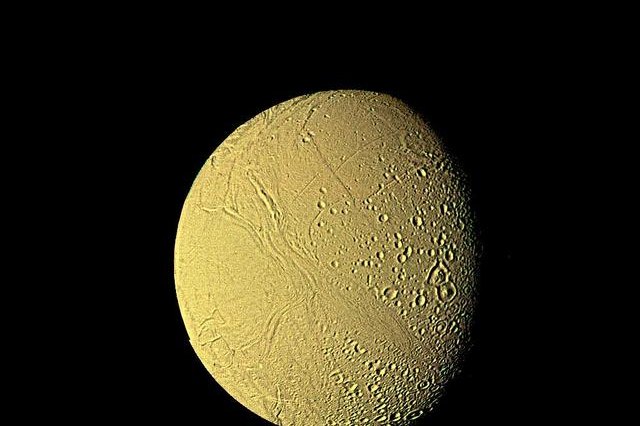
Astrobiologists have long maintained a checklist of chemical prerequisites for life as we know it. For Saturn’s moon Enceladus, water, organic compounds, and energy sources had all been confirmed. One critical item remained unverified: phosphorus in the form of phosphates.
That gap has now been closed. Phosphates serve as the structural backbone of DNA and RNA, and they form the molecular currency of energy within living cells.
Without this element, life cannot assemble its fundamental machinery. The newly announced detection of phosphates on Enceladus completes the set of known chemical ingredients required for life. Enceladus already possessed several promising characteristics.
It harbors a global subsurface ocean of liquid water. Hydrothermal vents operate on a rocky seafloor.
Geysers of water vapor erupt from the moon’s south pole. The Cassini spacecraft sampled that vapor before its mission concluded in 2017, previously detecting water, methane, carbon dioxide, and simple organics. Phosphorus, the rarest of the six essential elements for biology, had remained undetected until now.
The new evidence indicates that Enceladus’s ocean chemistry closely resembles Earth’s. On our planet, phosphorus enters oceans from rocks weathered by rain and transported by rivers.
On Enceladus, the element likely leaches from the rocky core into the overlying water, driven by tidal heating and chemical reactions at the seafloor. This discovery carries significance because phosphorus is not abundant in the universe; it is produced in supernovae and scattered thinly across space. Its concentration in an alien ocean at detectable levels from orbit suggests the geological and chemical systems on Enceladus are operating in a manner favorable to life. The implications extend beyond this single moon.
If Enceladus possesses all the ingredients, other icy ocean worlds—such as Jupiter’s Europa or larger bodies like Ganymede—may also contain the full chemical recipe. The search for life beyond Earth has been constrained by what scientists could prove.
Oceans could be inferred, energy could be inferred, but phosphorus availability could not. Now it can. Cassini no longer exists; it plunged into Saturn’s atmosphere in 2017, taking its instruments with it.
No spacecraft is currently en route to Enceladus. This leaves the scientific community with chemical evidence but no means to return for a closer examination.
Proposals for a dedicated Enceladus orbiter or lander have circulated for years without funding. This discovery may alter that calculation. The moon’s subsurface ocean sits beneath an ice shell in direct contact with rock.
That contact zone—the seafloor—is where chemical reactions that could support life are thought to occur. On Earth, similar environments teem with microbes.
The phosphate detection strengthens the case that Enceladus’s seafloor may be doing the same thing. There is no guarantee life exists there; having ingredients is not the same as having a finished product. However, the discovery eliminates the last major chemical objection to habitability.
Every essential building block is now confirmed present in a single, accessible environment. For scientists who have spent decades arguing that Enceladus deserved a dedicated mission, the news provides fresh ammunition.
The moon is no longer just a promising candidate. It is the only place beyond Earth where all six essential elements for life are known to exist simultaneously in a liquid water environment. That list currently has one member.




