
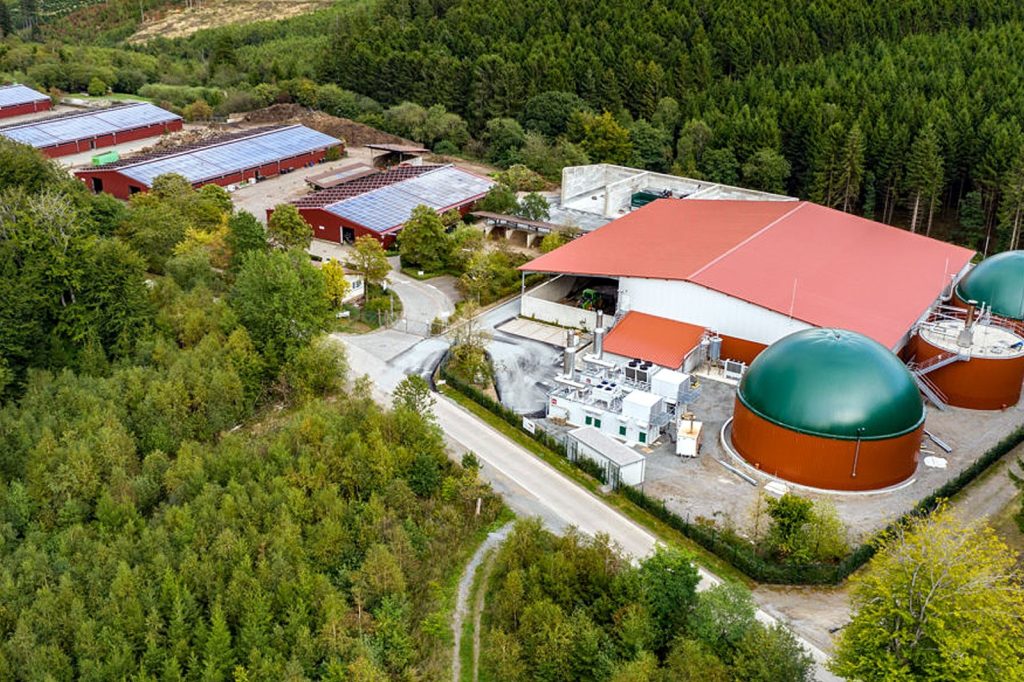
Data centers use 4.9% of the electricity consumed in the United States, and that share could double by 2030. At Lent Hill Dairy Farm in Steuben County, New York, one company thinks cow manure can help feed the demand.
The farm keeps some 4,000 cows. Two domed anaerobic co-digesters sit beside the barns, breaking down manure and local food waste into biogas, also called renewable natural gas, or RNG. Usually that gas goes to electricity, heating or vehicle fuel. Here, it also runs an on-site cryptocurrency mine.
Pennsylvania-based Ag-Grid Energy operates the site, which Sentient Media describes as the first of its kind in the country. The company says it processes the manure of 4,000 cows plus more than 45,000 gallons of food waste per day.
“At the end of the day, our model is providing value to the rural area that we are in,” founder and CEO Rashi Akki told Sentient. She wants to pair mid-sized dairies with small data centers, and to send AI computing capacity back to the same region over fiber optics. Tax credits, like those under the Inflation Reduction Act, would help, she said, if they covered electricity production for AI.
Big tech and the biogas lobby
Larger players are looking at the same fuel. In California, Microsoft has teamed up with Enchanted Rock to use RNG as backup power for data centers. Vanguard Renewables, a waste management company, has called RNG “the fuel of the AI age.” Vanguard says it is developing or operating more than 50 co-digesters and wants more than 100 finished by the end of 2028.
Patrick Serfass, executive director of the American Biogas Council, calls biogas an “excellent fit” for data centers because it is reliable. He estimates the U.S. has built only 10 to 15% of the biogas market’s capacity. “The data centers are going to be so hungry for power that they could eat up pretty much all of the supply that the biogas industry could create,” he said.
Critics see more factory farms
Sarah D’Onofrio, who works with communities near digesters, says RNG can be blended into existing natural gas systems, so companies can claim lower emissions without replacing fossil fuel infrastructure. She asked why anyone would fold it into the fuel system “during the period of climate change.” She fears data centers will open a large new market for manure energy and encourage more factory farms.
Researchers cite several problems. U.S. factory farms produce an estimated 941 billion pounds of manure a year. Digesters do not make it vanish, and USDA research found digested manure can be more polluting than the undigested kind. Brent Kim of the Johns Hopkins Center for a Liveable Future says subsidies create a “perverse incentive” for farmers to value waste over milk. World Resources Institute research puts the methane cut from manure storage at only about 25%.
A Friends of the Earth report found that dairies with digesters grew their herds by 3.7% a year, 24 times the rate of dairies without them.
Residents have pushed back. In Lind, Wisconsin, organizers fought a Vanguard co-digester that would have sent about 41,000 gallons of waste per day toward a tributary of Walla Walla Creek. The town denied the application in spring 2024. In Michigan, farmer Kathy Morrison lived beside a co-digester for years and said the smell sometimes woke her at night.
The money behind the industry is large. California’s Low-Carbon Fuel Standard funds nearly 200 digesters in 16 states, the Inflation Reduction Act put over $150 million toward biogas projects in 2023, and the Michigan Strategic Fund has approved more than $100 million in private bonds. In May, the USDA extended a 90-day moratorium on digester loans through the end of the year.
Sources
- Cow Manure Could Be the Next Data Center Fuel
- Manure-to-energy projects eye data centres as new market, raising environmental concerns




