
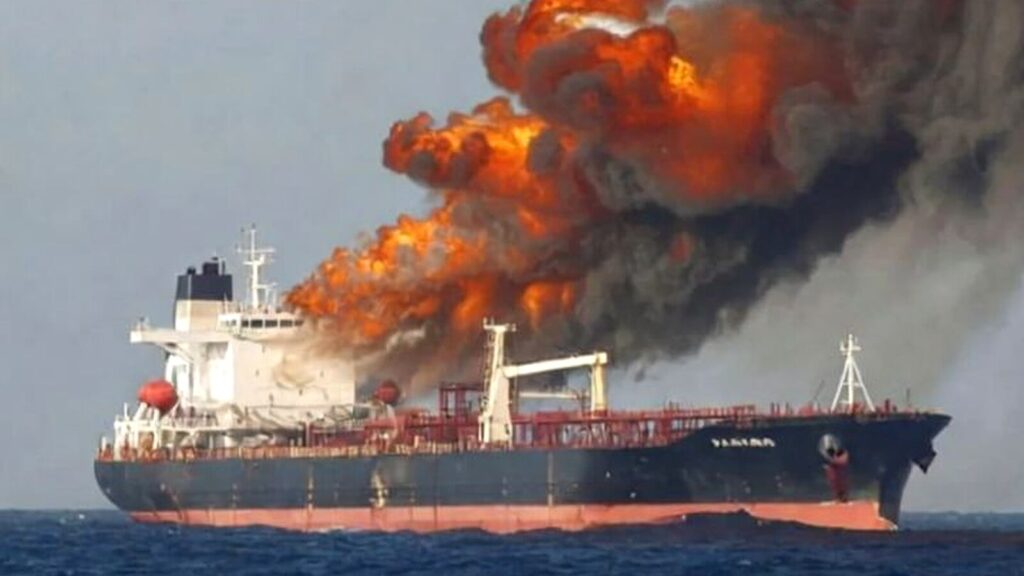
The scene is worth revisiting with clear eyes. On a Thursday in June 2019, explosions tore through two oil tankers in the Gulf of Oman, at the mouth of the Strait of Hormuz, forcing both crews to abandon ship and sending crude prices jumping within hours. The vessels were the Front Altair, flagged in the Marshall Islands, and the Kokuka Courageous, flying Panama’s flag; the cause of the blasts was never settled that day, though one operator suspected a torpedo strike on its ship.
What unfolded was a scramble with a human core. Iranian rescue teams, by the account of the state news agency IRNA, picked up 44 sailors in all, 21 off the Kokuka Courageous and another 23 off the Front Altair, and landed them at the nearby port of Jask. The U.S. Navy’s Fifth Fleet, based in Bahrain, also assisted after two distress calls. The Front Altair’s crew of 23 included 11 Russians, 11 Filipinos and a single Georgian, its Norwegian owner Frontline said — a reminder that for families across the region and beyond, tanker work is a wage, not a geopolitics. They were pulled out by the Hyundai Dubai, handed to an Iranian navy vessel and pointed toward Bandar Abbas.
What The Ships Suffered
The Kokuka Courageous, managed by BSM Ship Management of Singapore, took damage to the starboard side of its hull roughly 70 nautical miles — nearly 130km — off Fujairah in the UAE, and only 14 nautical miles, or 26km, from Iran’s coast. The management company said the ship remained in the area, was in no danger of sinking, and that its cargo of methanol was intact. One crew member was hurt and received treatment on a nearby vessel.
The Front Altair, chartered by Taiwan’s state refiner and loaded with 75,000 tonnes of naphtha, was “suspected of being hit by a torpedo” around noon Taiwan time, in the words of refiner executive Wu I-Fang, who told Reuters everyone aboard had been rescued. Frontline said the ship was ablaze but afloat, and flatly denied an IRNA report that it had sunk.
Why The Market Flinched
Brent crude climbed more than three percent on the day, to roughly $62 a barrel, coming just a month after four other tankers suffered damage in those same waters. The geography explains the nerves: a third of all oil moved by sea, some 20 percent of global oil trade, squeezes through Hormuz. Paolo d’Amico, who chairs the International Association of Independent Tanker Owners, warned that “supply to the entire Western world could be at risk”, adding: “I am extremely worried about the safety of our crews going through the Strait of Hormuz,” World Maritime University president Cleopatra Doumbia-Henry noted that any major Gulf shipping disruption would “have significant consequences on shipping markets because it affects oil tanker capacity as well as the cost of operation”. The ripples, she noted from Malmo in Sweden, reach into insurance, crews and the protective measures needed to keep ships moving.
Politics On Top Of Panic
Diplomacy was already in the room. The blasts coincided with Japanese Prime Minister Shinzo Abe’s visit to Tehran, where he met Supreme Leader Ayatollah Ali Khamenei in a bid to cool tensions. Iranian Foreign Minister Mohammad Javad Zarif called the incidents “suspicious”. Japan’s trade minister Hiroshige Seko confirmed a tanker carrying Japan-related goods was attacked, with no injuries, no Japanese crew and everyone safely off. France and Britain voiced alarm, with Paris urging de-escalation and free navigation.
The backdrop was a year of “maximum pressure”: President Donald Trump had quit the 2015 nuclear deal in May 2018, reimposed sanctions and vowed to cut Iran’s oil exports to zero; Washington had blacklisted the Revolutionary Guard as a “terrorist group”; and U.S. National Security Advisor John Bolton had already blamed Iran for the May 12 tanker sabotage — without evidence — while a UAE probe called those earlier attacks a “coordinated” state-actor operation that stopped short of naming anyone. Iran denied involvement.
For the 44 sailors who came ashore at Jask that day, the stakes were never abstract. Every ship through Hormuz carries someone’s son or daughter — and every flare-up on that water renews the same quiet fear for the families who wait.




