
The call came at 6 a.m. in June 2007. Elder Ken Elliott of Cowichan Tribes was on the line to biologist Tim Kulchyski, and he wanted him at the river fast.
Elliott had been restoring habitat around the sewage lagoons in Duncan, B.C., on Vancouver Island, in a wetland of nearly four hectares known as Fish Gut Alley. Heading downstream that morning, he heard a racket grow. “Crows, ravens, kingfishers,” he said. “Everyone was squawking and making a lot of noise.”
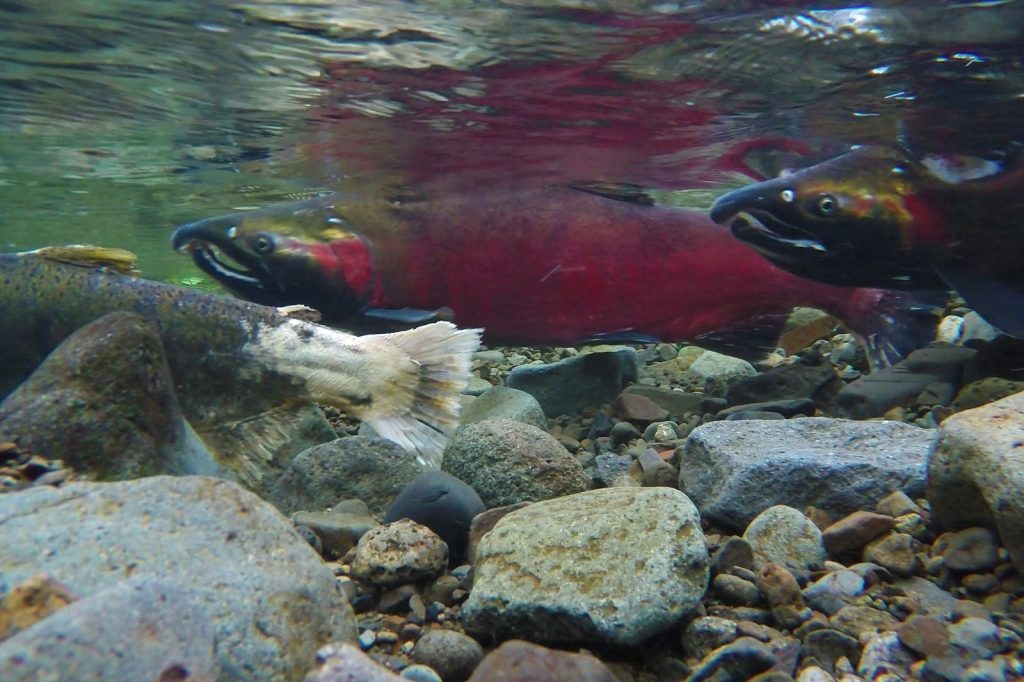
The scene he found was “a blow to the gut.” Thousands of juvenile coho salmon filled the river from bank to bank. They lay on their sides, swam in circles and gasped at the surface with their mouths wide open. Birds had come to feed on the dead and dying.
A search with no answer
Kulchyski had also phoned Willi Aquino, a fishery officer with the Department of Fisheries and Oceans. The three men walked the stream looking for a poison, and Elliott found no gasoline or anything like it. Aquino noticed the dead fish lay very close to a storm drain. “Something’s coming out of there,” he recalled thinking.
Heavy rain had fallen recently. Elliott suspected a local business had dumped something toxic into the drains, and that afternoon he drove around asking at dry cleaners, car washes and gas stations. Nobody knew anything.
The same mystery in Washington
Across the border, researchers in Washington state had spent years puzzling over a similar pattern. Coho were dying in urban streams near roads before they could spawn. Aquatic toxicologist Jenifer McIntyre of Washington State University, who studies Puget Sound streams, saw dead females still full of eggs. “The fact that they haven’t spawned is like … ‘Oh,’” she said.
Seven years of field studies showed the deaths came mostly in the most urbanized parts of Puget Sound, during or just after heavy rain. The fish swam in circles and gasped. About 40 per cent of the Puget Sound area was affected, and between 40 and 90 per cent of the salmon there died before spawning, within hours of exposure.
Her team tested pesticides, low oxygen and parasites and ruled each out. In 2016 they turned to car tires. Water run through a mulch of worn tire particles killed every coho tested in the lab. University of Washington professor Ed Kolodziej then joined with chemistry expertise. Of the hundreds to thousands of chemicals in their samples, he said, 57 were always present when the coho died.
The mystery compound matched no known tire ingredient. Chemist Zhenyu Tian then wondered if the culprit changed form after entering the environment. He found a 1983 industrial rubber paper describing 6PPD, a tire additive that turns into 6PPD-quinone when exposed to air and sunlight. The team bought 6PPD and tried it on salmon. They died the same way. Their paper appeared in Science at the end of 2020.
Why it matters
Anti-ozonants such as 6PPD came into wide use in the 1960s to keep tire rubber from cracking. Tires shed tiny amounts of it onto roads, and rain carries the particles into fish habitat, where the breakdown happens. One researcher put the lethal dose in vivid terms: a grain of rice in an Olympic-sized swimming pool.
A study from China detected 6PPD-Q in human urine and breast milk, though its effect on people is not yet clear. It has also turned up in air, dust and snow. “It is among the most toxic chemicals that we know of for aquatic life,” McIntyre said.
In February 2026, about 165 people attended the final Protecting Salmon From Tire Wear Toxicants workshop in Nanaimo. Vancouver Island University chemist Erik Krogh described a test, adapted from technology built for oilsands process water, that lets researchers process up to 100 samples a day and get results within minutes. Hundreds of volunteers have collected samples across the island over three years, giving his lab what he believes is the largest 6PPD-Q dataset in the world.




