
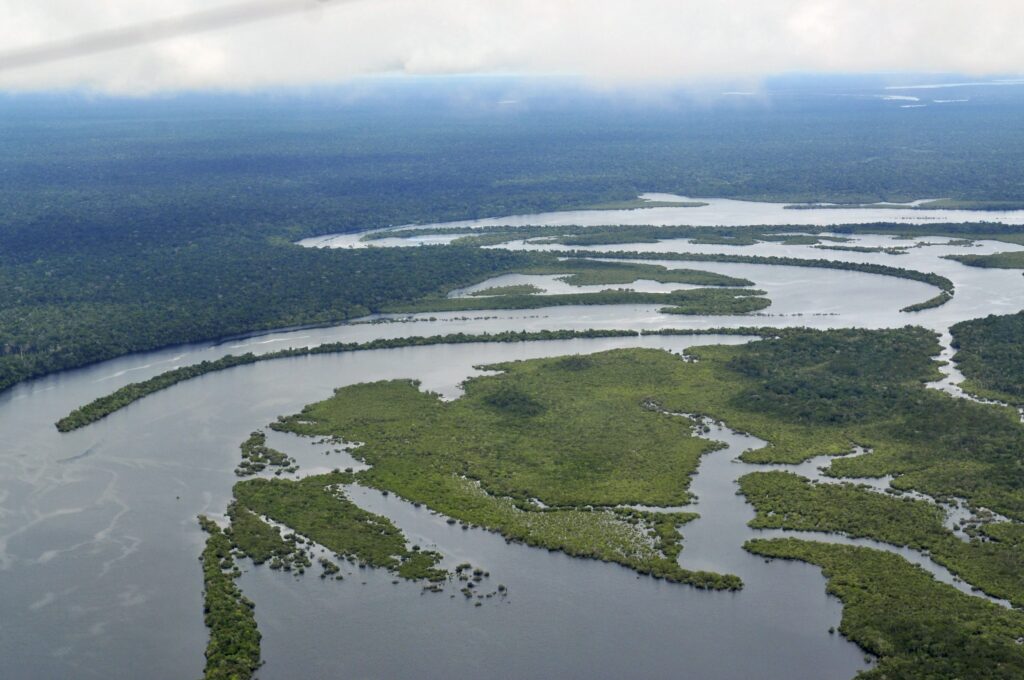
Nobody agrees on how many people lived in the Amazon before 1492. Published estimates for the whole basin run from 0.5 million to 20 million, a gap wide enough to hold two entirely different histories.
The older picture is of a vast forest left almost untouched, home to small, scattered tribes. Ecologists leaned on it for decades. Many read patterns of biodiversity as if the forests were “pristine” or “virgin.”
Mounds, causeways and canals
That view has been under pressure for years. Archaeologists have found earth mounds, causeways and canals across the Amazon lowlands, and they point to human activity far beyond local slash-and-burn farming. People have lived in Amazonia for at least 12,000 years.
The Llanos de Mojos in Bolivia is one of the places where the evidence is clearest. The region holds large habitation mounds, raised agricultural fields, causeways, canals and fish traps built across the landscape. Each mound is thought to mark a single settlement, raised by people who dug up and hauled the earth themselves.
What grew there? Work led by Francis Mayle of the University of Edinburgh, Heiko Prümers of the German Archaeological Institute and others has produced the first broad archaeobotanical record of the plants eaten and processed by pre-Hispanic people in lowland Bolivia. It includes maize, manioc, yam, squash, peanut, cotton and palm fruits.
Two camps
At one end are researchers who say the data still fit a mostly virgin rainforest. At the other are those who call the idea of a virgin forest a myth and describe an intensively managed “cultural parkland.” The Science paper “Amazonia 1492: Pristine forest or cultural parkland?” by Michael Heckenberger and colleagues, published in 2003, put that second phrase in front of a wide audience.
Population figures for the mound region alone are just as shaky. The few peer-reviewed estimates range from 0.15 to 2.0 persons per square kilometer. Umberto Lombardo of the University of Bern and Mayle are among those supervising a doctoral project at Reading that builds a computer model of individual households, each claiming land and turning it into cropland or agroforestry, to narrow that range.
The project is still under construction. Its authors want to compare the model’s output with estimates from architectural energetics and carrying capacity.
Sources
- Archaeology: Amazonia | cohesys-lab
- Raised Fields, Monumental Mounds, Ring Ditches and Causeways of the Bolivian Amazon




