
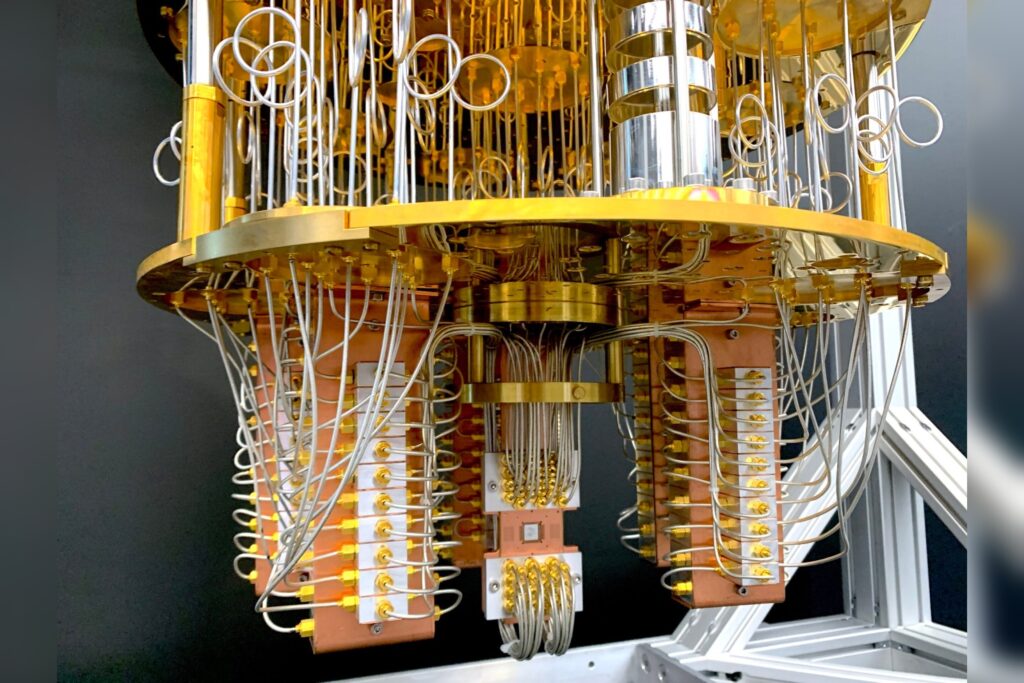
NEW YORK, July 6 — The qubit is the basic unit of quantum information, and it works nothing like the bits in your laptop. That is the whole point. Think of a classical bit as a light switch: it is either on or off, one or zero.
A qubit, by contrast, can be both at the same time. Physicists call this superposition.
It means a qubit exists in a blend of 0 and 1 simultaneously — until someone measures it, at which point it picks a side. That alone would be strange enough. But qubits have another trick: entanglement.
When two qubits become entangled, the state of one instantly influences the other, no matter how far apart they are. It is as if two coins flipped on opposite sides of the world always landed the same way, every time.
Researchers manipulate qubits using quantum gates. The Hadamard gate creates superposition. The CNOT gate entangles qubits together.
These operations are the building blocks of quantum algorithms — step-by-step procedures that exploit superposition and entanglement to solve problems that would take classical computers years or centuries. Two famous examples are Shor’s algorithm, which factors large numbers, and Grover’s algorithm, which searches unsorted databases. Both are far faster than anything possible with classical bits.
So what does this mean in plain terms? A classical computer trying to factor a very large number has to check possibilities one after another.
A quantum computer running Shor’s algorithm can check many possibilities at once, thanks to superposition, and use entanglement to coordinate the answer. The practical upshot: tasks that are effectively impossible today could become routine. Building a working qubit is not easy.
Different companies are pursuing different physical implementations. IBM and Google use superconducting circuits.
IonQ traps individual ions. Microsoft is working on topological qubits, a more exotic approach. Each method has trade-offs.
The biggest challenge is maintaining coherence — keeping qubits in their fragile quantum state long enough to perform calculations. Errors creep in easily. The environment, heat, stray electromagnetic fields — all can destroy superposition or break entanglement.
Minimizing those errors is the central engineering problem. No one has yet built a quantum computer that convincingly outperforms a classical machine on a useful task.
But the pace of progress is fast. Companies are scaling up the number of qubits, improving error rates, and designing algorithms that could one day crack encryption, model molecules for drug discovery, or optimize supply chains. For now, qubits remain a technology in the lab, not in the data center.
But the science is solid, the investment is enormous, and the potential is hard to overstate. Watch this space.
{“@context”: “https://schema.org”, “@type”: “NewsArticle”, “headline”: “Quantum Mechanics Powers Computing via Qubits and Entanglement”, “description”: “NEW YORK, July 6 — The qubit is the basic unit of quantum information, and it works nothing like the bits in your laptop. That…”, “datePublished”: “2026-07-06T09:30:00+00:00”, “author”: {“@type”: “Person”, “name”: “Erika Johnson”}, “publisher”: {“@type”: “Organization”, “name”: “InfoPulse Today”, “url”: “https://newsfeed.2bme.xyz/”}}




