
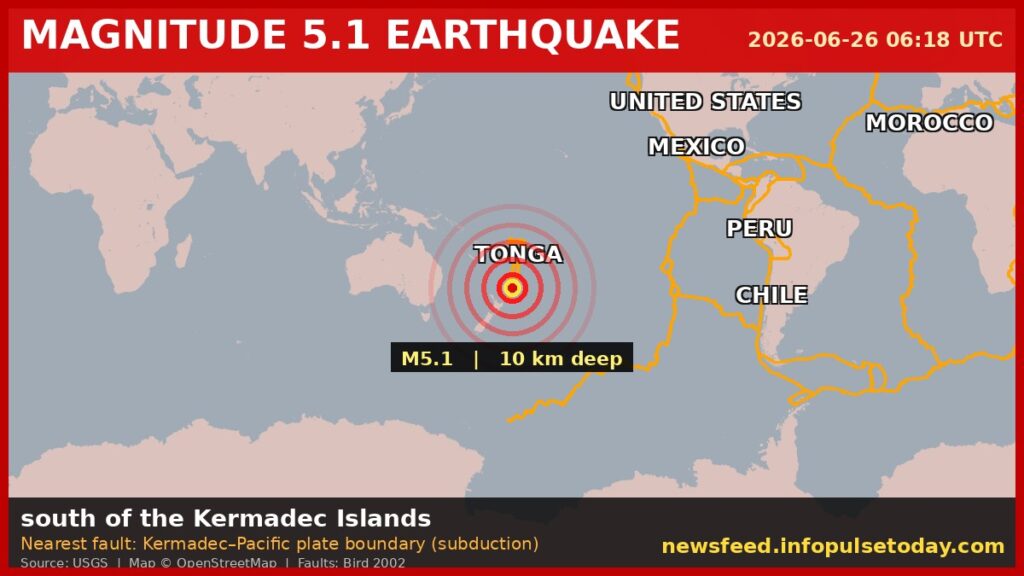
For the people who live and work in the Kermadec Islands region, a moderate earthquake is not a rare event. The U.S. Geological Survey recorded a magnitude 5.0 quake south of the islands on July 17, 2026, at 13:16 UTC. It struck at a depth of 10 kilometers.
That is shallow. And shallow means the shaking at the surface is stronger.
No tsunami warning was issued. That is the first thing residents likely checked. In a seismically active area, that fact matters more than the magnitude number.
The USGS data shows at least 500 earthquakes of magnitude 5.0 or greater have hit within about 300 kilometers of this spot in the last two decades. The biggest one was a magnitude 7.4 in 2020.
So a 5.0 is not the worst they have seen. But it is the one that happened today. Earthquakes in the magnitude 5 range are classified as moderate.
They can cause minor to moderate damage near the epicenter. The depth of this event — 10 kilometers — puts it in a category where shaking intensity can be amplified. A deeper quake of the same size would feel less violent.
This one did not have the luxury of depth to dampen its force. The energy traveled a short distance through the crust.
It arrived at the surface with less attenuation. For anyone in the immediate area, the ground moved. The USGS detected the event through its real-time global seismic monitoring network.
That network gives scientists the precise time, location, depth, and magnitude. But for people on the ground, the data is secondary.
What matters is whether things fell off shelves. Whether cracks appeared in walls. Whether the shaking stopped quickly or kept going.
Seismologists note that aftershocks are common following an earthquake of this size. The record shows they may continue for days or weeks. That means residents are advised to be prepared for further shaking.
Not panic. But aware.
A 4.0 aftershock can rattle nerves even if it does not cause damage. A 3.0 can be felt. The pattern is familiar to anyone who has lived through a moderate quake in a seismically active zone.
The Kermadec Islands region sits on an active plate boundary. That is why the USGS has recorded so many events there.
The 500 quakes of magnitude 5.0 or greater in two decades is a high number. It means the crust is constantly adjusting. Stress builds.
Stress releases. This quake was one of those releases. It was not the biggest.
It was not the smallest. It was the one that happened on July 17.
For the people affected, the immediate question is damage. The USGS report does not include any. No reports of injuries.
No reports of structural failure. But the absence of reports does not mean absence of impact.
A shallow 5.0 can knock items off walls. It can crack plaster. It can shift furniture.
In a remote island setting, even minor damage can be a hassle. Supplies are not always easy to get. Repairs take time.
The earthquake struck at a time when no immediate reports of damage or injury were available. That is typical.
In a sparsely populated region, it takes time to assess. Communication can be slow. Roads may be blocked by rockfalls.
The shaking itself may have been brief — a few seconds of rolling or jolting. But the aftermath is measured in hours and days, not seconds.
Residents in seismically active areas know the drill. They know a 5.0 is not a tsunami event. They know aftershocks will come.
They know the USGS will track them. They know the ground will settle. But knowing does not make the shaking any less real.
It does not make the adrenaline spike any less sharp. It does not stop the instinct to check on neighbors.
For now, the record stands. A magnitude 5.0 earthquake. Shallow depth.
No tsunami. No reported damage.
But the people in that region will feel the effects longer than the data shows. They always do.




