
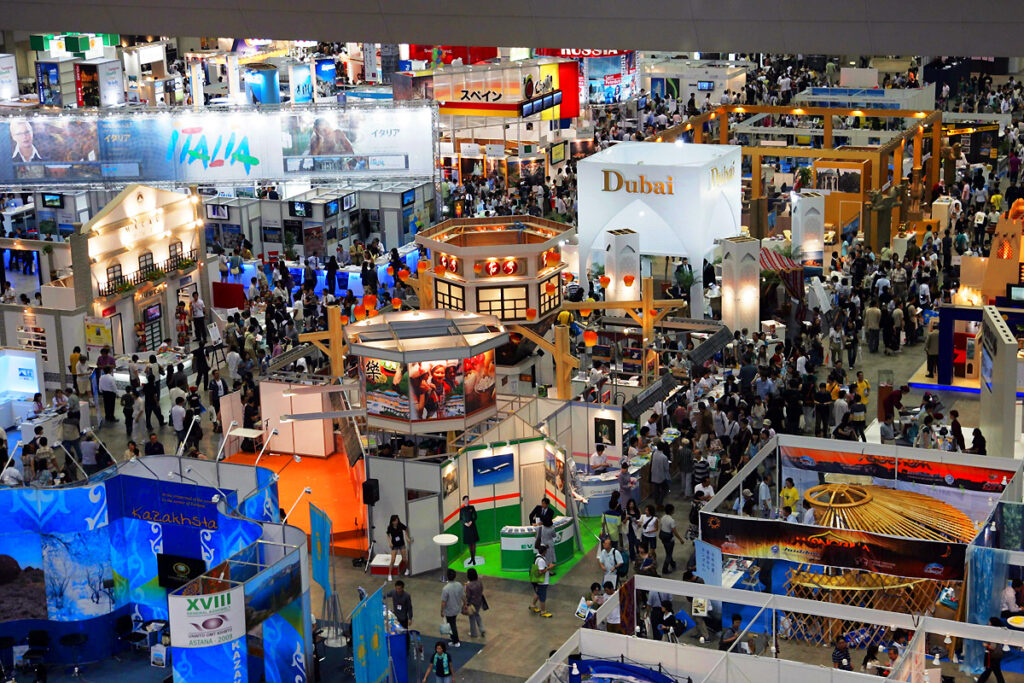
MOSCOW, September 25 — Two Russian trade exhibitions staged simultaneously this month sketched out a food-trade map that no longer runs through Europe. WorldFood Moscow ran from 15–18 September at Crocus Expo with 873 manufacturers and suppliers from 30 countries, 14 national pavilions and more than 400 new participants. The IX International Fishery Forum & Seafood Expo Russia, held in St. Petersburg from 16–18 September, expected more than 20,000 specialists from 81 countries and around 350 enterprises, including more than 70 foreign companies, with official delegations from 19 states.
The mechanics here matter more than the headline numbers. Moscow handled food imports, retail, wholesale, food manufacturing and HoReCa.
St. Petersburg handled fishing, aquaculture, seafood processing, logistics, shipbuilding, technology and export development. One platform sells into Russia; the other builds the capacity to sell out of it. The Russian analytical publication ‘Russia’s Pivot To Asia’, which compiled the report, called the pairing complementary commercial platforms and identified the central theme running through both: the gradual construction of a wider Russian food-trade network linking China, India, Vietnam, Central Asia, Iran, the Gulf, Africa and Latin America.
Not just commodities
On closer reading, the shift is structural rather than a simple redirection of cargo. The report describes a process that increasingly involves retail procurement, processing, aquaculture, technology, packaging, certification, cold-chain logistics, vessel construction, investment and joint ventures. That is a longer supply chain than a commodity export book, and it is harder to sanction at any single point.
WorldFood Moscow’s 16 product sections covered groceries, confectionery, bakery products, organic and healthy foods, fruit and vegetables, beverages, ingredients, frozen foods, oils and sauces, halal products, dairy, seafood, meat and poultry. Major Russian buyers included X5 Group, Magnit, Lenta, Auchan, Azbuka Vkusa, Ozon, METRO and Yandex Lavka, with more than 200 category buyers involved in structured procurement negotiations.
The Retail Chain Procurement Centre, Foreign Economic Activity sessions and Contract Expo were built to connect international suppliers directly with Russian retail and distribution channels. The previous year’s purchasing mechanism produced more than 3,500 negotiations and 2,834 contracts worth ₽91.5 billion (about US$1.0 billion), according to Russia’s Pivot To Asia. India was the 2026 partner country.
China, Vietnam, Indonesia, Kyrgyzstan, Uzbekistan, the UAE, Oman, Egypt, Türkiye, South Korea, Thailand, Brazil and Tunisia established national pavilions. Vietnam brought 30 enterprises to a 400-square-meter pavilion promoting rice, coffee, pepper, cashews, confectionery and processed foods.
Vietnam-Russia bilateral trade reached US$4.77 billion in 2025 and US$3.24 billion during January–July 2026, with both governments targeting US$15 billion. Brazil participated through its first national pavilion supported by ApexBrasil, with 19 companies; Kyrgyzstan and Uzbekistan brought approximately 14 and eight companies respectively.
The seafood leg
St. Petersburg extended the network into the industrial sphere. Its official program emphasized deep processing, aquaculture, international logistics, resource development and stronger export positions, alongside cooperation involving China, India, Iran, Kyrgyzstan, Thailand, Türkiye and South Korea. Seven African countries — Sierra Leone, Guinea, Guinea-Bissau, Morocco, Mauritania, Mozambique and Côte d’Ivoire — were included among the official international delegations.
Russia’s own production base is substantial. The country harvested approximately 4.64–4.7 million tonnes of aquatic biological resources in 2025, with 2026 production projected around 4.8 million tonnes.
Aquaculture contributed roughly 390,000–393,000 tonnes in 2025. Seafood exports were approximately 2.0–2.1 million tonnes worth US$6.0–6.1 billion in 2025, and export revenue increased during the first half of 2026. China remained the dominant destination, receiving approximately 1.2 million tonnes worth US$3.4 billion of Russian seafood in 2025.
Japan took about 118,000 tonnes worth US$952 million, with South Korea another major Asian destination. The catch is that China is increasingly significant not only as a buyer but as a potential technology and investment partner.
Russian fisheries companies hold wild-catch resources, particularly pollock, cod, salmon and crab; Chinese companies have capabilities in processing, aquaculture equipment, feed, logistics and consumer-market distribution. Cooperation can therefore move from raw seafood shipments toward fillets, surimi, processed seafood, aquaculture systems, feed, processing machinery and cold-chain infrastructure.
The wider BRICS and Global South dimension is also becoming more important. Russian seafood exports to BRICS markets have reportedly tripled in physical volume and increased 2.7 times in value over five years, reaching more than US$3 billion in 2025. Exports to Brazil increased approximately sixfold from 2021




