
Look up at dusk and you may see a string of lights marching across the sky in tidy formation. Those are Starlink satellites, and by the summer of 2022 Elon Musk’s SpaceX had put some 3,000 of them into orbit, with 10,000 or even 12,000 eventually possible by one analyst’s count. The aim is simple to state and enormous to execute: high-speed internet delivered from space to the places cables cannot reach.
Starlink works through sheer numbers. Its satellites fly in low-level orbit, keeping the connection between dish and spacecraft fast, but low orbits cover small patches of ground, so full coverage of the globe takes thousands of machines. “There are people in the UK in that category, but more across the world, in places like Africa”, says Dr Lucinda King, who manages space projects at the University of Portsmouth. Chris Hall, editorial director of Pocket Lint, makes the economic case: “Using satellites solves the problem of getting internet connections to remote locations in deserts and mountains”. No cables, no masts, just a dish on the ground.
The market has a ceiling, though. Starlink charged $99 a month, with the dish and router at $549, at a time when 96% of UK households, and 90% of those in the EU and the US, already had high-speed access. “Most of the developed world is already well connected”, says Professor Sa’id Mosteshar of the Institute of Space Policy and Law at London University, leaving the company to chase a thin slice of the market for revenue. By 2022 it claimed 400,000 subscribers across 36 countries, mostly in North America, Europe and Australasia, with expansion planned across Africa and South America, then into Asia. Hall tempered the promise: “Starlink’s prices may be too high for many households in Africa, say”, though schools and hospitals in remote areas could still benefit.
The Ukraine test
War gave the network its hardest proving ground. After Russia invaded Ukraine and shut down Ukrainian internet services, Musk opened Starlink to the country immediately, and roughly 15,000 dish-and-router kits were shipped in. In Hall’s view, the network has kept public services and government functioning there. “The Russians haven’t found a way of disabling it.” Dr Marina Miron, a defence studies researcher at King’s College London, notes the battlefield use: “Its signals cannot be jammed like ordinary radio signals can be, and it takes only 15 minutes to set up the kit.”
Crowded skies
Then there is the sky itself. Amazon plans thousands of Kuiper satellites in the same low-Earth orbit, and OneWeb is already there. Mosteshar warns of collision chains: satellites hitting other vessels and spawning fragments that “could cause a lot more damage when flying at high speeds”. There had already been near misses involving Starlink craft, including with China’s space station. “If there are too many fragments, it could make low-Earth orbit unusable in the future”, Dr King says, potentially trapping humanity below its own junk.
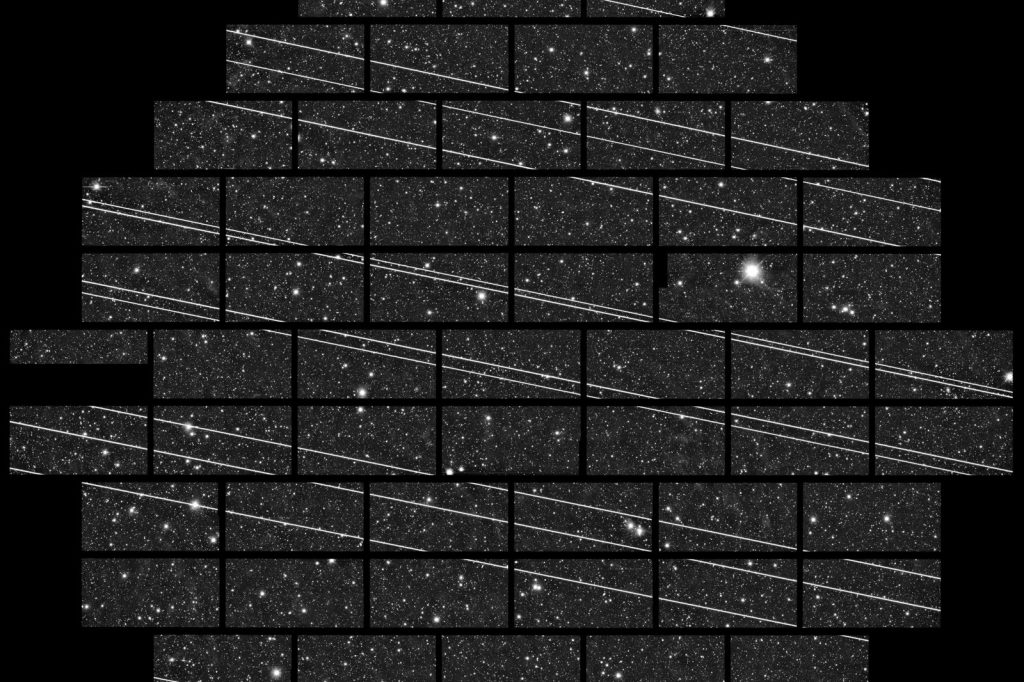
Astronomers feel the constellation too. At sunrise and sunset the sun glints off the satellites’ wings, leaving streaks across telescope images that obscure stars and planets. Starlink says it is working on darkening its fleet. Until then, every launch trades a little more night sky for a little more bandwidth.




