
The record of the Kuiper Belt opens with a timestamp. By 9:14 p.m. on August 30, 1992, David Jewitt and Jane Luu had two exposures of the same sliver of the constellation Pisces on their computer monitor, and when they ran the frames one after the other, a point of light had slid slightly west. Cosmic rays fake such specks all the time, so the verdict waited on repetition: a third image at 11 p.m. put the object farther west, a fourth taken just after midnight moved it again. What the two had found, working a Hawaiian mountaintop with a University of Hawaii telescope, was the first confirmed resident of the Kuiper Belt, the ring of frozen leftovers from the solar system’s construction.
The search was five years old by then. Jewitt and Luu, both at MIT when the quest began in the late 1980s, had spent years imaging patches of sky with no target in mind, first from Arizona. “We were literally just staring off into space looking for something,” Jewitt has said. The logic was a plain imbalance: the inner system teems with rocky worlds, asteroids and comets, while beyond the giant planets there seemed to be nothing but small, icy Pluto. Luu allowed that there might be more out there and that checking seemed worthwhile; years passed with nothing, and success was never promised.
Their method was patience: expose a patch of sky, wait an hour, expose it again, and hunt for anything that crept between frames at the rate great distance demands. A genuine object, Luu explained, would move at a predictable rate from frame to frame. The 1992 speck obeyed. Judged by its brightness and its pace, a crawl that would carry it across the face of the full moon in nearly a month, it measured roughly 250 kilometers, about a tenth of Pluto’s width, orbiting at 44 AU, farther from the Sun than Pluto itself. It was catalogued as 1992 QB1; the discoverers had hoped to call it Smiley. “We were just blown away.” Jewitt remembered the moment, and with reason: the volume of the solar system worth searching had just grown enormously.
A second object turned up within months, and the tally hit 40 or 50 within a few years as digital detectors grew bigger and more sensitive. Mike Brown, the Caltech astronomer, reads the inventory as a catalogue of worlds with stories attached. The discovery also explained an old embarrassment. Pluto had always been the odd one out, a runt smaller than Earth’s moon on a tilted path that sweeps far above and below the plane the other planets keep. “We suddenly understood why Pluto was such a weird planet,” Jewitt said. “It’s just one object, maybe the biggest, in a set of bodies that we just stumbled across.” The two predicted Pluto would not stay in the planet club; by 2006, it was out.
The name on the belt
The belt takes its name from Gerard Kuiper, and here the file is genuinely contradictory. A NASA science page dated September 13, 2001, credits the Dutch-American astronomer straightforwardly: in 1951 he proposed a belt of icy worlds past Neptune, and he proposed it to solve a comet problem. Short-period comets swing past the Sun often enough to evaporate within a few hundred thousand years, far too fast to have survived from the solar system’s birth, yet astronomers were tracking dozens. Kuiper’s fix was a reservoir of dark, comet-like bodies beyond Neptune that never stuck together and that now and then fall inward. The 2022 retelling in Science News, built on later scholarship, records the twist: Kuiper actually expected that region to be empty, its population cleared by gravity to more distant reaches. By that account he anti-predicted the belt that carries his name. Either way, no member of it was confirmed until the 1992 speck.
What the census showed
The 2001 page preserves the state of play at the turn of the millennium. The International Astronomical Union had catalogued 432 Kuiper Belt Objects, and Jewitt’s surveys put the true population at about 70,000 bodies larger than 100 km across, spread between 30 and 50 AU from the Sun. Roll them together, he estimated, and you get a body about one-tenth the mass of Earth, in a belt roughly 300 times as massive as the asteroid belt circling between Mars and Jupiter. The objects are dark for a chemical reason: cosmic-ray bombardment breaks molecules in the surface ice and rebuilds them as carbon-rich compounds, a ruddy organic goop that camouflages whatever lies beneath. Most reflect about as much sunlight as a lump of charcoal, on the order of 4 to 7%. Pluto itself returns 60% of the light that hits it, an artifact of size: the dwarf planet is massive enough to hold a thin atmosphere that lays bright frost back down on the surface.
The size distribution, a power law with an index of -4, implied a handful of Pluto-scale bodies, perhaps 5 or 10, with just one known. Candidates were already arriving. Varuna, found by Jewitt and colleagues the year before at 43 AU, measured 900 km across, nearly the girth of the asteroid Ceres at 933 km. Then came 2001 KX76, a Deep Ecliptic Survey find at 39 AU, briefly and wrongly saluted in press accounts as the largest asteroid ever; it was icy, and at perhaps 1200 or more km across it was no asteroid at all. The hardware was compounding, too: a camera with 24 times the area of the 1992 instrument pulled in two dozen objects for the price of one, and the next Pluto, Jewitt said, could appear at any time.
Two decades on, the Science News anniversary piece fixed the belt’s extent at roughly 30 astronomical units out to roughly 55, a puffed-up disk in Jewitt’s description: “Superficially, it looks like a fat doughnut.” The 2001 page had used 30 to 50; the gap between the two figures is twenty-one years of better surveys. The contents are construction debris, leftovers that never quite finished becoming planets, in the phrasing of astronomer Meredith MacGregor at the University of Colorado Boulder. When Neptune’s gravity kicks one of those leftovers inward and it approaches the Sun, it becomes what we call a comet; the ones on orbits of 200 years or longer more typically trace to the Oort cloud, farther out still. The belt is also a yardstick for reading other systems, since astronomers have found debris disks around distant stars that MacGregor considers directly comparable to our own.
The close-ups
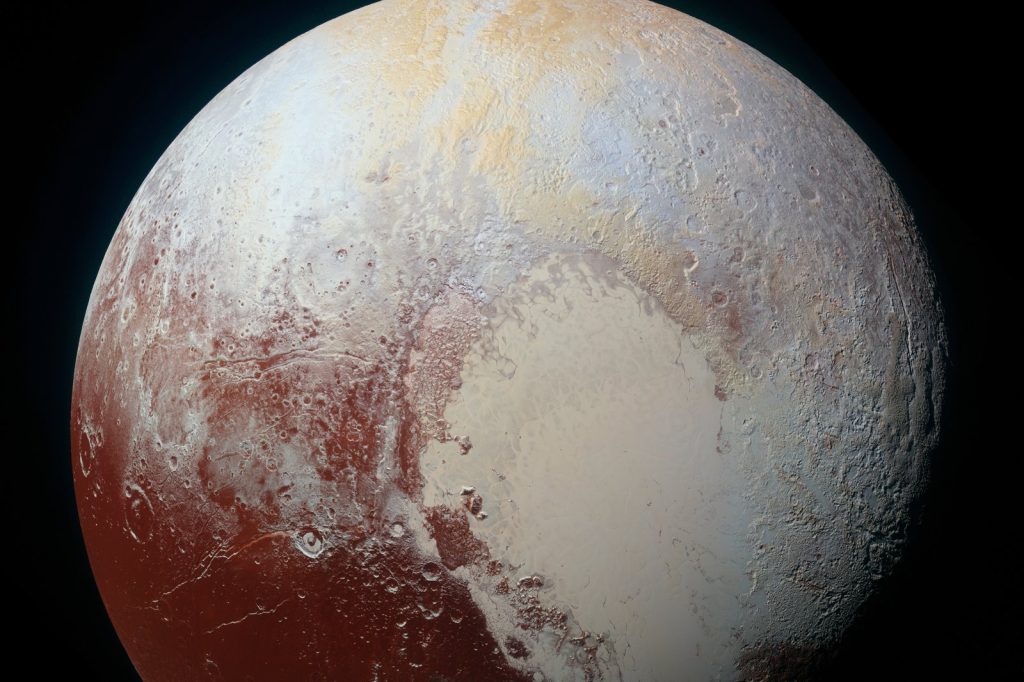
The belt has since been visited. In 2015 NASA’s New Horizons flew by Pluto, the first close look at any Kuiper Belt object, and the images that followed ran thousands of times sharper than any prior observation, turning a few fuzzy pixels into a world of ice volcanoes and deep canyons. Marc Buie, a mission-team astronomer at the Southwest Research Institute, could not have asked for more from the encounter.
New Horizons was not finished. On New Year’s Day 2019, some 1.5 billion kilometers past Pluto’s orbit, it flew by a second Kuiper Belt object, Arrokoth, whose name means sky in the Powhatan and Algonquian language. Roughly 35 kilometers end to end, it resembles two pancakes lightly fused together, and it was very likely two separate bodies that collided gently enough to stick. That structure told against the old collision-built model of how planets grow: past a certain size, bodies accelerate as they approach one another, and in the words of astronomer JJ Kavelaars, big ones “hit each other too fast, and they don’t stick together”. The favored explanation became gravitational instability, a denser clump pulling in the dust and gas around it and forming planets over thousands of years rather than millions. Buie, who discovered Arrokoth in 2014, closes the file: “Already Arrokoth has rewritten the textbooks on how solar system formation works.”
Sources
- The discovery of the Kuiper Belt revamped our view of the solar system
- What Lurks in the Outer Solar System?




