
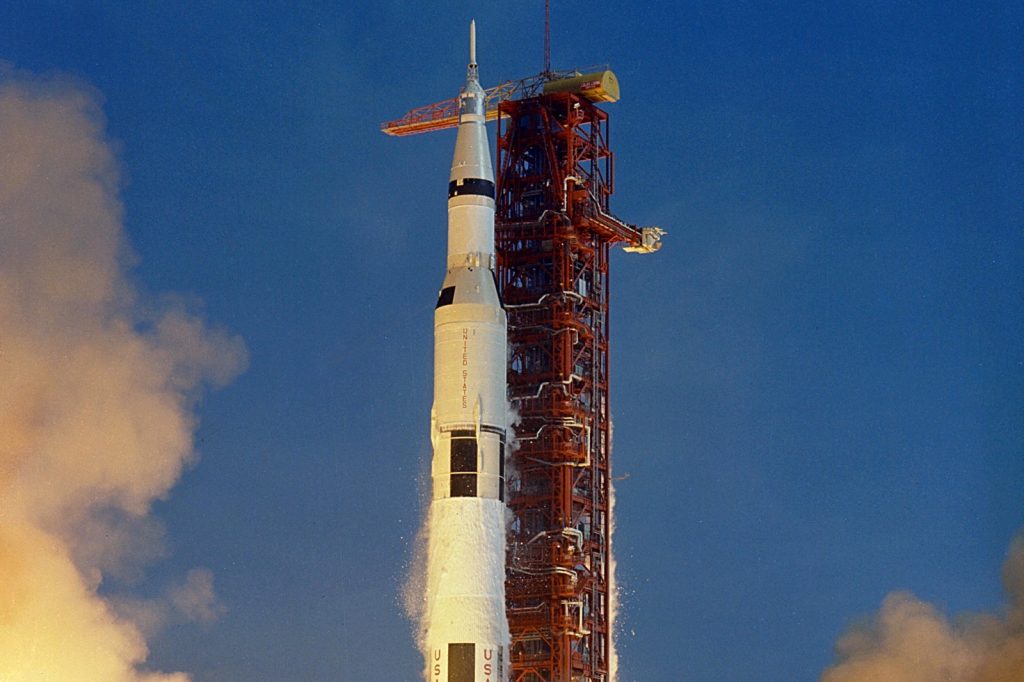
Five F-1 engines generated 7.5 million pounds of thrust when the Saturn V lifted off. The three-stage rocket stood 363 feet tall and had a liftoff weight of more than 6 million pounds. NASA compared its output to the power of 85 Hoover Dams. NASA still calls it the most powerful space launch vehicle the United States has ever developed. That hardware put six Apollo crews on the surface of the Moon.
NASA announced the new rocket on January 10, 1962, after the United States set a crewed lunar landing goal in 1961. Fifteen days later the agency assigned the work to Marshall Space Flight Center in Huntsville, Alabama. Marshall was already central to the space race; the Saturn V work capped a run that had earned Huntsville the nickname Rocket City.
A Three-Stage Machine
The first stage, called S-IC, was 138 feet long and 33 feet in diameter. Boeing built first stages for ground tests and flight at Michoud Assembly Facility in New Orleans and in Huntsville. The second stage, S-II, came mostly from North American Aviation at Seal Beach, California. It was 33 feet in diameter and 81 1/2 feet long, with five J-2 engines that produced a combined 1 million pounds of thrust.
Douglas Aircraft Company built the third stage, S-IVB, at Huntington Beach, California. That stage was 58 feet long, 21.7 feet in diameter, and carried a single J-2 engine. Across the country, up to 20,000 contractor companies worked on the rockets.
Shaken Before Launch
Before any crew could fly, NASA pushed a full-size vehicle through dynamic tests at Marshall. Engineers called the test vehicle SA-500D. Its first stage, S-IC-D, left New Orleans on the NASA barge Poseidon and was lifted into the Dynamic Test Stand on January 13, 1966. The second stage, S-II-F/D, arrived at Marshall on November 10, 1966. The third stage, S-IVB-D, had reached the center on January 4, 1965.
In early spring 1967, the 363-foot rocket endured more than 450 hours of shaking. Data came from some 800 measuring points. The stack moved as much as 6 inches at the top and up to 3 inches at the bottom. “Fog and clouds hovered around the top of the 360-foot tall test stand most of the day while the 300,000 pound stage was being lifted,” one observer reported.
Six Moon Landings and a Final Launch
On May 14, 1973, the last Saturn V lifted Skylab into orbit. Before that flight, 12 other Saturn V launch vehicles had carried Apollo spacecraft into space. Six of those missions took crews to the Moon. The Apollo 11 mission in July 1969 was the crowning flight.
Leftover Hardware on Display
Three complete Saturn V rockets remain on public display today. At Johnson Space Center in Texas, the rocket mixes stages from cancelled and unused missions. Its first stage, S-IC-14, was built for Apollo 18, which never flew. The second stage, S-II-15, came from the Skylab backup vehicle. The third stage was part of SA-513, the Skylab launcher.
Kennedy Space Center in Florida displays the S-IC-T all-systems test stage, built at Marshall in 1963 and static fired in 1965. Its second stage appears to be from SA-514, the Apollo 18 vehicle, though limited documentation leaves that uncertain. The third stage, S-IV-B-500F, started as a Saturn IB stage before serving as a Skylab test article. It moved to Kennedy for display in June 1974.
The Saturn V at the United States Space and Rocket Center in Huntsville is the Dynamic Test Vehicle, the rocket that shook through those early tests. The National Park Service designated it a National Historic Landmark in 1987 and called it a “unique engineering masterpiece that formed the key link in the chain that enabled Americans to travel to the moon.”
Other pieces remain at Michoud Assembly Facility and the National Air and Space Museum. The National Air and Space Museum now holds formal accountability for the Apollo/Saturn hardware.
Sources
- Three Saturn Vs on Display Teach Lessons in Space History
- Huntsville, AL | Learn About the SLS Rocket and Artemis Launch




