
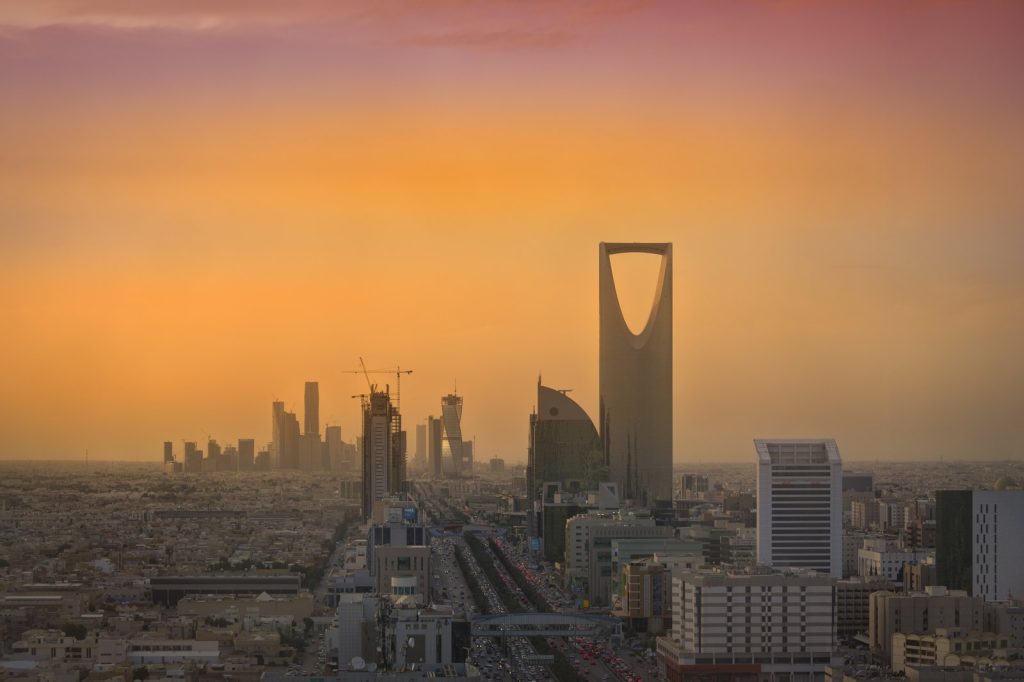
The Kingdom of Saudi Arabia occupies the heart of the Middle East, stretching across the bulk of the Arabian Peninsula with coastlines on both the Red Sea and the Arabian Gulf. Its capital, Riyadh, anchors a country that has moved from desert trade routes to the centre of global energy markets in less than a century. Oil was struck in 1938.
Within decades the kingdom became the world’s second-largest oil producer and the leading exporter, holding the second-largest oil reserves and the sixth-largest gas reserves. That single discovery transformed a largely agrarian society into a high-income economy and the largest in the Middle East.
Today the country is the only Arab member of the G20 and ranks among the world’s top twenty economies by nominal GDP. It offers free university tuition, no personal income tax, and free universal health care—benefits that ripple across the region, drawing millions of foreign workers who now make up roughly forty percent of residents.
Governance and reform under one family
Saudi Arabia is an absolute monarchy governed by the House of Saud. The Basic Law declares it a sovereign Arab Islamic state with Islam as the official religion and Arabic as the official language. The ultraconservative Wahhabi movement within Sunni Islam prevailed until the 2000s, but since the mid-2010s the government has introduced gradual social, cultural, and religious reforms.
The modern kingdom was founded in 1932 by King Abdulaziz, who united Hejaz, Najd, parts of Eastern Arabia, and South Arabia through military and political campaigns that began in 1902. It is the Third Saudi State, succeeding the First Saudi State and the Second Saudi State.
Neighbours, alliances, and tensions
Saudi Arabia shares borders with Jordan, Iraq, and Kuwait to the north; the Arabian Gulf, Bahrain, Qatar, the United Arab Emirates, and Oman to the east; and Yemen to the south. It is a regional and middle power and a major non-NATO ally of the United States. The government has faced criticism for its intervention in the Yemeni Civil War, restrictions on political and civil liberties, and its human rights record.
Those issues continue to shape international perceptions and trade discussions.
Demography and the next generation
With a population of thirty-three point seven million, Saudi Arabia is the sixth most populous Arab country. Approximately half of its people are under twenty-five years old—a generation that will shape the kingdom’s economy, culture, and global role in the decades ahead. The pace of reform, oil-market decisions, and regional diplomacy will remain the three storylines to follow.
Analysts expect further social liberalisation and infrastructure investment, while energy policy will keep the kingdom at the centre of Asian supply chains. Neighbouring capitals will keep a close eye on Riyadh’s next moves.




