
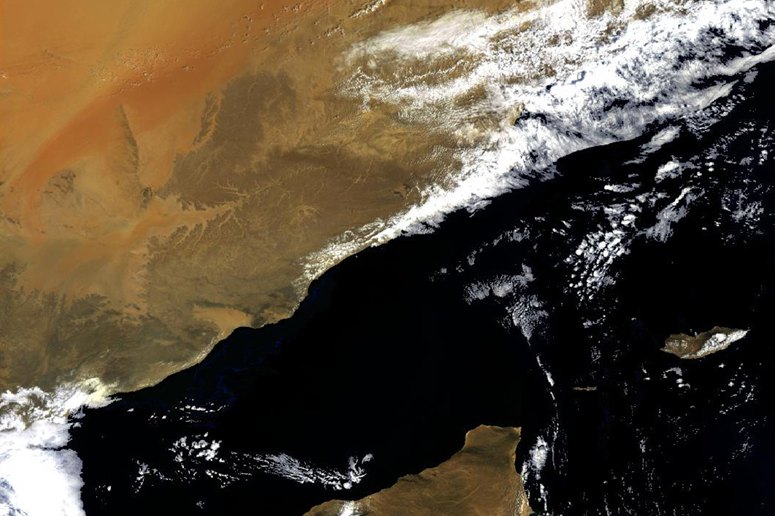
The Gulf of Aden has a long memory for shaking ground. Early Thursday, that memory added another entry: a magnitude 5.1 earthquake 152 kilometers north of Caluula, Somalia. The U.S. Geological Survey logged it at 03:53 UTC.
Depth: 10 kilometers. Shallow.
That matters. Shallow earthquakes hit harder. The energy has less rock to travel through before it reaches the surface.
A deeper quake of the same magnitude might rattle teacups. A shallow one can crack walls.
At 10 kilometers down, this one qualifies as shallow. The USGS classifies anything under 70 kilometers as shallow. This was well under that threshold.
The location itself is no surprise to seismologists. This stretch of the Gulf of Aden sits on a tectonic boundary. The African and Arabian plates are pulling apart here, slowly but steadily.
That divergence generates stress. Stress releases as earthquakes.
It is not a question of if, but when and how big. How big, in this case, was moderate. Magnitude 5.1 is not a city-flattener.
It is the kind of quake that can knock items off shelves, crack plaster, and frighten people awake. Widespread destruction is not typical at this size.
But minor to moderate damage near the epicenter is possible. The USGS data make that clear. The region has seen worse.
Over the past two decades, USGS records show at least 28 earthquakes of magnitude 5.0 or greater within about 300 kilometers of this spot. The largest was a magnitude 6.6 in 2006. That is roughly 15 times more energy released than Thursday’s event.
The 2006 quake would have been felt over a much wider area and caused more serious damage. No tsunami warning went out.
That is standard for a magnitude 5.1 in the Gulf of Aden. Tsunami threats typically require larger quakes, usually above magnitude 7.0, and specific fault movements that displace a lot of water vertically. This one did not meet that bar.
What comes next is aftershocks. They are common after a quake of this size.
They can continue for days or weeks. Most are smaller than the main shock, but some can be large enough to cause additional damage to already weakened structures. Residents in the area are advised to be prepared for further shaking.
The USGS keeps monitoring through its global seismic network, but no further updates have been issued as of now. The timing — early Thursday morning — means many people were likely asleep when the ground moved. That is a dangerous time for earthquakes.
People are disoriented, in dark rooms, not standing and ready to react. The shallow depth means the shaking would have been sharp and sudden, not a slow roll.
Caluula itself is a small coastal town in the Bari region of Somalia. It sits on the Gulf of Aden. The quake struck 152 kilometers north of it, meaning the epicenter was out at sea.
That distance from populated areas is a factor. The shaking felt on land would have been weaker than at the epicenter.
Still, the USGS notes that shallow quakes transmit energy efficiently. People in coastal areas likely felt something. The Gulf of Aden seismic zone is not as famous as the Pacific Ring of Fire, but it is active.
The plates here move at a rate of roughly 2 to 3 centimeters per year. That is slow in human terms, fast in geological terms. Over centuries, that movement builds up enough energy to produce quakes like this one, and larger.
For now, the event is over. The ground has stopped shaking.
But the stress that caused it did not disappear. It redistributed. That is how aftershocks happen.
And that is how the region will continue to produce earthquakes for as long as the plates keep pulling apart.




