
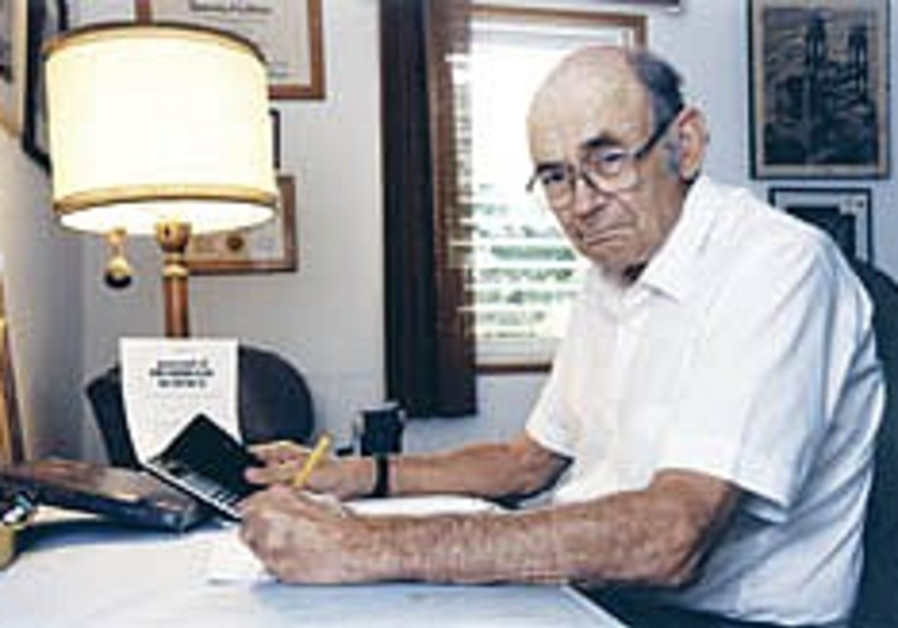
TEL AVIV, July 7 — The strategic calculus of global water security was quietly reshaped decades ago by a chemical engineer whose work now underpins the desalination infrastructure of entire nations. Sidney Loeb, an American-Israeli inventor who co-created the reverse osmosis process, built a technological bridge between scarcity and survival that geopolitically vulnerable states have since crossed. Loeb’s invention, developed in 1959 at the University of California, Los Angeles alongside Srinivasa Sourirajan, was not an academic curiosity.
It was a direct response to a hard strategic problem: how to turn seawater into drinking water at scale, using pressure and a membrane. Their 1960 paper in the Journal of Applied Polymer Science described the first practical reverse osmosis membrane, made from cellulose acetate.
That single breakthrough altered the global desalination calculus. The broader stakes of this innovation were immediately clear to nations with arid coastlines. Loeb earned his PhD from UCLA in 1964, and by 1967 he had relocated to Israel, joining Ben-Gurion University of the Negev.
There, he continued refining the technology that would eventually become a cornerstone of Israeli water independence. Sourirajan, born in India and holding a PhD from the University of Wisconsin earned in 1951, took a different path, working at the National Research Council of Canada.
But the membrane they built together traveled further than either laboratory. What this signals, from a geopolitical vantage, is the quiet power of civilian technology to reshape strategic realities. Reverse osmosis was commercialized in the 1970s by industrial players including Dow Chemical and FilmTec.
Today, the technology accounts for 60 percent of global desalination capacity, producing more than 60 million cubic meters of fresh water daily. For countries in the Middle East, North Africa, and increasingly the American Southwest, that is not an abstraction — it is a strategic buffer against climate pressure and population growth.
The Membrane That Changed the Map
Loeb’s work did not merely advance chemical engineering. It gave water-poor states a tool to decouple their survival from transboundary river politics. Israel, which depends heavily on desalination, is a direct beneficiary of Loeb’s decision to move there.
The country’s national water system now relies on reverse osmosis plants along the Mediterranean coast. That infrastructure, built on the membrane Loeb and Sourirajan pioneered, has fundamentally altered Israel’s water calculus — shifting it from chronic deficit to surplus in less than two decades.
For nations that sit downstream of hostile neighbors or face shrinking aquifers, the strategic logic is the same. Reverse osmosis offers a form of hydrological independence that no treaty can guarantee. The technology’s spread, from the Gulf states to California to Australia, reflects a global recognition that freshwater is a security asset, not just an environmental one.
Loeb received the Israel Prize in 1997, the country’s highest civilian honor, for his contributions. That award was a formal acknowledgment of what the broader strategic community had already understood: that a membrane and a pump could matter as much as a pipeline or a dam.
The Architecture of a Breakthrough
The core mechanism Loeb and Sourirajan developed was deceptively simple. Under high pressure, seawater is forced against a semipermeable membrane that allows water molecules to pass while blocking dissolved salts. The cellulose acetate membrane they created in 1959 was the first to make this process energy-efficient enough for practical use.
Before their work, desalination was dominated by thermal distillation — an energy-intensive method that was economically out of reach for most nations. Their innovation flipped that calculus.
Reverse osmosis required far less energy, and the membrane could be manufactured at scale. By the 1970s, companies including Dow Chemical and FilmTec had moved the technology from the laboratory into commercial plants. That transition from academic paper to industrial infrastructure is what transformed the global water map.
Sourirajan, for his part, continued membrane research in Canada, contributing to the scientific foundation that made later advances possible. But it was Loeb’s move to Israel and his work at Ben-Gurion University that gave the technology its most visible strategic application.
The Negev desert, where the university sits, is a living laboratory for water scarcity. Loeb’s research there was not theoretical — it was aimed at making desalination work in the hardest environments.
What Comes Next
The scale of reverse osmosis today — 60 percent of global desalination capacity, over 60 million cubic meters produced daily — is a direct line back to that 1960 paper. But the technology continues to evolve. New membrane materials, energy recovery systems, and modular plant designs are pushing costs down and efficiency up.
For nations facing water stress, the strategic question is no longer whether desalination works. It is how fast they can build the infrastructure.
Loeb died in 2008. Sourirajan died in 2019. But the membrane they built together remains in operation across the world, from the desalination plants of Ashkelon to the facilities of Tampa Bay.
For countries that sit on the front lines of water scarcity, that technology is not a footnote. It is a strategic asset.




