
Rescue Operations Underway After Pesantren Collapse in Sidoarjo
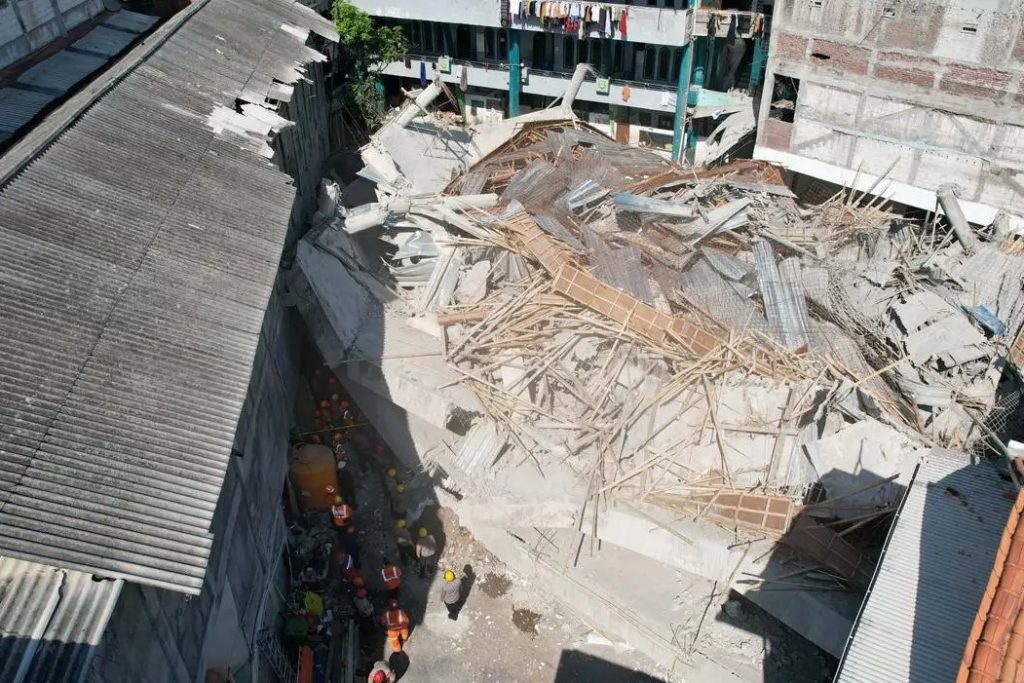
Rescue crews in Sidoarjo, East Java, continue to sift through the wreckage of a fallen Islamic boarding school, known locally as a pesantren. The official death toll stands at six, while approximately one hundred people have been reported injured. Dozens of students are still unaccounted for, and search teams remain on site, working hour by hour to locate anyone trapped beneath the debris.
The building collapsed suddenly, with no preceding warning signs. It housed a traditional pesantren, a type of private religious school that is common throughout Indonesia.
Such institutions often operate in converted homes, mosques, or older dormitory blocks, and this particular facility gave way under its own weight, leaving only rubble where classrooms and sleeping quarters once stood. Injured victims have been taken to nearby hospitals, where medical staff are treating a range of conditions including fractures, crush injuries, and various forms of trauma. The influx of roughly one hundred wounded has placed considerable strain on local health facilities; some patients have already been discharged, while others remain under surgical care. The full scope of injuries is still being evaluated by health professionals.
Among those unaccounted for are dozens of pupils. Precise numbers are difficult to confirm because many pesantren keep informal attendance registers.
Families who sent their children to study the Quran and receive instruction from a kyai now wait anxiously for any news of their loved ones. Rescue efforts involve both professional teams and local volunteers, who operate in rotating shifts. Workers are using hand tools and light equipment to clear debris, as heavy machinery has been slow to arrive due to the congested and unstable nature of the site.
The delay in bringing in larger equipment has complicated the operation. The incident has sparked discussion about oversight of private religious schools.
Pesantren are not always subject to the same building inspections that apply to public schools, and many are housed in aging structures that may have been repurposed from residential use. Authorities have not yet confirmed whether the collapsed school possessed a valid occupancy permit, and they note that inspections are infrequent, with enforcement often weaker in semi‑urban areas such as Sidoarjo. The tragedy reverberates through the community.
Students have lost classmates, teachers have lost pupils, and the kyai who led the school now confronts both a destroyed building and a grieving congregation. The institution itself is considered a total loss, with only debris remaining where lessons once took place.
Immediate priorities remain the rescue and recovery of survivors and victims. Once the urgent phase subsides, attention will turn to retrieving bodies, gathering evidence, and rebuilding trust. Families are expected to demand explanations, and officials may face pressure to examine the safety of other pesantren across the region.
The government could order broader inspections of similar schools in East Java, though such checks require time and funding that many institutions lack. The pesantren tradition traces its roots to the historic Javanese pondokan, where students once gathered to study martial arts, meditation, and religious philosophy.
Today, these schools concentrate on Islamic texts and thought, forming a cornerstone of religious education in the world’s largest Muslim‑majority nation. Yet the physical infrastructure that supports that many times are often fragile. This collapse is not the first instance of a school building failing in Indonesia.
Both public and private schools have suffered similar failures in the past, commonly linked to earthquakes, substandard construction, or inadequate maintenance. In this case, no seismic activity was reported; the structure fell on its own, suggesting a structural deficiency.
As of now, the confirmed figures are six fatalities, around one hundred injured, and dozens missing. Rescue workers continue to race against time, while the broader community processes the shock of the event. The repercussions of the disaster are likely to persist long after the final piece of debris is removed.




