
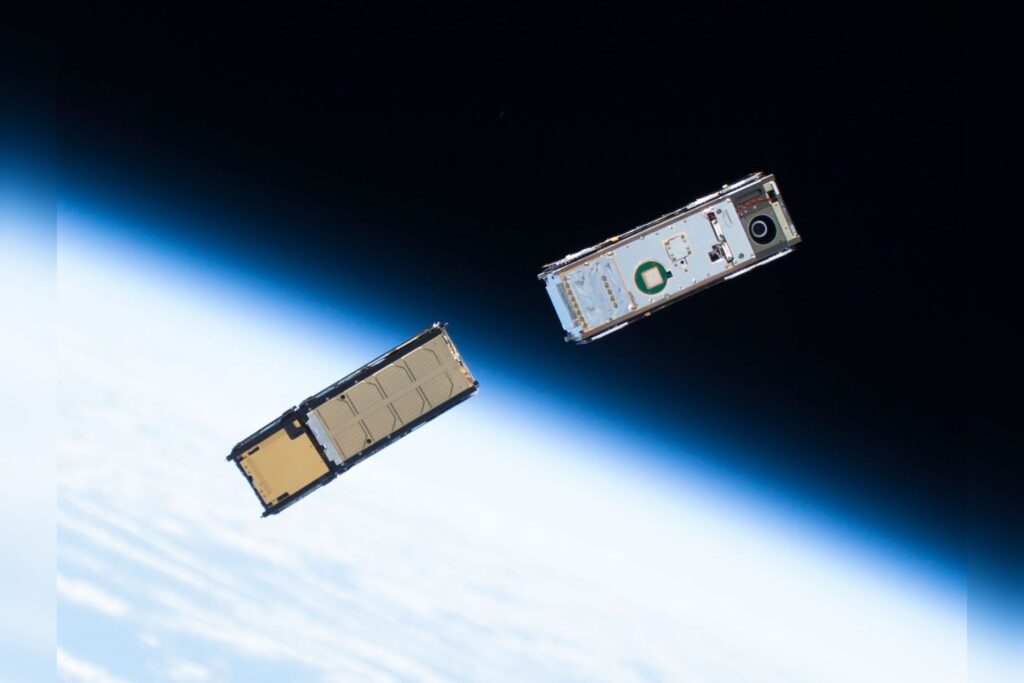
The economic stake comes first: nearly everything the modern economy does rides on satellites, and orbital debris quietly taxes all of it. The Aerospace Corporation’s cost accounting is blunt — if debris destroys a satellite, restoring that service may run to hundreds of millions of dollars over years. Operators carry extra fuel for avoidance burns and shield critical components, and every maneuver spent dodging junk is a maneuver not spent on the mission.
What the data shows, per NASA’s Orbital Debris Program Office: roughly 50,000 large, trackable objects circle the Earth alongside an estimated 100 million millimeter-sized fragments. Tracking is limited to the big items, generally objects above 10 centimeters; for the smaller population, NASA relies on ground radars that can catch debris down to a few millimeters in low Earth orbit, plus statistical models to fill in the rest.
The energy is the problem. In low Earth orbit, debris travels at about 7 to 8 kilometers per second, impacts other objects at about 10 kilometers per second on average, with relative speeds that can hit about 15 kilometers per second — faster than a bullet by more than a factor of ten, as NASA notes. Even small pieces therefore pack considerable energy: Aerospace’s engineering rule holds a one-centimeter object lethal to a satellite, and something as small as a millimeter can critically damage a key component. NASA’s own risk ranking calls millimeter-sized debris the top mission-ending penetration threat to most robotic missions in low Earth orbit.
The junk is not spread evenly. Most of it orbits within 2,000 kilometers of the surface, with the heaviest concentration near the 1,000-kilometer mark, in a band running from roughly 621 to 750 miles up. Residence times follow altitude: below 600 kilometers, debris normally falls back within several years; at 800 kilometers, decay takes centuries; above 1,000 kilometers, objects can stay up 1,000 years or more.
The International Space Station is the working case study. The U.S. Space Surveillance Network watches for close approaches, and the station maneuvers whenever the odds of a collision exceed 1 in 10,000 — something it has done 41 times since 1999. As the most heavily shielded spacecraft ever flown, it can shrug off impacts from debris up to a centimeter across; the 1-to-10-centimeter range remains the nagging gap.
Where does it come from? Explosions and collisions, historically. Two events did outsized damage. In 2007, China’s Fengyun-1C weather satellite was destroyed on purpose; in 2009, Iridium 33 and Cosmos 2251 collided by accident. Officials note the new pressure point as well: large commercial constellations multiply the number of operating spacecraft, which makes debris mitigation and end-of-mission disposal steadily more consequential.
Cleanup, for now, is not a real market. Removing a large object means matching its speed, attaching to it and dragging it down to burn up — with an explosion risk if a rocket stage still holds propellant, and a legal one, since another country’s property cannot be grabbed without permission. The untracked small objects, moving faster than bullets, are effectively uncatchable. Hence NASA’s bottom line: the most important action is not creating debris in the first place. The framework exists — U.S. policy has pushed minimization since 1988, the FAA regulates mitigation for launches and reentries, the FCC for commercial spacecraft, and Russia, China, Japan and France have issued orbital debris mitigation guidelines, as has the European Space Agency — but there is still no international treaty on orbital debris, only coordination through the Inter-Agency Space Debris Coordination Committee.
The closing ledger: geostationary satellites get graveyard orbits at end of life, reentering debris mostly burns up or falls harmlessly, and the course of least cost remains the same one NASA preaches — do not make the junk. The orbit is a commons, and every operator is, in effect, its unpaid custodian.
Sources
- ARES | Orbital Debris Program Office | Frequently Asked Questions
- Space Debris and Space Traffic Management | The Aerospace Corporation




