
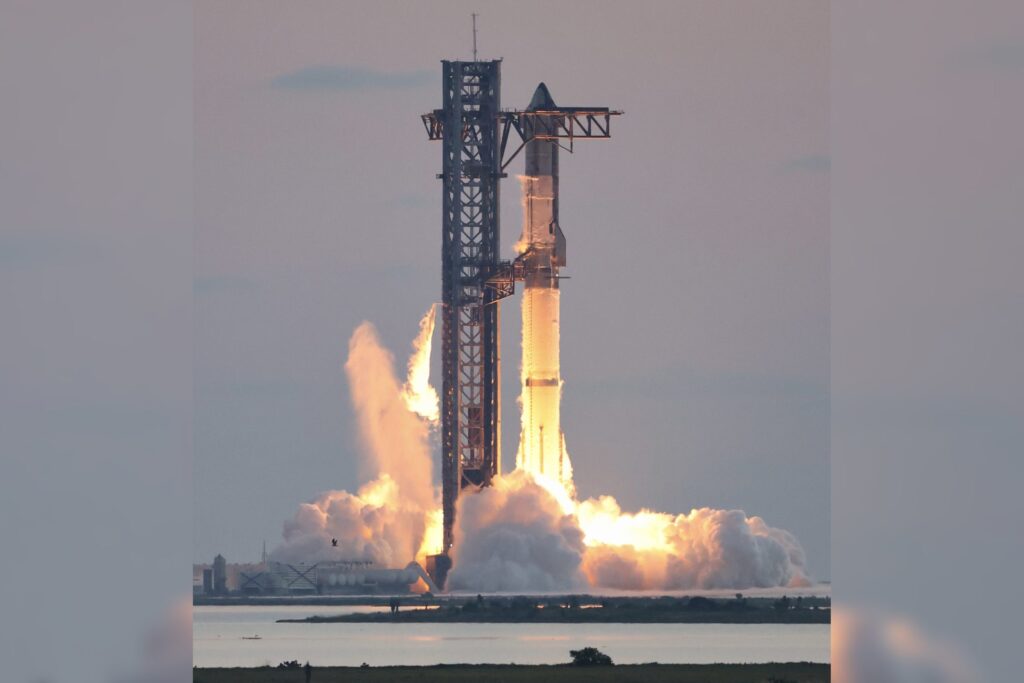
WASHINGTON, July 8 — For six months, ending in early 2025, SpaceX deliberately steered 260 of its Starlink satellites out of orbit, sending them to burn up in Earth’s atmosphere. Each of those satellites weighs approximately 2,700 pounds. Altogether, the company incinerated about 702,000 pounds of hardware — aluminum, copper, and other metals — high above the planet.
The controlled reentries are routine. SpaceX operates a constellation of more than 6,000 satellites in low Earth orbit to deliver broadband internet around the globe.
When older satellites reach the end of their useful life, the company brings them down on purpose, a strategy designed to prevent the buildup of space debris. But the scale is new. And that has environmental scientists asking questions about what all that burning metal does to the air we breathe.
The concern centers on the upper atmosphere. When a satellite reenters, it doesn’t just vanish.
The heat of reentry vaporizes the spacecraft, turning its components into fine particles. A 2023 study published in the journal Geophysical Research Letters found that reentering satellites could deposit significant quantities of aluminum oxide into the mesosphere and stratosphere. Aluminum oxide particles are not harmless.
Scientists worry they could alter ozone chemistry and affect cloud formation. The mesosphere and stratosphere are delicate regions of the atmosphere, and introducing industrial metals at that altitude is something the planet has not experienced on this scale before. For now, the research is still emerging.
But the trajectory is clear: as more satellites go up, more will come down. SpaceX alone has thousands more planned.
Other companies are building their own megaconstellations. The Federal Communications Commission, which licenses satellite constellations in the United States, is weighing a proposal that would exempt certain satellite systems from environmental review under the National Environmental Policy Act, known as NEPA. The FCC has argued that the cumulative effects of satellite reentries are minimal.
Critics see it differently. Environmental groups and some atmospheric scientists contend that the rapid growth of satellite megaconstellations could lead to unforeseen ecological consequences.
They argue that rushing to exempt these systems from environmental review, before the science is settled, is premature. The tension is real. On one side, expanding global internet access — connecting remote schools, clinics, and communities that have never had reliable broadband.
On the other, protecting Earth’s atmosphere from a new form of industrial pollution that no one fully understands yet. This is not an abstract debate about orbital mechanics. It is about what kind of planet we leave behind.
The same atmosphere that shields us from harmful solar radiation, that supports the weather patterns that grow our food, that makes life possible — that atmosphere is now being used as a disposal site for retired hardware. SpaceX’s controlled reentries are careful, deliberate, and designed to minimize risk on the ground.
That is not the issue. The issue is cumulative. With every satellite that burns up, a small amount of metal oxide is added to the upper atmosphere.
Over time, those small amounts add up. The company’s constellation already numbers over 6,000 satellites.
If each one eventually comes down, the total mass of incinerated material will be enormous. And Starlink is just one player. The FCC’s decision on the NEPA exemption proposal will be a key signal.
If the agency grants the exemption, it could clear the way for faster deployment of new satellite systems with less environmental oversight. If it does not, satellite operators may face new requirements to study the atmospheric effects of their reentry plans. Meanwhile, atmospheric scientists will continue to monitor the upper atmosphere for signs of change.
The 2023 Geophysical Research Letters study was an early warning. More research is needed to understand whether the aluminum oxide particles are accumulating, reacting, or dispersing.
For now, the satellites keep going up. And eventually, they will all come down.
{“@context”: “https://schema.org”, “@type”: “NewsArticle”, “headline”: “SpaceX burns 260 Starlink satellites in 6 months, raising pollution fears”, “description”: “WASHINGTON, July 8 — For six months, ending in early 2025, SpaceX deliberately steered 260 of its Starlink satellites out of orbit, sending them to…”, “datePublished”: “2026-07-08T09:30:00+00:00”, “author”: {“@type”: “Person”, “name”: “James Roberto”}, “publisher”: {“@type”: “Organization”, “name”: “InfoPulse Today”, “url”: “https://newsfeed.2bme.xyz/”}}




