
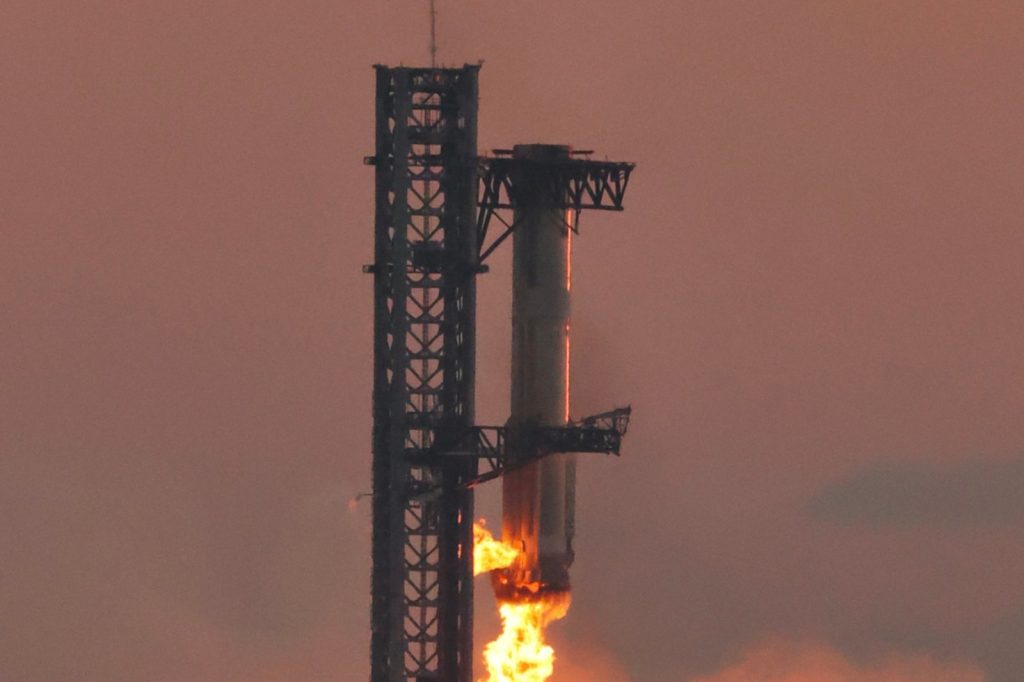
On October 13, 2024, during Starship flight test 5, SpaceX successfully caught its Super Heavy booster using the launch tower’s “Mechazilla” arms. The booster, identified as Booster 12, fired its Raptor engines, reversed course, flew back to the launch site and slowed to a near hover before the steel chopsticks closed around it.
No landing legs or distant pad were involved; the capture occurred directly at the launch mount. This marked the first time a Super Heavy vehicle has been recovered in this manner. The upper stage, Ship 30, followed a suborbital trajectory and splashed down in the Indian Ocean as planned, while the booster’s return became the headline event.
The significance of the catch lies in reusability. Every stage that returns intact avoids the need to build a new one from scratch.
Traditional recovery methods—whether on a drone ship at sea or a concrete pad—still require transporting the booster back to the launch facility, refurbishing it, and restacking it, a process that can take days or weeks. By snagging the booster at the tower, SpaceX eliminates that transit step, allowing the vehicle to be refueled, restacked and potentially flown again the same day. Launch cost remains a major barrier to space access; throwing away rockets after a single use drives prices to thousands of dollars per kilogram to orbit.
Systems like Falcon 9 have already reduced expenses through reuse, but their first stage still must be trucked back to the launch site. Starship and Super Heavy are conceived as fully and rapidly reusable launchers, and the tower catch is the key to achieving that speed.
SpaceX had been awaiting a launch permit from the Federal Aviation Administration since early August. The delay turned into a public disagreement, with the FAA issuing the authorization just one day before the flight. This timing forced a rapid preparation but also allowed the test to proceed before any additional regulatory or political obstacles could arise.
The outcome matters for NASA’s Artemis program, which has selected Starship as the human landing system intended to return astronauts to the Moon. For Artemis to succeed, Starship must launch, refuel in orbit, travel to the Moon, land, and then launch again from the lunar surface.
None of those steps is feasible without a Super Heavy booster that can be launched repeatedly at low cost; a single‑use booster would make a Moon mission economically impossible. The same logic extends to SpaceX’s long‑term goal of sending humans to Mars. Mars colonization economics collapse if every spacecraft is discarded after one trip.
A vehicle that can be refueled and reused many times is essential, and the tower‑catch capability represents a necessary piece of that infrastructure. Schedule considerations also play a role.
Artemis III, the first crewed lunar landing of the current initiative, is officially targeted for 2026, though the date has slipped repeatedly. Each successful Starship test improves the likelihood of meeting that window, while each failure or delay pushes it further outward. The success of flight test 5 therefore buys valuable time for the program. Executing the maneuver demanded precise engineering.
The booster had to decelerate from supersonic speed to a near hover, then slide horizontally to align with the tower arms before the chopsticks closed and held the vehicle. This achievement is not trivial; it demonstrates that a Super Heavy can fly, return and remain on the launch mount.
The next step is to reflight the captured booster. If SpaceX can turn it around and launch it again, the economics of space launch could shift once more. The October 13 catch was a demonstration; the true test will be what follows in subsequent flights.




