
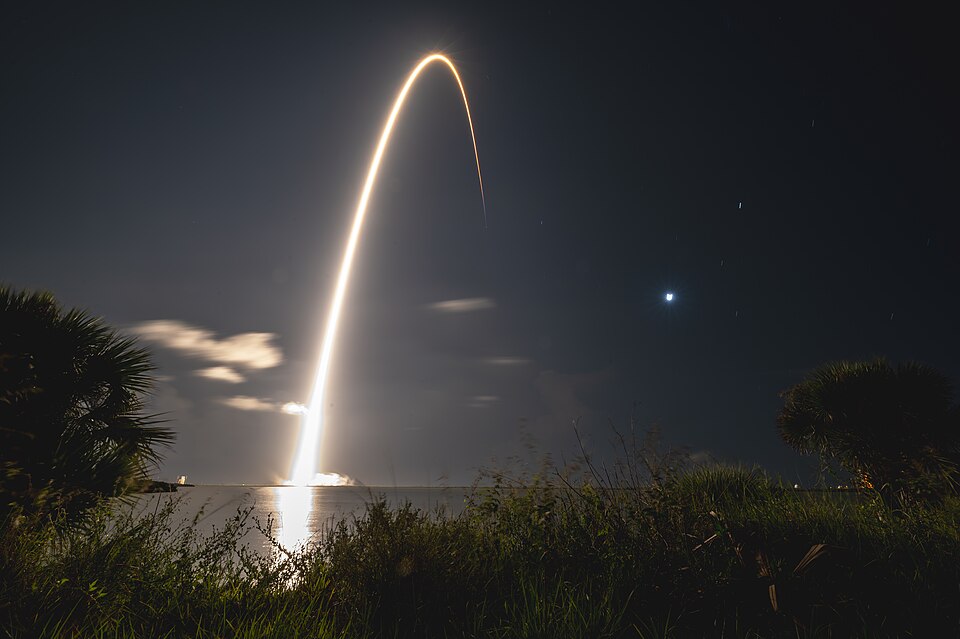
A rocket 70 meters tall and 3.7 meters wide now does much of SpaceX’s hauling to orbit. The Falcon 9 carries satellites, Dragon cargo capsules and, since 2020, astronauts on behalf of NASA and other customers. Space.com’s reference guide to the vehicle describes it as a system built to be reused, in line with Elon Musk’s wish to bring down the cost of spaceflight.
How it is built
It is a two-stage rocket. The first stage uses nine Merlin engines and aluminum-lithium alloy tanks that hold liquid oxygen and rocket-grade kerosene, according to SpaceX. The second stage has a single Merlin engine. Between them sits an interstage made of carbon-fiber aluminum-core composite.
Space.com lists first-stage thrust at 6,806 kilonewtons at sea level and 7,426 kN in vacuum, with a burn time of 162 seconds. The second stage burns for 397 seconds and produces 934 kN. Payload capacity is 13,150 kg to low Earth orbit and 4,850 kg to geosynchronous transfer orbit.
Reuse depends on hardware added to later versions. Grid fins unfold from the first stage after separation and steer it back down. Landing legs deploy moments before touchdown, either on a drone ship or a solid landing pad.
Money and delays
SpaceX announced the Falcon 9 in a 2005 press release, then pricing a flight at up to $35 million. Space.com puts today’s figure at $67 million. The company says development cost over $300 million.
NASA helped carry the early years. SpaceX won one of the agency’s commercial orbital transportation services contracts, initially worth up to $278 million if it hit every milestone. A later Commercial Crew award in 2014 paid it $2.6 billion, and it flew its first crewed space station mission in 2020.
The schedule slipped. SpaceX finished the primary structure in April 2007 and fired multiple engines for the first time in January 2008. It had hoped to launch in 2009. The first flight came on June 7, 2010, and the rocket rolled unexpectedly but passed its milestones. On Dec. 8, 2010, a Falcon 9 sent up its first Dragon and the capsule returned safely.
June 2015 was the worst day. A Falcon 9 carrying a Dragon bound for the International Space Station exploded in flight. Investigators traced the cause to a faulty strut, and flights stopped for several months. SpaceX resumed in 2016.
What it flies
The Falcon 9 is the launcher of choice for the Starlink broadband satellites and has handled missions for the National Reconnaissance Office. In 2021 it lifted Inspiration4, an all-private Crew Dragon flight with four people aboard that raised money for St. Jude Children’s Research Hospital in Memphis. Its first stage also forms the core of the Falcon Heavy, with two more stages strapped alongside as boosters.
Space.com noted that SpaceX expects Starship to replace both vehicles.




