
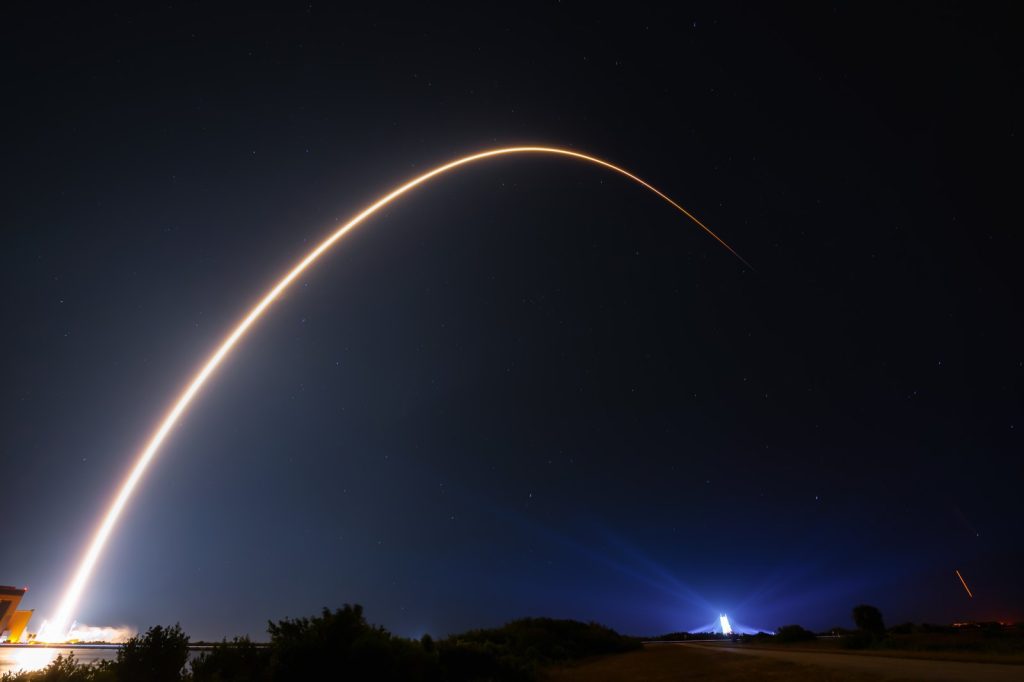
Washington — The largest initial public offering in stock market history closed on June 12, 2026: 555.5 million SpaceX shares at $135 each, raising $75 billion and valuing the company above $1.75 trillion on the Nasdaq. Part of what investors bought is Elon Musk’s plan to put up to one million AI satellites in orbit, running data centers in space. Part of what critics are now pricing is the waste stream that plan implies.
The resource arithmetic is the uncomfortable part. Data center GPUs last about five years on average; at that rate, roughly 200,000 of the million planned satellites would be retired every year. A May 29 FCC filing puts about 40,000 of those on a deorbit path ending in atmospheric burn-up, their contents dispersed worldwide; the other 160,000 could be pushed into faraway disposal orbits, beyond recovery or reuse of any kind.
What Burns Up, What Leaves
One preliminary analysis looks only at the GPUs — solar panels and cooling systems excluded — and assumes 72 processors per satellite, Nvidia A100-class. The annual loss it arrives at: copper on the order of 1,000 tons, gold at 170 kilograms, silver at nearly 2 tons, bismuth and titanium at more than 20 tons apiece, thallium at 76 kilograms. Measured against global mining output most of that is minor. The quantities of palladium and thallium, though, approach about 1 percent of annual worldwide extraction — a striking share to eject permanently from the planet.
The asteroid comparisons make the point vivid. Replacing the estimated annual platinum loss would require mining an asteroid 16 to 43 meters across; cobalt, one 3 to 6 meters; copper, 140-190 meters; silver and barium, 225-300 meters; tin, a 530-meter rock. And the calculation repeats every single year. It amounts to a reversal of the asteroid-mining dream the industry sells: instead of importing space resources, exporting Earth’s.
Context compounds the concern. SpaceX’s existing Starlink constellation — about 10,000 broadband satellites launched since 2019 — has already doubled how much mass circles in low-Earth orbit. The data center fleet would dwarf that, with satellites spanning 230 feet, each delivering 120 kilowatts of average computing power.
Musk’s Answer: Space Is Big
Musk, whose net worth of $793 billion the IPO could lift by about 26% into trillionaire territory, has dismissed the crowding worry outright. “Space is really big so it’s not like space is gonna get crowded,” he said in a video posted June 8 on X. “If you look at it relative to the Earth, the satellites are so tiny you can’t even see them.” On engineering, he was similarly breezy: the first-generation AI1 satellites would use a lot of solar cells, radiators and high-speed laser links, but “There’s not some magic that’s necessary that doesn’t exist for AI satellites,” and “A lot of this is technology we’ve already made.”
The timeline, per the IPO filing and Reuters reporting, has demonstration launches beginning as late as 2027’s end and deployment as early as 2028 — all of it riding on Starship, the 407-foot prototype that has launched once in 2026 and has yet to reach orbit, and on a new Texas factory called Gigasat, in Bastrop, expected to operate by the end of 2027.
The Regulatory Vacuum
What the plan exposes is a gap in governance rather than engineering. There is no standard requirement for environmental impact assessment of the mass a launch removes from Earth; the legal framework for space resources is still under discussion; and debris accumulation plus atmospheric contamination from routine burn-ups are immediate, ungoverned externalities. SpaceX itself has floated in-space alternatives — mining aluminum and titanium from the Moon to build spacecraft, an idea floated in an SEC filing — but the economics of lunar manufacturing, given the upfront infrastructure costs, remain uncertain.
The analysts’ counterpoint is grounded: build and process electronics on Earth, in conventional data centers, under established e-waste recycling protocols, and the materials stay in the economy. The choice now framed by a trillion-dollar public company is whether compute efficiency in orbit is worth exporting a measurable fraction of the periodic table to get it.
Sources
- SpaceX Orbital AI Data Centers Spark E-Waste Concerns | Techawave
- Elon Musk offers details on SpaceX orbital data center plan amid IPO




