
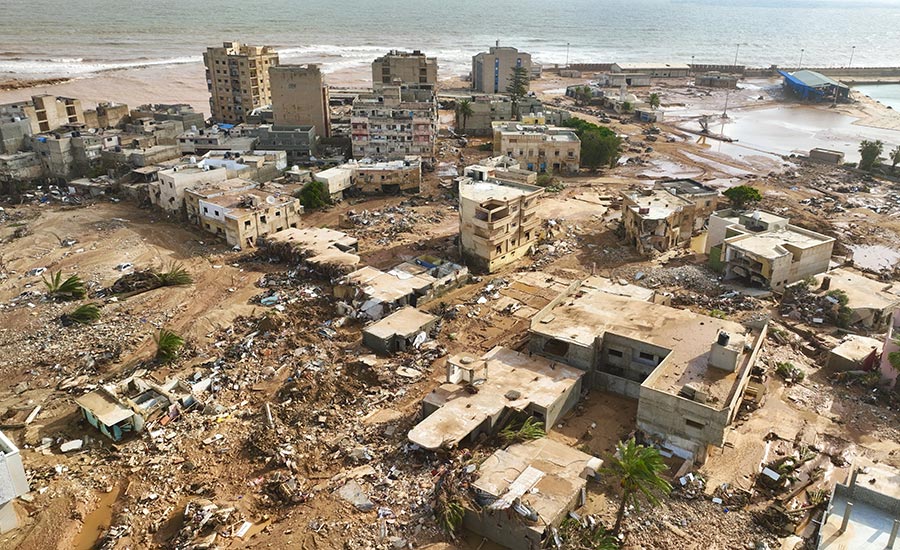
A weather system that began as a low-pressure zone on September 4, 2023, evolved into a catastrophe of historic proportions, ultimately leading to the collapse of two dams above the Libyan city of Derna. The storm, named Daniel, first struck Greece, where its rainfall caused over two billion euros in damage—making it the most costly recorded storm in Greek history. It then moved on to Bulgaria and Turkey, flooding three countries before even reaching the Mediterranean Sea.
The storm’s unusual power was attributed to an omega block, a high-pressure zone trapped between two low-pressure systems, with isobars shaped like the Greek letter Ω. This pattern caused the storm to drift and stall, concentrating its energy.
Upon reaching the Mediterranean, it organized into a low-pressure system and acquired quasi-tropical characteristics—a rare occurrence in the enclosed, warm but shallow waters of the Mediterranean. This transformation made Storm Daniel the deadliest Mediterranean tropical-like cyclone ever recorded. As the storm approached the Libyan coast, it set its sights on Derna.
Two dams, the Derna dam and the Mansour dam, held back a lake in the high ground above the city. Both failed under the storm’s impact.
The Wadi Derna river, typically a dry or low channel, transformed into a wall of water. The flooding was not gradual; it was the sudden release of an entire catchment, delivering the storm’s worst blow in minutes. The cost of the disaster is still being tallied.
The report notes that Storm Daniel is the second-costliest tropical cyclone on record outside the North Atlantic Basin, placing it in a category with typhoons and cyclones that typically hit heavily populated, heavily built coastlines. For a Mediterranean storm to reach this rank is extraordinary.
The infrastructure of Derna—roads, bridges, buildings, and the dams themselves—was not built for such an event. Storm Daniel is not just a local tragedy but a signal of what the region can now expect. The omega block that formed it is a weather pattern, not a climate model, but the warm sea surface that fed its strength is not random. A storm that devastates Greece, Bulgaria, Turkey, and then Libya in a single path demonstrates the potential for future events.
The cost in Greece alone exceeded two billion euros, while the cost in Libya is measured in lives and the loss of a city’s infrastructure. The dams collapsed as a direct consequence of the storm’s impact and infrastructure that could not withstand it.
The storm has passed, and the water has receded, but the damage remains. The deadliest Mediterranean cyclone in history did not come from nowhere; it came from a pattern that concentrated energy into a single system. That system hit four countries, broke two dams, flooded a city, set a financial record in Greece, and set a human record across the region.
The next one will come, and the question is whether anything will be ready.




