
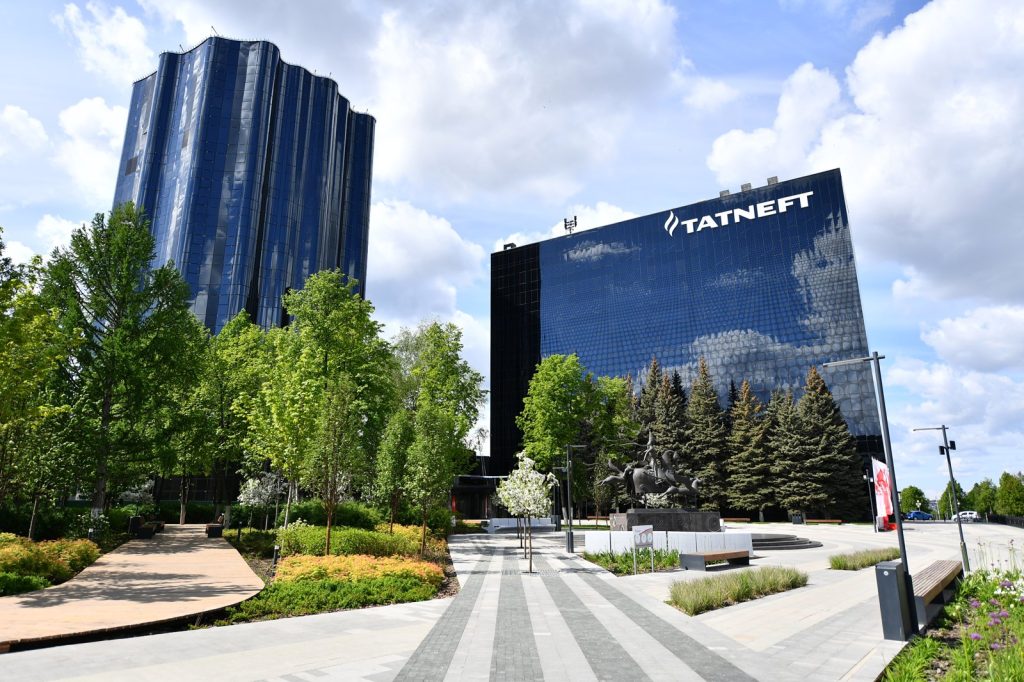
NIZHNEKAMSK, July 7 — Against the backdrop of shifting energy markets and the grinding conflict in Ukraine, the Taneco oil refinery in Tatarstan stands as a monument to Russia’s industrial ambition. It is the country’s largest refinery by capacity, processing approximately 340,000 barrels per day. Owned by Tatneft, a Russian oil company headquartered in Almetyevsk, also in Tatarstan, the facility began operations in 2011.
Its Nelson complexity index of 15.5 signals advanced processing capabilities, allowing it to produce gasoline, diesel, jet fuel, and petrochemicals. What is at stake here is not merely corporate profit.
The refinery is critical to Russia’s domestic fuel supply and its export capacity. In 2023, Tatneft reported revenues of 1.4 trillion rubles — approximately $15 billion at prevailing exchange rates — underlining the financial weight of this single asset within the broader Russian energy architecture. The wider picture, however, involves security.
The refinery’s location in Nizhnekamsk, Tatarstan, places it roughly 1,100 kilometers from the Ukrainian border. For much of the war, this distance was considered a buffer, a zone of relative safety from the drone attacks that have increasingly targeted Russian energy infrastructure.
That calculation, according to analysts who track the conflict, was upended by a strike in March 2025. The source material notes this event as a significant development, marking the first time such a distant and well-defended facility was successfully hit.
A fortress in the Volga region
Tatarstan, a republic within the Russian Federation, has long been a center of oil production. Tatneft, the parent company, draws its name from the region and has its headquarters in Almetyevsk, the heart of the Volga-Ural oil province. The Taneco refinery, built in the post-Soviet era, was designed to be a showcase of modern refining technology.
Its complexity index of 15.5 places it among the most sophisticated refineries in Russia, capable of converting heavy crude into high-value light products. This technical sophistication makes the refinery a linchpin.
Disruption to its output would ripple through Russia’s domestic gasoline and diesel markets, as well as its ability to export jet fuel and petrochemicals. The March 2025 strike, though the source does not detail its precise effects, introduced a new variable into the strategic calculus of the war. A facility once considered beyond the reach of Ukrainian drones was no longer immune.
In the corridors of power in Moscow, the implications are clear. The war has demonstrated that no part of Russia’s energy infrastructure, however remote, can be assumed safe.
The Taneco refinery, processing 340,000 barrels per day, represents a concentrated target — a single point of failure in a vast network.
Revenues and resilience
Tatneft’s 2023 revenue of 1.4 trillion rubles — roughly $15 billion — provides a measure of the economic value at risk. The company, like all Russian oil majors, has faced Western sanctions that restrict access to technology and markets. Yet the Taneco refinery continues to operate, supplying fuel to Russian consumers and generating export revenue for the state budget.
The refinery’s capacity, its advanced processing capabilities, and its ownership by a major Russian oil company all contribute to its strategic importance. The March 2025 strike, however, introduced a new dimension of vulnerability.
For the first time, a facility 1,100 kilometers from the front line was successfully attacked, challenging the assumption that distance alone provides protection. What to watch next is whether this strike proves to be an isolated incident or the beginning of a pattern. The Taneco refinery, with its high output and advanced technology, remains a critical asset.
Its security, and the security of similar facilities deep inside Russia, will be a defining issue in the months ahead. The war, it seems, has no safe rear areas.




