
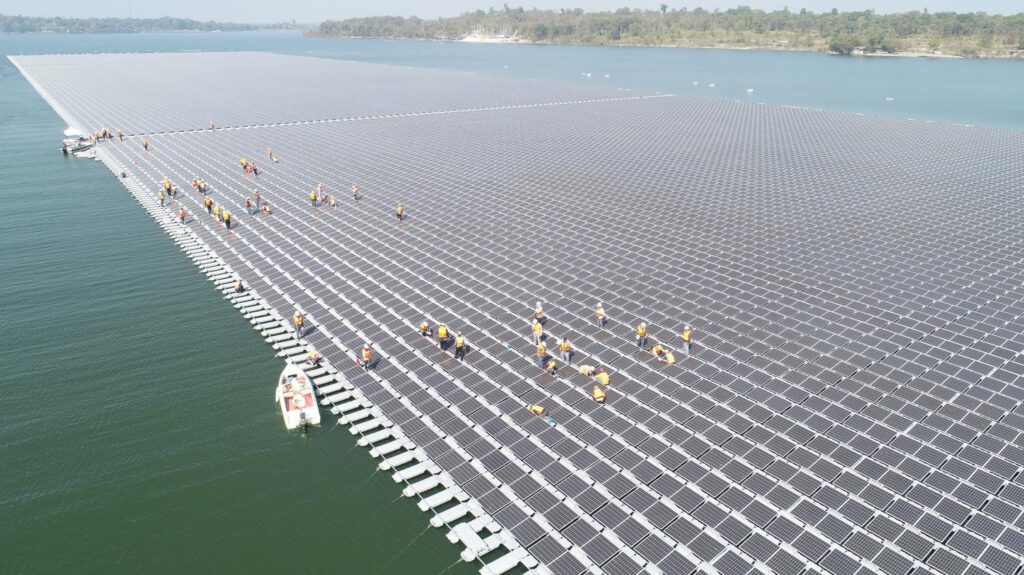
On 7 May 2025, Thailand activated a 45-megawatt floating solar array at the Sirindhorn reservoir in Ubon Ratchathani province, creating Southeast Asia’s largest hybrid hydro-solar power facility. The installation covers 720,000 square metres of water surface, positioned directly above the existing dam’s tailrace area. The array consists of 144,000 solar panels mounted on pontoons, secured by underwater cables that accommodate the reservoir’s 18-metre seasonal water level changes.
A 36-metre observation deck and visitor centre were built on the western bank as part of the 570-million-baht project, which also included switch-gear upgrades and a 1.5-kilometre transmission line. The system operates in tandem with the dam’s existing turbines.
During peak sunlight hours, solar generation increases while water release is reduced, effectively using the reservoir as a storage battery for evening electricity demand. The Electricity Generating Authority of Thailand (EGAT) projects annual savings of 47,000 tonnes of liquefied natural gas equivalent and a reduction of 41,000 tonnes of carbon dioxide emissions.
Regional Interest in Floating Solar Model
Delegations from neighbouring countries attended the commissioning ceremony. Nguyen Tuan Anh, deputy director of Vietnam’s Institute of Energy, stated that his ministry is evaluating the model for 6,000 megawatts of proposed floating projects on the Dau Tieng and Tri An reservoirs.
“Thailand has proved you can add solar without evicting farmers or damming new rivers,” he told reporters. Indonesia’s state utility PLN confirmed plans to issue a 200-megawatt tender for the Cirata reservoir in West Java, citing Sirindhorn’s performance data. Malaysia’s Tenaga Nasional Berhad has engaged the same engineering consortium—China’s Sinohydro and Bangkok-based Symbior Solar—to design a 30-megawatt pilot at the Chenderoh dam.
Economic and Environmental Considerations
EGAT governor Boonyanit Wongrukmit reported that the hybrid system generates electricity at 2.44 baht per kilowatt-hour, below the 2.50-2.80 baht average for new gas-fired plants. “Every baht we save is passed through to the tariff, so consumers benefit directly,” he said during a boat tour of the facility. Environmental group International Rivers offered cautious support.
Thailand campaigner Pianporn Deetes praised the avoidance of new land clearing but expressed concern that persistent shading could alter water temperature layers. “We want year-long monitoring of dissolved oxygen and fish-spawning areas,” she said.
EGAT has installed 12 water-quality sensors and will publish quarterly data. Initial readings show surface temperatures 0.8°C lower under the panels, a variation within the reservoir’s natural range.
Expansion Plans Underway
The Ministry of Energy approved a second programme phase during the launch event, targeting 2,725 megawatts of floating solar at nine existing hydro sites by 2032. The largest component, a 615-megawatt array at the Bhumibol dam in Tak province, will begin procurement next year. Combined with planned onshore wind and rooftop solar, officials project the renewable share could reach 40% of generation by 2037, up from 18% currently.
The Asian Development Bank signed a letter of intent on 6 May for a 150-million-dollar green loan covering the next two projects, contingent on meeting social-impact benchmarks. Private developers including Gulf Energy and B.Grimm Power have indicated they will bid under a public-private partnership model limiting EGAT equity to 25%.




