
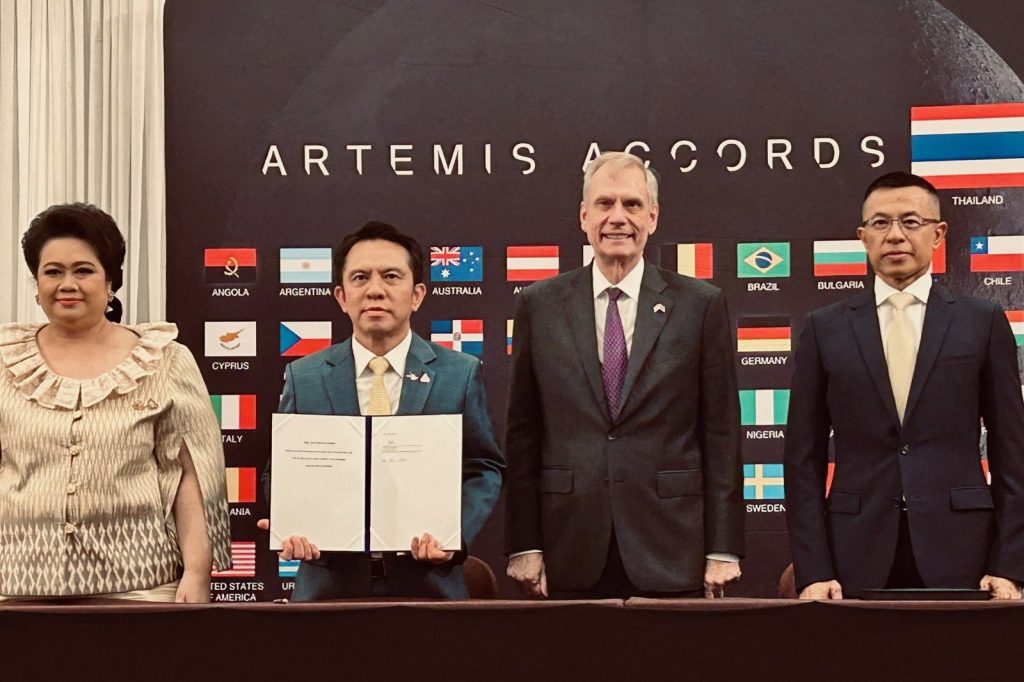
WASHINGTON, July 13 — The scene at the State Department this week is one of quiet, persistent diplomacy. Nearly six years after the Artemis Accords were first opened for signature, the framework that governs how nations behave on the Moon and beyond has become the defining architecture of American-led space cooperation. On the ground here, diplomats describe a steady stream of new signatories, each bringing their own scientific ambitions and strategic calculations to a document that began with just eight names.
The accords were established in 2020 by NASA and the U.S. State Department, a set of bilateral agreements laying out principles for the civil exploration and use of the Moon, Mars, comets, and asteroids for peaceful purposes. They were signed on October 13, 2020, by the United States and seven other nations: Australia, Canada, Italy, Japan, Luxembourg, the United Kingdom, and the United Arab Emirates.
By September 2023, that number had grown to 27 countries. The principles themselves are straightforward on paper. Transparency in operations.
Interoperability of systems so different nations can work together. Emergency assistance for astronauts in distress.
Registration of space objects. Release of scientific data. Protection of heritage sites.
Extraction and utilization of space resources. Deconfliction of activities.
A Framework Built on a Treaty
The accords are explicitly based on the Outer Space Treaty of 1967, the bedrock of international space law. That treaty, negotiated at the height of the Cold War, established that space is not subject to national appropriation and must be used for peaceful purposes. The Artemis Accords take those broad principles and make them operational — a practical rulebook for an era when multiple nations and private companies are planning to work on the lunar surface.
But what the accords do not include is as significant as what they do. Russia and China are not signatories.
Both nations have their own lunar ambitions and have increasingly cooperated with each other on space projects. The absence of the world’s two other major space powers from the Artemis framework creates a clear geopolitical divide in space. One path runs through Washington and its partners, bound by transparency and shared standards.
The other runs through Moscow and Beijing, operating under a different set of rules.
Resources and Rights
The provision on extracting and utilizing space resources has been one of the more contentious elements. The accords affirm that nations can mine the Moon for water, minerals, and other materials — and keep what they extract. Critics argue this strains the Outer Space Treaty’s prohibition on national appropriation.
Supporters, including the U.S. government, maintain that using resources is not the same as claiming territory. It is a distinction that will be tested as actual mining operations move closer to reality.
By nightfall, the diplomatic cables continue to move. The State Department’s space team works through the mechanics of each new accession — the legal reviews, the interagency coordination, the ceremonial signing. The accords are bilateral, meaning the United States signs separate agreements with each partner, but the principles are identical across all of them.
This creates a web of commitments rather than a single monolithic treaty, a structure that allows for flexibility while maintaining a common standard.
What Comes Next
The accords aim to create a safe, peaceful, and prosperous future in space. That language, broad as it is, masks the hard work of making it real. Every new signatory means another set of national space agencies that must align their procedures with the accords’ requirements.
Every new mission to the Moon means testing whether the deconfliction mechanisms actually work when two landers aim for the same region. For now, the United States continues to press for more signatories, particularly among emerging space nations in Africa, Southeast Asia, and Latin America.
The administration sees the accords not just as a technical framework but as a tool of foreign policy — a way to build a coalition of like-minded nations that share a vision for how space should be governed. Whether that coalition can hold together as the competition with China and Russia intensifies is the question that hangs over every new signature.




