
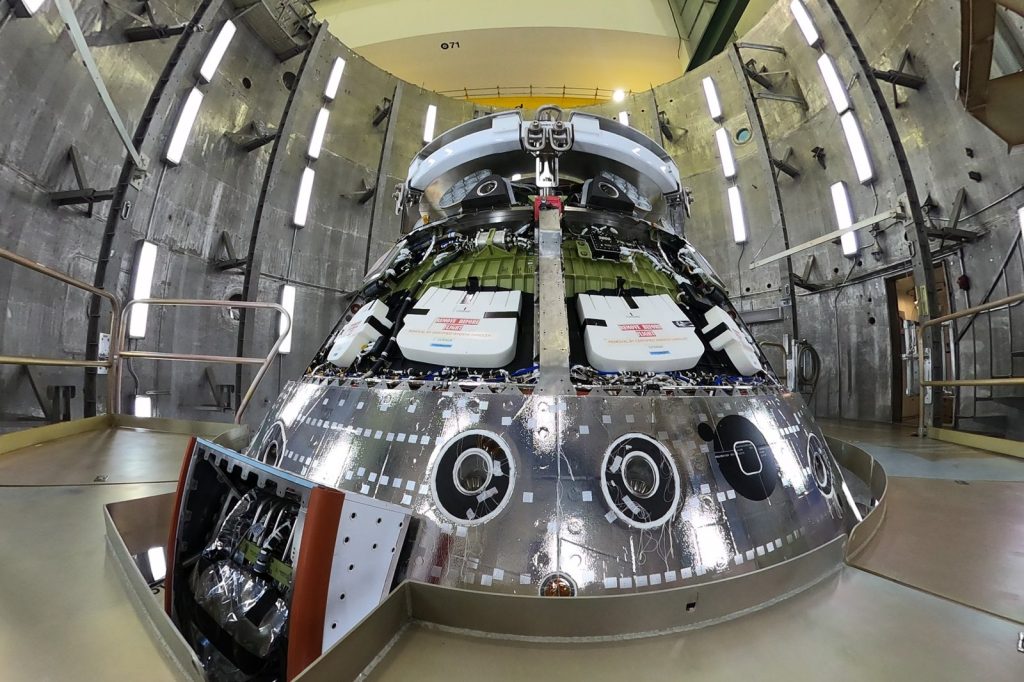
WASHINGTON, July 13 — When the first astronauts climb into Orion for a journey around the Moon, they will be sitting inside a machine built by thousands of hands across two continents. The spacecraft, a centerpiece of NASA’s Artemis program, represents something deeply human: the desire to push beyond where we have been before. Orion is not a single vehicle but a partnership.
The crew module, built by Lockheed Martin, can carry up to six astronauts, though the Artemis missions will carry four. The European Service Module, provided by the European Space Agency and constructed by Airbus Defence and Space, handles the heavy lifting — propulsion, power, thermal control, and life support.
It is a marriage of American and European engineering, and it is designed for missions far beyond the familiar confines of low Earth orbit.
A spacecraft built for deep space
The crew module itself is 16.5 feet in diameter, with a habitable volume of 316 cubic feet. That is not a lot of room for four people, but it is enough. The spacecraft is designed to support astronauts for up to 21 days without docking to another vehicle.
For the families of those astronauts, that means three weeks of waiting, watching, and hoping. Safety is built into every decision.
Orion carries a launch abort system, a tower-mounted rocket that can pull the crew module away from the launch vehicle in an emergency. It is a reminder that behind every breakthrough in spaceflight is a fundamental commitment to bringing people home.
The road to Artemis II
Orion has already flown. The first uncrewed test flight, Exploration Flight Test 1, launched on December 5, 2014, atop a Delta IV Heavy rocket. That flight proved the spacecraft could survive the rigors of launch, orbit, and reentry.
Now the program is preparing for its first crewed mission. Artemis II, the first flight with astronauts aboard, is planned for no earlier than November 2024.
That date has shifted before, as these things often do. But the goal remains: to send humans farther from Earth than anyone has gone in more than half a century. For the men and women who will fly that mission, Orion is more than a machine.
It is a home away from home, a lifeboat, and a ticket to a place only 24 people have ever seen with their own eyes.
What comes next
The Artemis program does not stop at the Moon. Orion is designed for missions to Mars, though that remains years away. For now, the focus is on proving the spacecraft can do what it was built to do.
Every test, every launch, every orbit brings that future a little closer. Behind the hardware, behind the acronyms and the engineering reports, there is a story about people.
The people who build the spacecraft. The people who will fly it. And the people who will watch from the ground, hoping for a safe return.
Sources
{“@context”: “https://schema.org”, “@type”: “NewsArticle”, “headline”: “The Orion Spacecraft: NASA’s Crew Vehicle for Deep Space Exploration”, “description”: “WASHINGTON, July 13 — When the first astronauts climb into Orion for a journey around the Moon, they will be sitting inside a machine built…”, “datePublished”: “2026-07-13T09:30:00+00:00”, “author”: {“@type”: “Person”, “name”: “James Roberto”}, “publisher”: {“@type”: “Organization”, “name”: “InfoPulse Today”, “url”: “https://newsfeed.infopulsetoday.com/”}, “citation”: [{“@type”: “CreativeWork”, “url”: “https://en.wikipedia.org/wiki/Orion_%28spacecraft%29”}]}




