
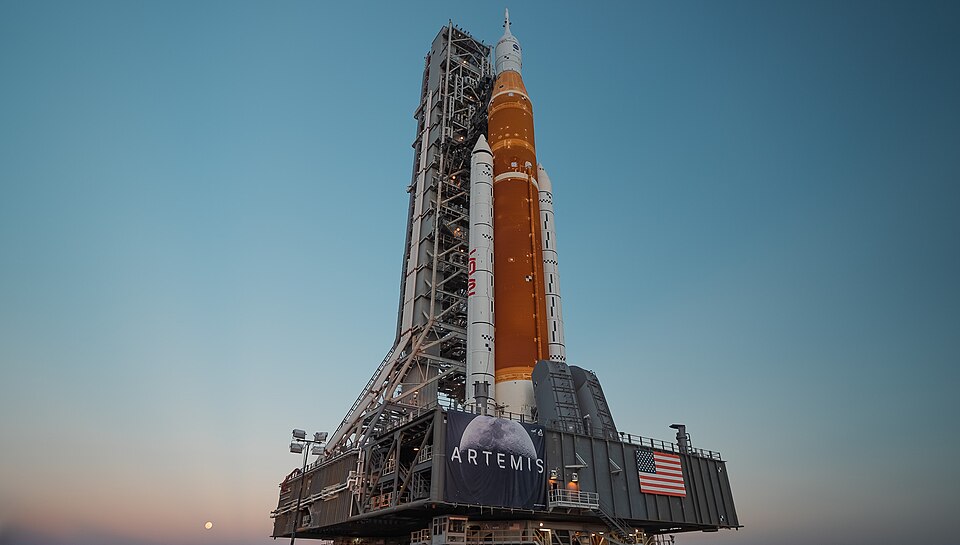
CAPE CANAVERAL, July 13 — The Space Launch System remains the centerpiece of America’s return to deep space, a super heavy-lift vehicle that has been in development since 2011 and now serves as the primary launch vehicle for NASA’s Artemis program. Strategically, the SLS represents a deliberate bet on government-led heavy infrastructure for lunar and eventually Martian exploration, a calculus that carries both extraordinary capability and extraordinary cost. The numbers frame the stakes.
The SLS Block 1 configuration, which flew the uncrewed Artemis I mission on November 16, 2022, from Kennedy Space Center’s Launch Complex 39B, stands 322 feet tall. At liftoff, its four RS-25 engines — repurposed Space Shuttle main engines — and two solid rocket boosters produce 8.8 million pounds-force of thrust.
That is enough to lift about 95 metric tons to low Earth orbit in its current variant. What this signals is a vehicle designed for missions that no other American rocket can perform. The SLS is built to carry the Orion spacecraft, and its mission set is explicitly crewed operations beyond low Earth orbit.
The Artemis program depends on it. The development cost through 2022 reached approximately $23 billion.
Each individual SLS launch is estimated to cost about $2 billion. Those figures have drawn scrutiny from critics who argue that the program’s expendable nature and reliance on Shuttle-era hardware make it an expensive path to the Moon. But for NASA and its contractors, the calculus has been about assured access to heavy lift capacity rather than commercial cost efficiency.
Planned upgrades are already on the roadmap. The Block 1B and Block 2 configurations are intended to increase lift capacity to 130 metric tons. That would place the SLS in a class of its own among current launch vehicles.
For now, the SLS program operates as the heavy lifter for a strategic national objective: returning humans to the lunar surface and establishing a sustained presence there. The geopolitical dimension is unmistakable.
As other nations develop their own deep space ambitions, the SLS provides the United States with a capability that no other country currently matches — a dedicated super heavy-lift vehicle for crewed exploration. The broader stakes are clear. Every SLS launch represents not just a technological achievement but a validation of the investment calculus made over a decade ago.
The vehicle’s performance on Artemis I, its first and so far only flight, demonstrated that the basic design works. The question now is whether the program can sustain the launch cadence needed to meet Artemis’s ambitious schedule.
What to watch next: the transition from Block 1 to the more powerful Block 1B configuration, which will introduce an upgraded Exploration Upper Stage and increase the vehicle’s capability for crewed lunar missions. That upgrade will determine whether the SLS remains America’s primary deep space workhorse or becomes a bridge to other architectures. The strategic choice, as always, is about where to place the bet.
Sources
{“@context”: “https://schema.org”, “@type”: “NewsArticle”, “headline”: “The Space Launch System: NASA’s New Heavy-Lift Rocket for Artemis”, “description”: “CAPE CANAVERAL, July 13 — The Space Launch System remains the centerpiece of America’s return to deep space, a super heavy-lift vehicle that has been…”, “datePublished”: “2026-07-13T09:30:00+00:00”, “author”: {“@type”: “Person”, “name”: “Noah King”}, “publisher”: {“@type”: “Organization”, “name”: “InfoPulse Today”, “url”: “https://newsfeed.infopulsetoday.com/”}, “citation”: [{“@type”: “CreativeWork”, “url”: “https://en.wikipedia.org/wiki/Space_Launch_System”}]}




